Walking a Standard Poodle Past Other Dogs
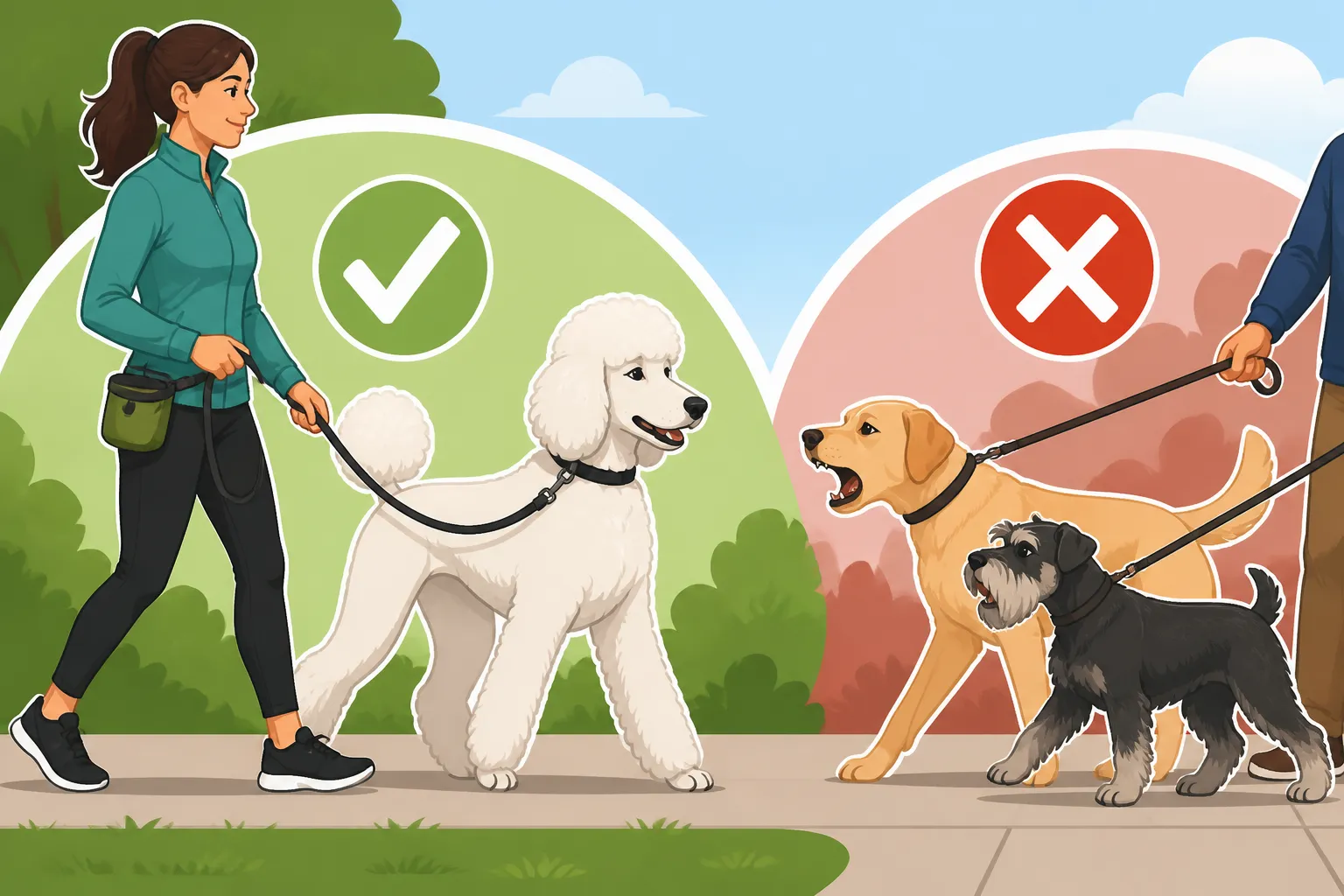
Oh, the joy and sometimes sheer agony of walking a Standard Poodle! There's nothing quite like the elegance and intelligence of these dogs, but if your magnificent Poodle transforms into a barking, lunging, or freezing statue the moment another dog appears, you know the frustration. This guide is here to help you navigate those challenging on-leash encounters, offering practical strategies to help your Standard Poodle learn to pass other dogs calmly and make your walks enjoyable again.
Understanding Why Your Poodle Reacts to Other Dogs
It’s easy to feel embarrassed or even angry when your Poodle starts acting out on a walk. You might wonder if they’re just being stubborn, or if you’ve done something wrong. But understanding the root cause of their reactivity is the first step toward helping them. It’s rarely about defiance; it’s almost always about an underlying emotion or unmet need.
The Poodle's Natural Sensitivity and Intelligence
Standard Poodles are renowned for their sharp minds and often their sensitive natures. This combination, while a huge advantage in training and companionship, can sometimes manifest as anxiety or overstimulation when faced with certain triggers, like other dogs. Imagine processing every detail of a situation, anticipating outcomes, and then reacting strongly because your finely tuned senses are overwhelmed. That's often what a sensitive Poodle experiences. They aren't just seeing another dog; they're analyzing its gait, its scent, the owner's body language, and the perceived threat or opportunity. This deep processing can be a blessing, but it also means they can feel things very intensely. You might find this sensitivity reflected in other aspects of their personality; they often form strong bonds and can be quite attuned to your emotions. Poodle Temperament and Sensitivity delves deeper into their unique character traits.
Socialization Gaps and Fear Periods
Many reactive behaviors stem from insufficient or improper socialization during crucial developmental periods. A Poodle puppy needs to be exposed to a wide variety of sights, sounds, people, and calm dogs in a positive way before they reach about four months old. If this window is missed, or if early experiences with other dogs were negative or overwhelming, your Poodle might develop fear or apprehension. Even well-socialized puppies can hit "fear periods" where novel things, even those they previously tolerated, suddenly seem scary. A Poodle who had a bad encounter with a boisterous dog at a young age, or simply wasn't exposed much to other dogs, might learn that other dogs equal stress or danger. This can lead to a defensive reaction when they see a new dog approaching. To prevent this, early, positive exposure is critical. You can learn more about this in Socializing a Poodle Before It Turns Wary.
Frustration, Over-Excitement, or a Mix
Reactivity isn't always fear-based. Sometimes, a Poodle is reacting out of pure frustration because they really want to greet the other dog but are restrained by the leash. This can escalate into barking, whining, and lunging because they can't get what they want. Think of a child wanting a toy in a store – they might scream and thrash. Similarly, over-excitement can be a factor. Some Poodles genuinely love other dogs but become so overstimulated that their greetings are rude and boisterous, which can still look like reactivity to others and cause issues on the leash. It’s also possible for a dog to exhibit a mix of these emotions; they might be anxious but also want to investigate, leading to a complex display of pulling and vocalization. Identifying the primary emotion driving your Poodle's behavior is crucial for choosing the right training approach.
Essential Tools and Preparations for Success
Before you even step out the door, setting yourself up for success with the right tools and mindset can make a world of difference. It’s not just about restraining your Poodle; it’s about clear communication and managing their environment.
The Right Leash and Harness
For a Standard Poodle, which can be surprisingly strong and agile, the right equipment is paramount. A flat collar is generally not sufficient for a reactive dog, as it offers little control and can put pressure on their delicate trachea, especially if they lunge. This can also reinforce negative associations with seeing other dogs due to discomfort.
- Front-Clip Harness: These harnesses have a leash attachment point on the dog's chest. When your Poodle pulls, the leash redirects them to the side, turning their body and making it harder for them to pull forward with full force. Many owners find these invaluable for gaining better control without causing discomfort or pain. Brands like Easy Walk or Freedom Harness are popular and often available through Amazon.
- Head Halter (Halti, Gentle Leader): These fit over your Poodle's muzzle and behind their ears, similar to a halter on a horse. They allow you to gently guide your Poodle's head, which in turn controls their body. If you can control where their head is pointed, you can often redirect their attention more effectively. While some dogs initially resist them, with proper introduction and positive reinforcement, they can be incredibly effective for strong, reactive Poodles.
- Leash: A standard 6-foot leash is generally ideal. Avoid retractable leashes, as they offer no consistent tension, can snap back, and don't teach your dog proper leash manners. They can also be dangerous in a reactivity situation, as they don't allow you to quickly shorten the leash for control. Leash Manners for a Standard Poodle is a great resource if you're looking to refine your Poodle's general leash behavior.
Remember, the goal isn't just to restrain your Poodle, but to have comfortable, effective tools that aid in communication and redirecting their focus without causing pain or fear.
High-Value Treats and Engagement
When your Poodle is focused on another dog, ordinary kibble or a stale biscuit simply won't cut it. You need "high-value" treats – something utterly irresistible that can compete with the excitement or fear of another dog. Think small pieces of cooked chicken, cheese, hot dogs, or even commercial high-value training treats. The smellier and softer, the better!
The purpose of these treats is to create a positive association with other dogs and reward calm behavior. Every time your Poodle sees another dog and doesn't react, or looks at you instead of the other dog, a high-value treat should appear. This changes their emotional response over time from "other dog = stress/excitement" to "other dog = yummy treats!"
Beyond treats, your engagement is a powerful tool. You need to be more interesting than the environment. Use enthusiastic vocal praise, quick games, or even a favorite squeaky toy to keep your Poodle's attention. BAXTER & Bella offers excellent online training programs and resources that emphasize positive reinforcement and building engagement, which can be hugely beneficial for handling reactivity. Their approach often focuses on making you the most exciting thing in your dog's world, a crucial element when facing distractions.
Reading the Environment and Proactive Management
One of the biggest shifts you can make as an owner of a reactive Poodle is becoming a proactive environmental manager. This means constantly scanning your surroundings, not just for other dogs, but for potential triggers like children, bicycles, or even sudden loud noises.
- Spotting Triggers Early: Learn to spot other dogs or potential stressors from a distance. The earlier you see them, the more time you have to implement your strategies and keep your Poodle below their reaction threshold. This might mean keeping your head up, not staring at your phone, and actively looking ahead and behind you.
- Distance Management: This is critical. Identify your Poodle’s "threshold" – the distance at which they can notice another dog without reacting. It might be 50 feet, 100 feet, or even further. Your goal is to keep your Poodle under that threshold during training walks. If you repeatedly cross it, you're just reinforcing the reactive behavior.
- Planning Escape Routes: Always have a plan. If you see another dog approaching that's too close, think about where you can go. Can you cross the street? Duck behind a parked car? Step into someone's driveway (with permission, of course)? The ability to change direction quickly and efficiently is a skill that will save you many stressful encounters.
Proactive management reduces your Poodle's stress, your stress, and increases the success rate of your training sessions.
Strategies for Managing On-Leash Encounters
Now that you're geared up and mentally prepared, let's talk about what to do when you actually encounter another dog. These strategies are about managing the immediate situation while building better habits for the long term.
Distance is Your Friend
This cannot be stressed enough when working with a reactive Poodle. The closer your Poodle gets to their trigger (another dog), the higher their arousal levels climb, and the less likely they are to think clearly or respond to your cues. Your primary goal on walks is to keep your Poodle below their "threshold"—the point at which they start to become aware of the other dog but can still remain calm and focused on you.
Think of it like this: if you’re trying to have a calm conversation with someone, you wouldn’t stand three inches from their face, right? You’d give them space. Your Poodle needs that same space from other dogs. This might mean starting your training at distances where the other dog is barely a speck, or only visible in the far distance. As your Poodle gets better at remaining calm, you can gradually, and I mean gradually, decrease that distance. Pushing them too far, too fast, will lead to a blowout, reinforce the bad behavior, and set your training back weeks. It's a marathon, not a sprint.
Engage and Disengage (The "Look at That!" Game)
One of the most effective techniques for reactivity is known as "Engage and Disengage," or sometimes the "Look at That!" game. The idea is to change your Poodle's emotional response to seeing another dog.
Here's how it works:
- Spot the Trigger: As soon as you spot another dog at a distance where your Poodle notices it but hasn't reacted yet (below their threshold), say "Look at that!" (or whatever phrase you choose).
- Reward for Calm Observation: The instant your Poodle looks at the other dog and then looks back at you (or even just remains calm), immediately praise them and give them a high-value treat.
- Repeat and Move On: Continue this pattern. They look at the dog, you mark the calm observation, they look at you, they get a treat. Then, calmly walk away or change direction. The goal is not to get closer, but to show them that seeing another dog means good things happen when they stay calm.
- Gradual Progression: Over time, as your Poodle associates other dogs with positive rewards and your attention, they'll start looking at you automatically when they see another dog, anticipating their treat. You're building a new, positive emotional response. Many online trainers, including those affiliated with BAXTER & Bella, provide detailed video tutorials and step-by-step guides for implementing this exact training method, which can be a game-changer for many owners.
Changing Direction and U-Turns
Sometimes, despite your best efforts, another dog will suddenly appear too close for comfort, or a situation will escalate faster than you can manage. In these moments, your best strategy is often to simply leave the scene calmly and efficiently.
- The Emergency U-Turn: Practice this when there are no distractions. Say a cue like "Let's go!" or "This way!" and immediately turn 180 degrees, walking briskly in the opposite direction. Praise and reward your Poodle for following you.
- Applying it in Real-Time: When you see an approaching dog that's too close, use your "Let's go!" cue, make a sharp U-turn, and walk quickly away, creating distance. As soon as you're further away and your Poodle calms, offer praise and a treat. This isn't failing; it's a successful management strategy that prevents a meltdown and teaches your Poodle that you'll help them avoid uncomfortable situations. It also prevents the reactive behavior from being practiced.
- Crossing the Street: If a U-turn isn't feasible, simply crossing the street as soon as you see an approaching dog can create enough distance to keep your Poodle under threshold. Always be looking for these opportunities to put space between your Poodle and their trigger.
These techniques empower you to control the environment when it feels out of control, making walks less stressful for both of you.
Building Focus Games
Beyond simply reacting to triggers, you want your Standard Poodle to actively choose to pay attention to you, even when there are distractions. This takes practice and turning training into a fun game.
- "Find It" Game: Scatter a few high-value treats on the ground and say "Find it!" This game encourages your Poodle to use their nose and focus downward, away from potential triggers. You can use this as a quick distraction if you anticipate an encounter or need to buy yourself a few seconds. Products for enrichment and training, like puzzle toys or snuffle mats, can easily be found on Amazon and might complement this type of training at home or in less distracting environments.
- "Touch" Game: Hold a treat near your open palm and say "Touch!" When your Poodle touches your hand with their nose, they get the treat. This is a great way to quickly redirect their attention to you and can be used to move them past a trigger or change direction.
- Quick Recall Checks: Even if you're not planning off-leash work, practicing short, enthusiastic recall bursts on-leash during your walk (when no other dogs are around) can strengthen your bond and your Poodle's responsiveness to your voice. This strengthens their overall engagement with you.
By making training a game, you keep your Poodle mentally stimulated and reinforce the idea that you are the source of all good things, even when other dogs are nearby.
Long-Term Training and Behavior Modification
Managing on-leash reactivity is not just about quick fixes; it's about a consistent, long-term commitment to changing your Poodle's emotional response and teaching them alternative behaviors.
Consistency is Key
This is perhaps the hardest, yet most critical, aspect of training a reactive Poodle. Every single walk is a training opportunity, and every reactive outburst, unfortunately, reinforces the behavior you're trying to extinguish. One "bad" walk where your Poodle is allowed to lunge and bark can undo weeks of careful, patient work.
- Every Outing Counts: This means that even a quick potty break in the yard needs to be managed if there's a chance of seeing another dog. If you can't guarantee a "successful" walk (one where your Poodle stays under threshold), it's sometimes better to find alternative ways to exercise them, like indoor games or a sniffari in a quiet area.
- Family Buy-In: If multiple people walk your Poodle, everyone needs to be on the same page regarding the training plan, cues, and treat values. Inconsistency from different handlers can confuse your Poodle and slow down progress.
- Patience and Persistence: There will be setbacks. There will be days when you feel like you've made no progress. It's vital to remember that changing deeply ingrained emotional responses takes time. Celebrate the small victories: the day they noticed another dog but only offered a soft whine instead of a bark, or when they looked at you for a treat instead of lunging. Your Poodle's intelligent mind means they can learn new behaviors, but their sensitivity means you need to be understanding. Training a Poodle That Outthinks You can give you more insights into leveraging their intelligence for training.
Professional Guidance
While this guide offers many strategies, there are times when an expert eye and personalized plan are indispensable. If your Poodle's reactivity is severe, causing you significant stress, or if you feel you've hit a wall, please don't hesitate to seek professional help.
- Certified Professional Dog Trainer (CPDT-KA): Look for trainers who specialize in reactivity and use positive reinforcement, force-free methods. Avoid anyone who suggests aversive tools like shock collars, prong collars, or choke chains, as these can actually worsen reactivity in sensitive dogs like Poodles by increasing fear and anxiety. A good trainer will observe your Poodle, identify the specific triggers and underlying emotions, and create a tailored training plan. Finding a Trainer a Poodle Will Not Shut Down For offers advice on selecting the right professional.
- Veterinary Behaviorist (Dip ACVB): For very severe cases, or if your Poodle's reactivity is accompanied by other anxiety behaviors, a veterinary behaviorist (a veterinarian with specialized training in animal behavior) can be invaluable. They can assess if medication might be an appropriate tool to help manage anxiety alongside behavior modification, allowing your Poodle to be in a better state of mind to learn.
A professional can provide objective feedback, help you fine-tune your techniques, and offer support through the challenging moments.
Continuing Socialization (Controlled Settings)
Once your Poodle shows significant improvement in their on-leash manners around other dogs at a distance, you might consider controlled socialization experiences. This is not about letting them run wild at a dog park, which can be overwhelming for a reactive dog.
- Parallel Walks: This involves walking with a known, calm, dog-savvy dog and its owner, maintaining significant distance between the two dogs. The goal is for your Poodle to simply exist in the presence of another dog without interaction, gradually decreasing the distance over many sessions as both dogs remain relaxed.
- Small, Supervised Playgroups: Only consider this if your Poodle is truly social, and their reactivity is primarily frustration or over-excitement rather than fear or aggression. These should be with carefully selected, calm dogs in a secure, neutral environment, with constant supervision.
- Avoid Dog Parks: For most reactive Poodles, dog parks are a recipe for disaster. They are unpredictable environments with unknown dogs and often overwhelmed owners, which can easily undo weeks or months of progress.
The key is always controlled, positive experiences that build confidence, rather than throwing them into situations where they are likely to fail. Even a multi-dog household can present challenges, and A Poodle in a Multi-Dog House offers insights into managing those dynamics.
Mental Stimulation at Home
Reactivity on walks can often be a symptom of underlying anxiety, boredom, or an excess of pent-up energy. Providing ample mental stimulation at home can significantly reduce your Poodle's overall stress levels and make them more receptive to training when outside.
- Puzzle Toys and Snuffle Mats: These turn mealtime into a brain game, requiring your Poodle to use their problem-solving skills to get their food.
- Scent Work: Poodles have surprisingly good noses! Hide treats around the house and encourage them to "find it." This is a fantastic way to tire them out mentally without needing a physical outing. Nose Work as Exercise for a Poodle is a great article if you want to explore this further.
- Trick Training: Your Poodle's intelligence makes them excellent candidates for learning tricks. "Shake a paw," "spin," "bow," or "fetch specific toys by name" are all ways to engage their minds and build your bond. This reinforces their connection to you and channels their mental energy constructively.
- Chew Toys: Providing appropriate, long-lasting chew toys can help reduce stress and boredom.
A mentally satisfied Poodle is often a calmer Poodle, making walks less fraught with anxiety and more amenable to learning good manners around other dogs.
| Training Tool/Strategy | Description | Pros | Cons | Best For |
|---|---|---|---|---|
| Front-Clip Harness | Leash attaches to the chest, redirects pulling. | Reduces pulling, comfortable, safe for trachea. | Some dogs can still pull effectively; requires proper fit. | Standard Poodles who pull strongly, mild-moderate reactivity. |
| Head Halter | Fits over muzzle and behind ears, guides head. | Excellent control, easy to redirect attention, prevents lunging. | Some dogs dislike initial feel; needs positive introduction to prevent aversion. | Strong pullers, highly reactive Poodles, attention redirection. |
| High-Value Treats | Irresistible food rewards (e.g., chicken, cheese). | Creates positive associations, motivates focus on owner. | Can add calories (use small pieces); needs to be truly high-value to compete with triggers. | All reactivity training, changing emotional responses. |
| "Look at That!" Game | Reward for noticing trigger and looking back at owner. | Changes emotional response to triggers; builds focus on owner. | Requires consistent timing; must start at appropriate distance. | Building positive associations with other dogs. |
| Emergency U-Turn | Quickly change direction to avoid too-close encounters. | Prevents reactive outbursts; teaches dog you'll help manage situations. | Requires vigilance from owner; can feel like "running away" but is strategic. | Avoiding over-threshold situations, teaching disengagement. |
| Mental Stimulation | Puzzle toys, scent games, trick training at home. | Reduces overall stress/boredom; makes dog more receptive to training. | Doesn't directly address on-leash behavior but supports it; requires dedicated time. | Reducing anxiety, channeling energy, supporting overall well-being. |
Disclaimer
This article is for general informational purposes only and does not constitute professional advice. Laws, prices and regulations vary by location and change over time. Consult a qualified professional for guidance on your specific situation.