How Many Repetitions a Poodle Actually Needs
Many Poodle owners, myself included, often fall prey to the delightful myth that owning one of these brilliant dogs means training will be a breeze, a quick five-repetition affair, and then poof – perfect obedience! The reality, however, can sometimes feel a little different when your supposedly "genius" Poodle is suddenly feigning deafness at the dog park. This guide will dive deep into what those training repetitions actually mean for a Poodle, the factors that truly influence their learning, and how to set realistic expectations for a well-trained companion who is, after all, still a dog.
The Myth of the "Five Repetition" Poodle
It's a wonderful thought, isn't it? Get a Poodle, teach them something five times, and they've got it for life. The truth is, while Poodles are incredibly intelligent and often pick up new concepts with astonishing speed, training a reliable, fluent behavior goes far beyond a magical five repetitions.
What "Smartest Dog" Really Means for Training
When we talk about Poodles being one of the smartest dog breeds, often citing Dr. Stanley Coren's rankings, we're typically referring to their "working and obedience intelligence." This means they excel at understanding new commands and will generally obey them with fewer repetitions than many other breeds. It’s an undeniable advantage in the training arena. For example, a Poodle might indeed grasp the concept of "sit" or "stay" after just a handful of tries in a quiet living room, especially with a skilled handler and tasty rewards. They do learn quickly. This rapid initial acquisition is fantastic, and it’s why Poodles are so often seen in performance sports and as service dogs. However, this initial understanding is just the first step on a much longer journey. You might be thrilled when your Poodle gets it so fast, thinking "Wow, this is easy!" – but that's just the tip of the iceberg. The challenge isn't usually in them learning what to do; it's in them learning to do it consistently, everywhere, every time, under every condition. If you want to know more about this, check out Why Poodles Learn a Cue in Five Repetitions.
Why a Poodle Isn't a Robot
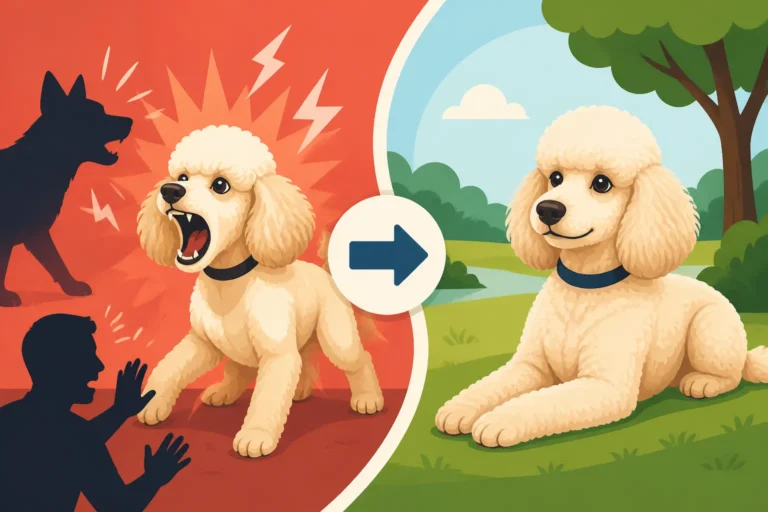
For all their brainpower, Poodles are still sentient beings with their own personalities, emotions, and external influences affecting their behavior. They aren't programmable robots that, once a command is "uploaded," will perform flawlessly forevermore. Picture this: your Poodle flawlessly executes "recall" in your backyard, coming zooming back to you the moment you call. But take them to a busy park, where there are other dogs, exciting smells, and new people, and suddenly that perfect recall becomes… optional.
This isn't a flaw in their intelligence; it's simply what it means to be a dog. Distractions, their emotional state (are they tired? anxious? overstimulated?), and even your own consistency can dramatically impact their willingness or ability to perform a learned behavior. A Poodle's brilliance can even work against you sometimes! They're so smart that they'll often try to figure out what you want and how to get the reward with the least effort, or, if bored, they might decide to try a different, more interesting activity. They might even try to "negotiate." Expecting perfect, robotic execution after only a few repetitions fails to acknowledge the complex, living, breathing individual standing (or, more likely, bouncing) in front of you.
Factors Influencing a Poodle's Repetition Needs
So, if it’s not just five reps, what is it? The number of repetitions a Poodle actually needs for a behavior to be truly reliable is influenced by a multitude of factors, extending far beyond the initial "aha!" moment.
The 'Three Ps': Preparedness, Practice, and Proofing
Achieving true reliability in training comes down to three crucial, interconnected stages that demand varying numbers of repetitions:
- Preparedness: This is all about you, the trainer. Before you even ask your Poodle for a behavior, are you prepared? Do you have high-value treats (think tiny pieces of cooked chicken, cheese, or specialized training treats like Zuke's Mini Naturals, readily available on Amazon)? Is your clicker ready if you're using one? Do you understand the mechanics of the cue – how to lure, how to mark the desired behavior, and when to reward? If you're fumbling with treats, your timing is off, or your instructions are unclear, your Poodle will need many more repetitions to decipher what you're asking. A clear, consistent approach from the start drastically reduces wasted repetitions and frustration for both of you.
- Practice: This is where repetitions really come into play. Once your Poodle understands the basic concept, consistent practice is vital. We're not talking about marathon sessions here. For Poodles, especially young ones or those with Why a Bright Poodle Gets Bored, short, frequent training sessions (think 5-10 minutes, several times a day) are far more effective than one long, tedious session. These repetitions cement the neural pathways in their brain, turning a learned action into a habit. Varying the practice slightly (different spots in the house, different times of day) begins the process of generalization.
- Proofing: This is often the most overlooked and time-consuming stage, requiring the most repetitions. Proofing means practicing the learned behavior in a wide variety of environments, with increasing levels of distraction, and with different people. Your Poodle might "sit" perfectly in your kitchen, but can they do it at a busy park, with a ball bouncing by, or when a stranger walks past? Each new environment, each new distraction, effectively requires a new set of repetitions to teach your Poodle that "sit" means "sit" everywhere. This is where the initial "five reps" quickly turns into hundreds, if not thousands, over time. Without comprehensive proofing, your Poodle's knowledge remains context-specific, and you'll find them "forgetting" commands when you need them most. Poodles are clever, and they can sometimes invent their own shortcuts if the proofing isn't thorough enough, as discussed in Why a Poodle Invents Its Own Shortcuts.
Motivation, Distraction, and Generalization
Beyond the 'three Ps', these factors constantly influence how many repetitions your Poodle needs:
- Motivation: What's the payoff for your Poodle? High-value rewards are incredibly powerful. If your Poodle isn't motivated by the reward you're offering, they'll require more repetitions (or simply refuse to perform) until they find sufficient incentive. For a Poodle, sometimes praise is enough, other times it needs to be that special chew. Keep those rewards varied and exciting to keep them engaged. If you're considering Fading Rewards With a Quick-Learning Poodle, remember that fading too quickly can increase the repetitions needed.
- Distraction Level: This is huge. A Poodle learning "down" in a quiet room will likely pick it up quickly. But ask for "down" when a flock of pigeons just landed in the park, and you're essentially starting the teaching process again in a high-distraction environment. Each increase in distraction level demands more repetitions for your Poodle to practice overriding those urges and focusing on you. It's not that they don't know the cue; it's that the distraction is momentarily more compelling.
- Generalization: As mentioned under proofing, a Poodle needs to generalize a command. They don't automatically understand that "stay" at home is the same as "stay" at the vet's office. This requires repeated practice in new contexts. It’s like learning a language: you might know a word, but using it correctly in different sentence structures and social situations takes much more practice than simply memorizing its definition. Without adequate generalization, your Poodle will perform well only where they've been specifically trained. They'll need many repetitions to understand that the cue is universally applicable, not tied to a specific location or person. Sometimes, a Poodle might even start anticipating the cue, performing the action before you've given the command, which indicates they've learned well, but still requires careful management as detailed in When a Poodle Starts Anticipating the Cue.
The Role of the Owner and Training Methodology
Your approach as the owner and the methods you use are just as, if not more, important than your Poodle's innate intelligence in determining how many repetitions they actually need.
Consistency and Clear Communication
This cannot be stressed enough: consistency is paramount. If you use "come," "here," "front," or "get over here" interchangeably for recall, your Poodle will need exponentially more repetitions to figure out which sound means what. If your timing for delivering a reward is inconsistent, sometimes immediately after the action, sometimes a few seconds later, your Poodle will struggle to associate the reward with the specific behavior you're trying to reinforce.
Clear communication means using the same verbal cues, the same hand signals, and rewarding the correct behavior immediately and consistently. Positive reinforcement methods, which many reputable trainers and online courses (like those offered by BAXTER & Bella) advocate, focus on making expectations clear and rewarding success. This minimizes confusion for your Poodle, allowing them to learn faster and require fewer repetitions to grasp the intended behavior, rather than spending repetitions trying to guess what you want. Think of it: if you always speak clearly and consistently, your Poodle learns far faster than if your instructions are garbled and changing. If you're interested in structured training, consider How Long a Poodle Training Session Should Run to optimize your approach.
Recognizing a Poodle's Learning Style
Just like people, individual Poodles can have different learning styles. Some are highly visual, responding best to hand signals. Others are more auditory, picking up verbal cues with ease. Some Poodles are naturally "offerers," throwing out behaviors to see what might earn a reward, which can speed up initial learning. Others are more thoughtful, taking a moment to process before acting, and might need a bit more time to connect the dots.
Observing your Poodle's responses and tailoring your training approach can significantly impact the number of repetitions needed. If your Poodle seems to ignore your verbal "sit" but immediately responds to a hand signal, lean into the hand signal initially, gradually pairing it with the verbal cue. If your Poodle isn't food motivated, find what does motivate them – a favorite toy, a quick game of tug, or enthusiastic praise. Adapting your methods to their individual style makes the learning process more efficient and enjoyable for both of you, reducing the total repetition count for mastery. Understanding Clicker Timing With a Fast-Learning Poodle can be particularly helpful with highly intelligent breeds like Poodles.
How Many Repetitions Does a Poodle Need? A Realistic Outlook
So, after all this, what's the magic number? The honest, realistic answer is that there isn't one. It's a spectrum, an ongoing process, and it changes depending on the desired outcome.
Initial Acquisition vs. Fluency
It’s crucial to distinguish between a Poodle understanding a cue and being fluent in it.
- Initial Acquisition: A Poodle might understand "sit" after 5-15 repetitions in a low-distraction environment. They've made the connection: "When my human says this sound and does this motion, if I put my butt on the floor, I get a treat!" This is a huge win, and it often happens quickly with Poodles.
- Fluency: For that "sit" to be truly fluent – meaning your Poodle performs it consistently, immediately, happily, and correctly, regardless of distractions, location, or who is asking – you are looking at hundreds, if not thousands, of repetitions. This isn't just about knowing what to do; it's about muscle memory, conditioning, and proofing under duress. It's the difference between knowing how to say "hello" in a new language and being able to hold a complex conversation in that language. True fluency requires relentless, varied, and consistent practice throughout their life. This is where Training a Poodle That Outthinks You becomes less about initial learning and more about nuanced application.
Lifetime Learning and Maintenance
Training with a Poodle isn't a destination; it's a journey. Even after your Poodle is a seasoned pro at various commands, regular maintenance repetitions are essential. Without them, behaviors can become rusty, slower, or less reliable, especially as new distractions or life changes occur.
Continue to integrate short bursts of training into your daily routine. Ask for a "sit" before opening the door, a "down" before dinner, or a "stay" while you grab the mail. Keep these maintenance repetitions fun, varied, and rewarding. Use different treats, praise, and play as reinforcement. The goal isn't to reach a point where zero repetitions are needed; it's to maintain an engaged, responsive, and happy Poodle who sees training as an enjoyable interaction with you, not a chore. Just like we continue to review skills or information we want to retain, our Poodles benefit from ongoing reinforcement. It keeps their minds sharp and their behaviors polished.
Ultimately, the number of repetitions your Poodle actually needs isn't a fixed count, but rather a dynamic process of teaching, reinforcing, generalizing, and maintaining throughout their life. Embrace the journey, celebrate every success, and remember that even the smartest Poodle is still a wonderfully imperfect dog.
Here's a quick summary to illustrate the stages of learning and the repetitions involved:
| Stage of Learning | Typical Repetitions (Low Distraction) | Goal | Factors Influencing Reps |
|---|---|---|---|
| Initial Acquisition | 5-15 | Poodle understands the action associated with the cue. | Clarity of cue, reward value, trainer's timing, Poodle's focus. |
| Fluency Building | 50-100+ (per setting) | Poodle performs cue consistently in various low-medium distractions. | Consistency, varied practice, higher distractions gradually. |
| Proofing & Generalization | 100s-1000s (across environments) | Poodle performs cue reliably in any environment, under any condition. | Range of distractions, different locations/people, emotional state. |
| Maintenance | Ongoing | Reinforce learned behaviors, keep them fresh and reliable. | Continued positive reinforcement, varied rewards, short sessions. |
Disclaimer
This article is for general informational purposes only and does not constitute professional advice. Laws, prices and regulations vary by location and change over time. Consult a qualified professional for guidance on your specific situation.