What a Ring Judge Checks on a Poodle
Stepping into the dog show ring with your beautiful Poodle can feel like an intensely scrutinized dance, full of unspoken rules and expert eyes. You’ve put in countless hours of training and meticulous grooming, but sometimes it feels like the judge is looking for something you can’t quite grasp. This guide will pull back the curtain on what exactly a Poodle judge is looking for, from nose to tail, helping you understand the criteria that make a champion.
The Poodle Standard: The Judge's Blueprint for Perfection
Every breed has a "breed standard" – a detailed word picture of the ideal dog of that breed. For Poodles, this isn't just a suggestion; it's the rulebook, the blueprint that guides every single judge's decision in the show ring. Judges spend years studying these standards, and when they look at your Poodle, they're essentially comparing it to that perfect mental image. It's not about personal preference, but about how closely your dog embodies the traits laid out in this foundational document. They're looking for the historical essence of the Poodle, bred for function and elegance.
General Appearance and Balance
The first thing a judge sees is the Poodle's overall silhouette, its balance, and how it carries itself. They want to see an elegant, proud, and well-proportioned dog, carrying itself with an air of distinction. Think of a Poodle as an athlete in a fancy coat – beneath all that beautiful hair, there should be a strong, harmonious structure. A judge will sweep their eyes over the dog, taking in the length of the neck, the set of the tail, the balance of the body, and the angles of the legs. They are looking for a square appearance, meaning the length of the body, from breastbone to rump, should be roughly equal to the height at the shoulder. Any deviation from this square proportion can indicate an imbalance that affects the dog's movement and overall athleticism, even if it's subtle. This isn't just aesthetics; it speaks to the breed's historical role as a powerful water retriever, needing both agility and endurance. The Poodle the Standard Describes goes into greater detail on this.
Head, Expression, and Dentition
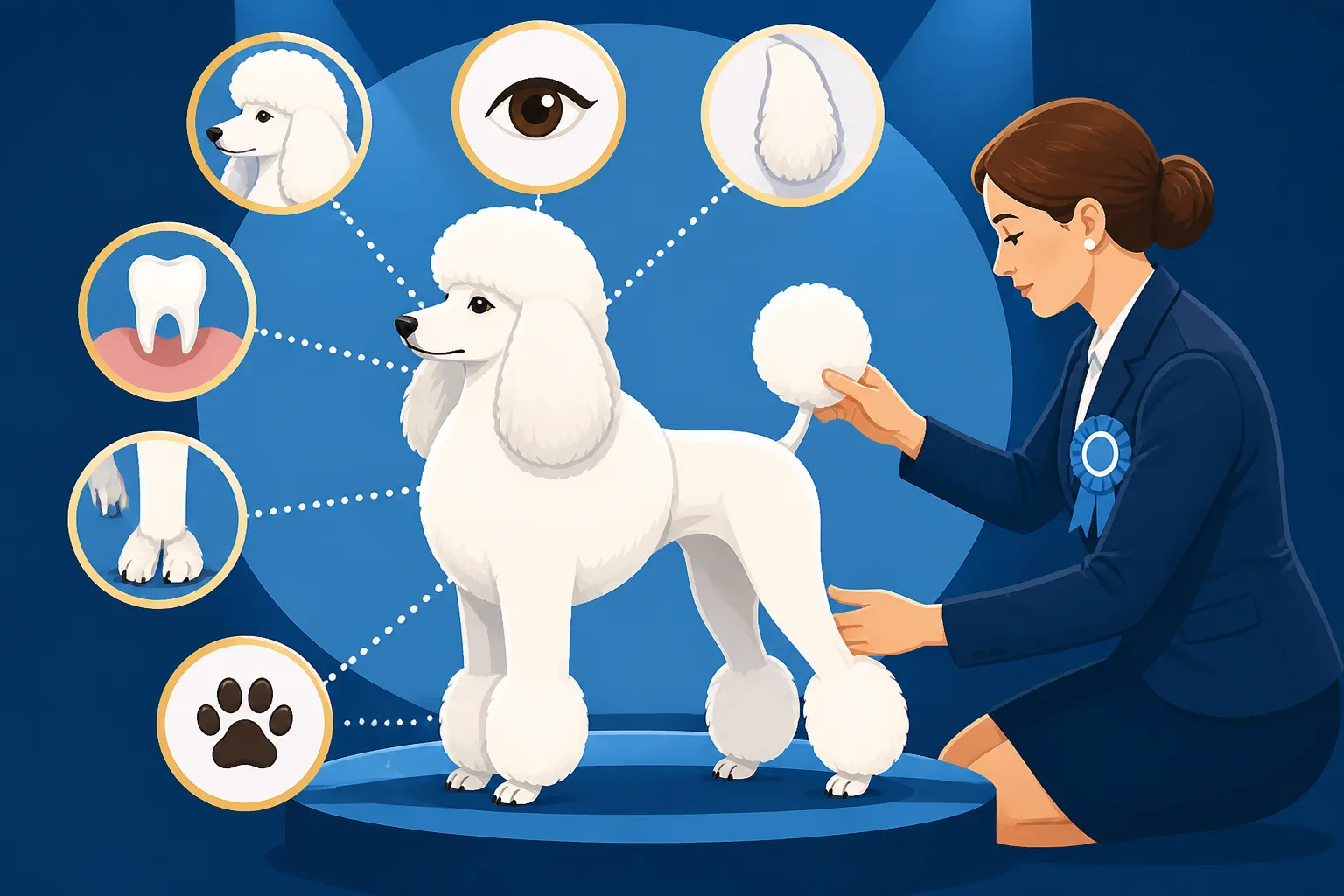
After the initial overview, the judge will move closer, focusing on the finer details, starting with the head. A Poodle's head is considered refined and aristocratic. They'll assess the length and shape of the skull, which should be moderately rounded, and how it transitions smoothly into the muzzle. The muzzle should be long, straight, and fine, but with substance – not snipey or weak. Eyes are crucial for expression; they should be dark, oval, and set fairly close together, conveying intelligence and alertness. A Poodle's expression should be bright and inquisitive, never dull or worried. Ear set and length are also important, typically flat and hanging close to the head.
Then comes the dental check. Judges will carefully examine the Poodle's mouth to ensure a correct scissor bite, where the outer side of the lower incisors just touches the inner side of the upper incisors. All teeth should be present and healthy. Missing teeth (unless due to injury or age, which might be noted) or an incorrect bite, like an overshot or undershot jaw, are considered faults. While not the most glamorous part of the inspection, a healthy, correctly aligned bite is vital for a dog that was once retrieving game from water, and it's a key indicator of overall breed type and health.
Examining the Poodle's Structure and Movement
Once the judge has taken in the overall picture and examined the head, they'll get hands-on. This is where they feel the dog's underlying bone structure, muscle tone, and coat texture. They're not just petting your Poodle; they're meticulously assessing its conformation – how it's put together – to determine how well it can perform its historical duties. Every touch, every gentle prod, is a check against the standard.
Body, Neck, and Topline
The judge will start by feeling the neck, which should be strong and well-set, rising elegantly from the shoulders to carry the head proudly. A short, thick neck or one that appears to merge directly into the shoulders without a clear arch is considered incorrect. Next, they'll assess the topline, which should be level from the highest point of the shoulder blade to the tail. The Poodle Topline and Why It Matters explains why this is so critical for balance. A Poodle should not have a roached (arched) or swayback (dipped) appearance. They'll run their hands down the back to feel the firmness of the muscles and the strength of the spine.
The chest needs to be deep and moderately wide, with well-sprung ribs that extend far back. This provides ample room for the heart and lungs, essential for stamina. A shallow chest or flat ribs would indicate a lack of robust health and endurance. The loin (the area between the last rib and the hip) should be short and muscular, contributing to the square body shape and providing strength for agile movement. Finally, the tail set is observed – a high tail set, carried gaily but not curled over the back, is preferred.
Forequarters and Hindquarters
This is where the judge checks the "engine" of the Poodle. They'll meticulously feel the shoulders, ensuring they are well-laid back and form proper angles with the upper arm. This angulation is crucial for reach and efficiency of movement. Straight shoulders can lead to a choppy, restricted gait. The judge will check the bone, looking for substance appropriate for the Poodle's size – neither delicate nor coarse. Elbows should be close to the body, and the pasterns (the equivalent of a dog's wrist) should be strong and slightly sloping, acting as shock absorbers.
Moving to the hindquarters, the judge will look for strong, muscular thighs and well-bent stifles (knees) and hocks (ankles). Again, proper angulation here is paramount for drive and propulsion. The hocks should be parallel when viewed from the rear, neither turning in (cow hocks) nor out. Feet are examined for size, shape, and condition – small, oval, "cat-like" feet with well-arched toes and thick pads are desired. They'll also check that nails are short and tidy. Maintaining healthy paws is essential, and good quality grooming tools and even paw balms, often found on sites like Chewy, can help keep them in top condition for the ring.
Gait and Temperament
After the hands-on examination, the judge will ask the handler to move the Poodle around the ring, typically in a triangle pattern and then straight up and back. This is where they assess the Poodle's gait, its movement. They are looking for a seemingly effortless, springy, and vigorous trot. The Poodle should move with good reach in the front and strong drive from the rear, converging to a single track at speed. The topline should remain firm and level, and the tail carried high. Any limping, paddling, crabbing (moving sideways), or stiff movement would be noted as a fault. The Poodle should cover ground efficiently and gracefully.
Equally important is the Poodle's temperament in the ring. A Poodle should be intelligent, alert, and keen to please. It should carry itself with dignity and confidence, but without aggression or shyness. A judge will observe how the Poodle interacts with the handler, how it reacts to being touched by a stranger (the judge), and its general demeanor. A nervous Poodle cowering away, or an aggressive one snapping, would be a serious fault and could even lead to dismissal from the ring. Even the most perfectly conformed Poodle can be penalized for poor temperament. Reading a Poodle's body language is key for handlers to ensure their dog is comfortable and confident.
The Poodle's Coat and Presentation: A Masterpiece of Grooming
For Poodles, the coat isn't just a pretty accessory; it's a defining characteristic and a testament to the breed's working heritage. The elaborate clips we see today evolved from practical necessity, protecting vital organs from cold water during retrieves. In the show ring, the coat is scrutinized for its texture, condition, and, of course, its perfectly executed clip. This is where the handler's dedication to grooming truly shines.
Coat Texture and Condition
A Poodle's coat should be dense, harsh, and curly. It should feel woolly and resilient to the touch, not soft, silky, or sparse. The judge will run their hands through the coat, especially on the topknot and main body, to assess its texture. A proper Poodle coat should offer resistance, bouncing back into place. They'll also check for any signs of skin issues, dandruff, or excessive oiliness. A healthy coat implies a healthy dog, and diet plays a significant role in coat condition. Many owners find quality food and supplements, readily available from retailers like Chewy, contribute to a gleaming, healthy coat. How Often a Poodle Must Be Brushed and Shampoo That Suits a Curly Poodle Coat offer insights into maintaining this unique coat.
The color of the coat is also important, and the standard calls for solid, even colors. Fading, uneven coloration, or white patches (unless a parti-Poodle in specific non-AKC registries) are considered faults. The coat should be clean, free of mats, and perfectly brushed out to create the desired voluminous appearance of the clip.
Accepted Clips and Grooming Standards
This is perhaps the most visually striking aspect of Poodle judging. The AKC (American Kennel Club) and other major kennel clubs specify only certain clips are acceptable in the show ring, primarily to maintain a consistent breed image and to highlight the Poodle's structure rather than obscure it. The primary clips allowed for adult Poodles are the Continental Clip and the English Saddle Clip. For puppies under a certain age (often 12 or 18 months, check specific rules), a Puppy Clip is also acceptable. Which Poodle Clips the Ring Allows delves into this.
- The Continental Clip: This is probably the most iconic show Poodle clip. It features a completely shaved face, feet, and tail base (with a pompom on the end). The body has a full coat with "rosettes" (rounded areas of longer hair) over the hips and a "bracelets" (bands of longer hair) on each leg, typically on the hocks and just above the feet. The chest, neck, and topknot are left full, creating a dramatic, sculpted look.
- The English Saddle Clip: Similar to the Continental in many ways, but instead of hip rosettes, it has a "saddle" of shorter hair over the back with a patch of longer hair remaining over the loin and hindquarters, giving the appearance of a rider's saddle. It still features bracelets on the legs.
- The Puppy Clip: This clip is generally for younger Poodles. It allows for a uniformly long coat over the body, legs, and topknot, but the face, feet, and tail base must still be shaved, with a pompom on the tail. Why Adult Poodles Cannot Show in a Puppy Clip explains why this clip is temporary.
The execution of these clips must be absolutely flawless. Sharp lines, even length, and perfect symmetry are paramount. A judge will scrutinize every shaved area for nicks or unevenness and every sculpted section for precision. This level of grooming requires skill, expensive tools, and regular maintenance, often with products and blades that Poodle owners stock up on from trusted sources.
Common Faults a Judge Looks For
While judges are looking for the ideal Poodle, they are also keenly aware of faults that detract from the breed standard. These faults can range from minor imperfections to serious structural flaws or temperament issues that significantly lower a Poodle's placement in the ring, or even lead to disqualification. Understanding these common pitfalls can help owners and breeders alike focus on improving their Poodles.
Structural and Temperament Faults
Many structural faults revolve around incorrect angulation, which directly impacts movement and efficiency. For example, straight shoulders or stifles can lead to a choppy, inefficient gait. Similarly, cow hocks (when the hocks turn inward) or barrel hocks (when they turn outward) are deviations from the parallel hindquarters required for strong drive. A judge will feel for these structural discrepancies during the physical examination and observe their impact during the gaiting portion. Poor bone substance – too delicate or too heavy for the Poodle's size – is also a fault.
Temperament issues are perhaps the most serious non-physical faults. A Poodle that exhibits shyness, fearfulness, or aggression in the ring is a major problem. They are supposed to be intelligent, proud, and outgoing, willing to be handled and confident in their surroundings. A Poodle that tries to bite, snaps at the judge, or cowers to the point of being unmanageable will not only be penalized but often dismissed from the ring. This isn't just about showmanship; it speaks to the core character of the breed. What Sends a Poodle Down the Placings highlights other common reasons.
Presentation and Health Faults
While grooming is essential, sometimes faults in presentation can emerge. A matted coat, for instance, even a small mat, indicates poor care and will be penalized. Uneven clipping, nicks from clippers, or an untidy appearance will also detract from the Poodle's overall presentation. Judges are looking for a dog that is perfectly turned out, reflecting the dedication of the owner and handler.
Health issues, even subtle ones, can also count as faults. A Poodle with dull eyes, unhealthy skin, or poor muscle tone might indicate a lack of proper conditioning or underlying health problems. Judges are looking for a robust, healthy specimen. This underscores the importance of a quality diet and regular veterinary care. Investing in good nutrition, perhaps using premium foods found on sites like Chewy, ensures your Poodle has the energy and vitality expected in the ring. Overweight or underweight Poodles also present a health fault, as it impacts their movement and overall condition. The ideal Poodle should be fit and well-muscled, without being bulky or bony.
Ultimately, a Poodle judge is looking for a dog that embodies the breed standard as closely as possible – a perfect combination of elegant appearance, sound structure, effortless movement, proper coat, and confident temperament. It's a tall order, but it's what makes the Poodle a truly magnificent breed in and out of the show ring.
Disclaimer
This article is for general informational purposes only and does not constitute professional advice. Laws, prices and regulations vary by location and change over time. Consult a qualified professional for guidance on your specific situation.