Which Poodle Clips the Ring Allows
Stepping into the world of Poodle conformation showing can feel like learning an entirely new language, especially when it comes to grooming. Many new Poodle owners, or even seasoned enthusiasts, find themselves scratching their heads, wondering which of the many iconic Poodle clips are actually allowed in the show ring, and why. It's a common frustration, because a Poodle's coat is so versatile, but the rules are quite specific. This guide aims to demystify the regulations around Poodle show clips, walking you through the historical context and the exact grooming standards you'll need to know to present your Poodle with confidence and correctness.
The Deep Roots and Purpose of Poodle Show Clips
It's easy to look at a Poodle in a fancy show clip and assume it's purely for aesthetics, a sort of canine couture. But the truth is, the elaborate clips recognized in the conformation ring today have very practical, working dog origins. Understanding this history helps us appreciate why these specific styles are not just allowed, but required, and why they look the way they do.
Why a Poodle's Coat is Unique
A Poodle's coat is truly a marvel of nature – dense, curly, and non-shedding, it's more like human hair than traditional dog fur. This unique texture is a huge part of the breed's appeal, especially for those seeking a companion with minimal shedding. However, it also means that the coat requires constant attention; it never stops growing, and if neglected, it will quickly mat. This continuous growth is also what makes it so sculptural and allows for the intricate clips we see today. If you've ever wondered why your Poodle's coat just keeps going, our article on The Poodle Coat and Why It Never Stops Growing delves deeper into this fascinating aspect.
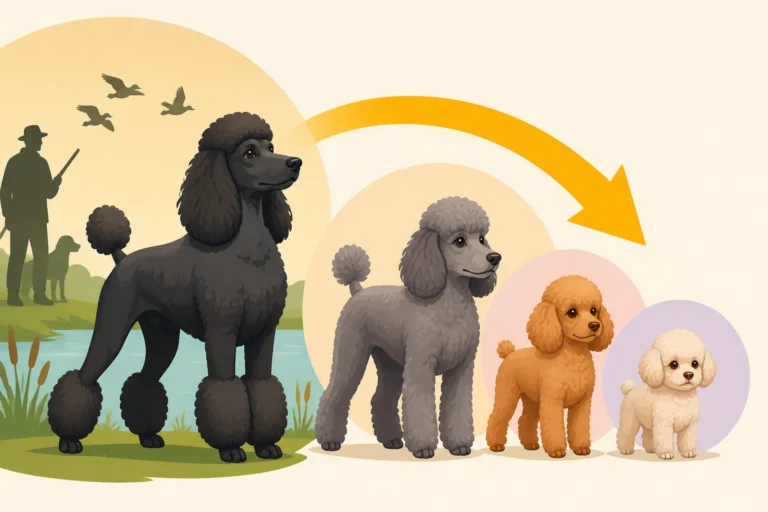
This distinctive coat isn't just a beauty feature; it's a functional one. Poodles were originally water retrievers, tasked with plunging into icy waters to fetch fowl. Their thick, curly coats provided insulation and protection. Imagine trying to swim with a full, shaggy coat that absorbs water like a sponge – it would weigh them down and make them less efficient. This is where the clipping came in.
The Working Dog Roots of the Show Clip
The Poodle's ancestry as a water dog is directly responsible for the development of its signature clips. Hunters needed a dog that could move freely through water and dense underbrush without getting bogged down by a heavy, wet coat, but still retain insulation for vital organs and joints in cold conditions. This led to the practice of shaving certain areas to reduce drag and weight, while leaving strategic patches of hair to protect from the cold and injury. It was a practical solution born out of necessity, not vanity.
Consider a Poodle diving into a frigid lake. Shaving the legs, tail, and body reduces the amount of water the dog has to carry, making them more agile and less prone to hypothermia once out of the water. Yet, leaving hair on the chest, around the joints, and on the lower back provided crucial warmth and protection. These seemingly artistic "pompoms" on the tail and legs? They were originally functional. The tuft on the tail acted as a flag, helping hunters spot their dog in rough waters. The puffs on the joints were believed to protect them from rheumatism in the cold water. It's a testament to the breed's history that these functional elements were preserved as they transitioned from working dogs to companions and show ring stars. For a fascinating look at this heritage, check out Why a Working Poodle Was Clipped at All.
Evolution from Function to Form
Over centuries, as Poodles transitioned from utilitarian working dogs to beloved companions and then to glamorous show animals, the practical clips evolved. The basic outline remained, but the artistry and precision became paramount. What was once a rough, functional trim became a highly stylized, elegant presentation. Judges in conformation events are looking for a Poodle that not only conforms to the breed standard in terms of structure and movement but also in presentation. The clip itself is a defining characteristic of the breed, a nod to its heritage while showcasing the unique coat.
This evolution meant that the exact execution of the clip became a precise skill. No longer was it just about shaving to function; it was about shaping, sculpting, and perfecting every line and curve. The goal now is to highlight the Poodle's elegant structure, enhance its natural beauty, and demonstrate the health and quality of its coat. The intricate styling demands hours of meticulous grooming, transforming the Poodle into a living work of art that moves gracefully in the ring.
Approved Poodle Clips for Conformation Showing
When you enter a Poodle into a conformation show, you're not just presenting a dog; you're presenting a tradition. The rules regarding acceptable clips are strict, ensuring consistency and a proper representation of the breed. There are essentially two primary clips accepted for adult Poodles, and one for puppies, each with its own specific guidelines.
The Continental Clip: The Quintessential Show Poodle
The Continental Clip is arguably the most recognizable and iconic Poodle show clip. When people picture a Poodle in the show ring, this is often the image that comes to mind: shaved hindquarters and lower back, with "rosettes" on the hips, bracelets on the legs, a full mane, and a topknot. It’s dramatic, elegant, and requires an immense amount of skill and maintenance. The precision of the shaved areas contrasts sharply with the voluminous, artfully sculpted hair, creating a striking silhouette that accentuates the Poodle's athletic build and proud carriage.
The body is mostly shaved, but a distinct patch of hair, often shaped like a kidney bean, is left over each hip, forming the "rosettes." The legs are shaved except for the distinct "bracelets" around the ankles. The tail is shaved at the base with a pompom left at the tip. The most impressive feature is often the full, meticulously sculpted mane and topknot, which should blend seamlessly. Achieving this clip requires not just a steady hand but an understanding of canine anatomy to ensure the balance and symmetry highlight the Poodle's best features. Our article, How Much Work a Continental Poodle Takes, elaborates on the dedication needed for this spectacular clip.
The English Saddle Clip: A Less Common but Approved Alternative
While the Continental Clip dominates the show ring, the English Saddle Clip is also fully recognized and permitted. It's a sophisticated clip that maintains more coat on the hindquarters than the Continental, offering a slightly softer, yet equally elegant, appearance. It's not seen as often as the Continental, but it's a beautiful and correct presentation that showcases the Poodle's grace.
In the English Saddle clip, the face, feet, and base of the tail are shaved, just like the Continental. However, instead of shaved hindquarters and rosettes, the English Saddle leaves a short blanket of hair over the back and hindquarters. This blanket of hair has shaved bands or "crescents" across the flank, creating a saddle-like appearance. The legs have two distinct bracelets, not just one, and a pompom on the tail. The mane and topknot are full and styled, similar to the Continental. This clip emphasizes the Poodle's balanced proportions and fluid movement, allowing for a more natural flow of coat on the body while still highlighting the breed's distinct features.
Puppy Clip: When it's Allowed and When it's Not
Ah, the puppy clip! This is often where confusion arises. The puppy clip (sometimes referred to as the "Sporting Clip" or "Kennel Clip" if the topknot is shorter) is indeed allowed in the show ring, but only for Poodles up to a certain age. Generally, Poodles under 12 months old can be shown in a puppy clip. Once they reach the age of one, they must transition to either the Continental or English Saddle clip for conformation competition.
The puppy clip is essentially a uniform, full coat that is trimmed to follow the outline of the dog's body, leaving the coat slightly longer on the legs and head, but without any shaved patterns on the body or bracelets on the legs. The face, feet, and base of the tail are still shaved clean, and there's a pompom on the tail, as these are fundamental to Poodle grooming. The purpose of allowing the puppy clip is to not put undue pressure on owners to maintain a full adult show coat on a growing puppy, whose coat is still developing and changing. It allows judges to evaluate the puppy's structure and movement without the full commitment of an adult show clip. However, as soon as a Poodle turns one year old, the puppy clip is no longer acceptable in the adult conformation classes. This is a critical rule to remember; our article on Why Adult Poodles Cannot Show in a Puppy Clip goes into more detail about this important transition.
Understanding the Rules and Regulations of the Show Ring
Navigating the rules of Poodle show clips isn't just about knowing the names; it's about understanding the nuances and standards set by the governing kennel clubs. These regulations ensure fair competition and uphold the breed's integrity.
AKC, CKC, and FCI Standards: What to Expect
Different kennel clubs around the world—like the American Kennel Club (AKC), the Canadian Kennel Club (CKC), and the Fédération Cynologique Internationale (FCI) which governs many European countries—all have detailed breed standards for Poodles, including specific guidelines for grooming and presentation in the show ring. While there are slight variations, the core principles for Poodle clips are generally consistent.
For example, the AKC Poodle standard clearly outlines the acceptable clips: "Any of the currently accepted show clips are permissible. A Poodle under 12 months of age may be shown in a 'Puppy Clip.' A Poodle 12 months or older must be shown in either the 'Continental Clip' or the 'English Saddle Clip.' In all clips, the face, feet, and base of the tail must be shaved." These precise instructions are what judges follow to ensure every Poodle is presented according to tradition. What a judge checks on a Poodle goes far beyond just the clip; it includes structure, temperament, and movement, but the correct clip is the first visual impression and a critical component. You can learn more about this in What a Ring Judge Checks on a Poodle.
| Clip Name | Age Eligibility | Shaved Body Areas | Coat Left On Body | Distinctive Features |
|---|---|---|---|---|
| Continental Clip | 12 months and older | Hindquarters, lower back, parts of legs | Full mane/chest, topknot, rosettes on hips, bracelets on legs, tail pompom | High contrast between shaved and full areas, very sculptural, dramatic |
| English Saddle Clip | 12 months and older | Face, feet, base of tail, bands on hindquarters | Full mane/chest, topknot, blanket of hair on hindquarters, two bracelets on legs, tail pompom | Softer look than Continental, "saddle" appearance on back, two leg bracelets |
| Puppy Clip | Under 12 months | Face, feet, base of tail | Even, full coat over entire body and legs, topknot, tail pompom | Uniform length, less stylized than adult clips, allows natural coat growth in young dogs |
These rules are not arbitrary; they are there to preserve the historical integrity and distinct appearance of the Poodle breed. Deviating from these clips can lead to disqualification or lower placings, as it indicates a lack of understanding of the breed standard.
Prohibited Clips and Fanciful Trims
Just as there are approved clips, there are also explicitly prohibited ones. Any clip not specifically mentioned in the breed standard is generally considered unacceptable for conformation showing. This includes popular pet clips like the "Teddy Bear" or "Lamb Clip" (where the face is left fuzzy), or any highly stylized, non-traditional designs that might be fashionable for pet Poodles.
"Fanciful" trims are a definite no-go. This means no dyeing of the coat (unless specifically allowed for minor touch-ups for natural coat color, which is rare and highly scrutinized), no glitter, no ribbons woven into the coat (beyond a simple, functional bow if permitted), and no creative patterns or designs shaved into the body. The judge is evaluating a purebred Poodle's conformation and quality, not a groomer's artistic flair. The focus is on the dog's natural attributes, enhanced by a traditional, recognized clip.
Preparation Beyond the Clip: Grooming for the Ring
While the correct clip is crucial, it's only one part of presenting a Poodle for the show ring. The quality of the grooming, the health of the coat, and the Poodle's overall presentation are equally vital. A Poodle's coat, whether in a Continental or English Saddle clip, needs to be immaculately clean, conditioned, and expertly dried and brushed to achieve its full volume and texture. This means regular bathing and intensive drying sessions to get that signature straight, flowing look before clipping. Many owners spend hours perfecting their Poodle's appearance, and products from places like Chewy can be invaluable for maintaining coat health between professional grooms.
For a show Poodle, grooming is a daily commitment, not just a pre-show ritual. The coat must be kept free of mats, brushed to the skin, and maintained to the correct length for the chosen clip. This involves a consistent routine of brushing, bathing, and even minor trimming between full grooming appointments. Learning to properly blow-dry your Poodle straight is an art form in itself, and essential for achieving the crisp lines and full volume required for the ring. Our guide on Drying a Poodle Straight offers excellent tips for this. You'll also need a well-equipped grooming corner at home, complete with quality brushes and combs, which we discuss in more detail in Setting Up a Poodle Grooming Corner at Home.
Moreover, a show Poodle must be comfortable with the grooming process. From a young age, they need to be desensitized to clippers, dryers, and extensive handling. A Poodle that fights on the grooming table will never look its best in the ring. It's a journey of patience and positive reinforcement, ensuring that your Poodle sees grooming as a positive experience, not a punishment. This comprehensive approach to grooming and presentation is what truly sets a show Poodle apart, making the hours of dedication all worthwhile when they step confidently into the ring.
Disclaimer
This article is for general informational purposes only and does not constitute professional advice. Laws, prices and regulations vary by location and change over time. Consult a qualified professional for guidance on your specific situation.