Fading Rewards With a Quick-Learning Poodle
It's an interesting problem, isn't it? You get a Poodle, famed for their incredible intelligence, and they just soak up new commands. It’s thrilling! But then, a few weeks or months down the line, you notice something: your clever companion is starting to look at you, then at your hand for the treat, and if it's not immediately obvious, they might just decide to ignore you or offer a string of behaviors until they hit the jackpot. This guide is all about tackling that exact frustration – how to gracefully and effectively fade out constant rewards so your quick-learning Poodle performs reliably, not just for a piece of kibble, but because they understand and enjoy the work.
The Poodle Paradox: Learning Fast, Demanding Smart Rewards
It’s truly a marvel to witness a Poodle learn. They pick up new cues with a speed that often leaves other breeds in the dust, sometimes seeming to understand what you want after just a handful of repetitions. Why Poodles Learn a Cue in Five Repetitions is a testament to this incredible mental capacity. But this very brilliance can sometimes create an unforeseen challenge for us, their human companions. We get so excited by their rapid progress that we fall into a pattern of continuous reinforcement, giving a treat for every single correct response. While this is fantastic for initial learning, it can inadvertently teach our Poodles to expect a payout every time, leading to a frustrating dependence on the reward itself.
The Brilliant Brain and the Bait: How Quick Learning Makes Poodles "Reward-Savvy"
Think of your Poodle as a furry little scientist, constantly experimenting with cause and effect. They quickly establish a link: "I sit, I get a treat." "I come when called, a tasty morsel appears." This rapid association is precisely why they rank so high on intelligence scales, as detailed in discussions like What Coren Measured to Rank the Poodle. However, their intelligence also means they're not just mindlessly repeating actions; they're optimizing. If they learn that a sit always means a treat, and then suddenly the treat isn't there, they might conclude that the rule has changed, or that the sit wasn't "good enough." They become "reward-savvy," meaning they can become highly attuned to the presence or absence of a reward before even offering the behavior. This isn't naughtiness; it's smart economizing of effort.
This intelligence can also manifest as your Poodle developing a sort of "mental checklist" of behaviors. Instead of just performing the requested "sit," they might run through sit, down, paw, and then look at you as if to say, "Okay, which one did you want? Now where's my prize?" This chain of behaviors, often offered with increasing speed and decreasing precision, is a clear sign that your Poodle is brilliant but might be a little too focused on the treat and not enough on the specific instruction. It’s like they’re trying to hack the system, predicting what might earn them the reward rather than truly listening to the individual cue.
Anticipation vs. True Understanding: When Your Poodle is Guessing, Not Processing
One of the biggest pitfalls of relying too heavily on constant treats with a quick-learning Poodle is that they can start to anticipate the cue rather than truly process it. You might say "sit" and your Poodle drops before you've even finished the word, or they perform the behavior the moment your hand moves towards your treat pouch. While this looks impressive on the surface, it often means they've linked the context (your body language, the environment, the sound of the first syllable) to the behavior, not necessarily the precise verbal cue. When a Poodle Starts Anticipating the Cue highlights this very phenomenon. They're making an educated guess, and usually, their guesses are pretty accurate because they're so tuned into us.
The problem arises when you change the context or introduce distractions. If your Poodle only "sits" perfectly in the quiet living room when you have treats, but utterly ignores you at the park or when the doorbell rings, it’s a strong indicator that their understanding isn't as robust as it seems. They haven't generalized the behavior, and their motivation is tied directly to the visible reward. This is where you might feel frustrated, wondering why your "smart" dog suddenly seems to forget everything. It's not forgetfulness; it's a lack of true understanding and a reliance on predicting the reward rather than executing a known command under varying circumstances. Our goal is to shift them from being a brilliant guesser to a reliable, confident performer.
Mastering the Art of Reward Fading for Your Clever Poodle
Fading rewards isn't about removing rewards entirely; it's about making them less predictable and less dependent on continuous food. It’s about teaching your Poodle that their effort is still appreciated, but not every single correct response needs a physical treat. This is a critical step in building a truly reliable and well-mannered Poodle, one who performs because they understand and trust you, not just because they're on the payroll.
Transitioning from Constant to Variable Rewards: The 'Pop Quiz' Approach
The journey from constant reinforcement (a treat for every correct action) to variable reinforcement (rewards given intermittently and unpredictably) is the cornerstone of effective reward fading. Think of it like a pop quiz. If your Poodle knows every single correct answer will earn them a treat, they might get bored or just go through the motions. But if they know a treat might come, and it might be a really good one, they stay highly engaged and motivated. This unpredictability keeps them trying. Initially, you might reward every second or third correct response. Then, gradually stretch that to every fourth, fifth, or even tenth response. The key is to be unpredictable – sometimes they get a treat immediately, sometimes they do three perfect sits before getting one.
This variable schedule mirrors the way we get rewarded in real life, and it builds resilience. Your Poodle learns that even if a treat doesn't appear this time, it's worth continuing to try because a reward will eventually come. This is especially important for behaviors you want to perform consistently in distracting environments, where you can't always be fumbling for a treat. A program like BAXTER & Bella, known for its comprehensive online puppy training, often emphasizes moving to variable rewards as a crucial step for building reliable performance in everyday situations. It helps build a strong work ethic where the dog continues to offer the behavior even without immediate gratification.
Beyond the Treat: Expanding Your Poodle's Reward Menu
While food is an excellent motivator, especially for a smart Poodle who will work hard for a delicious morsel, it's not the only reward. To truly fade food rewards, you need to diversify your Poodle's "paycheck." Think about all the things your Poodle loves, beyond just eating. This could include:
- Praise and Affection: Enthusiastic verbal praise ("Good dog!", "Yes!"), a gentle scratch behind the ears, a belly rub.
- Toys: A quick game of tug, a toss of their favorite squeaky toy, or a moment with a beloved fetch toy.
- Access to the Environment (Life Rewards): Want to go sniff that interesting bush? You have to sit first. Want to go out the door? You must wait politely. Want to get on the sofa for cuddles? Offer a calm down. These are powerful, natural motivators.
- Activities: A short burst of their favorite activity, whether it's chasing a ball, a brief run, or even just permission to explore.
By offering a variety of rewards, you teach your Poodle that good behavior can unlock many desirable things in their life, not just food. This makes them less reliant on any single type of reward and reinforces the idea that cooperating with you leads to good outcomes, rather than just performing for a specific treat. It also allows you to choose the most appropriate reward for the situation – a quick "Good!" might be better than a treat when you're on a busy walk.
Strategic Reduction: Gradually Decreasing Treat Value and Frequency
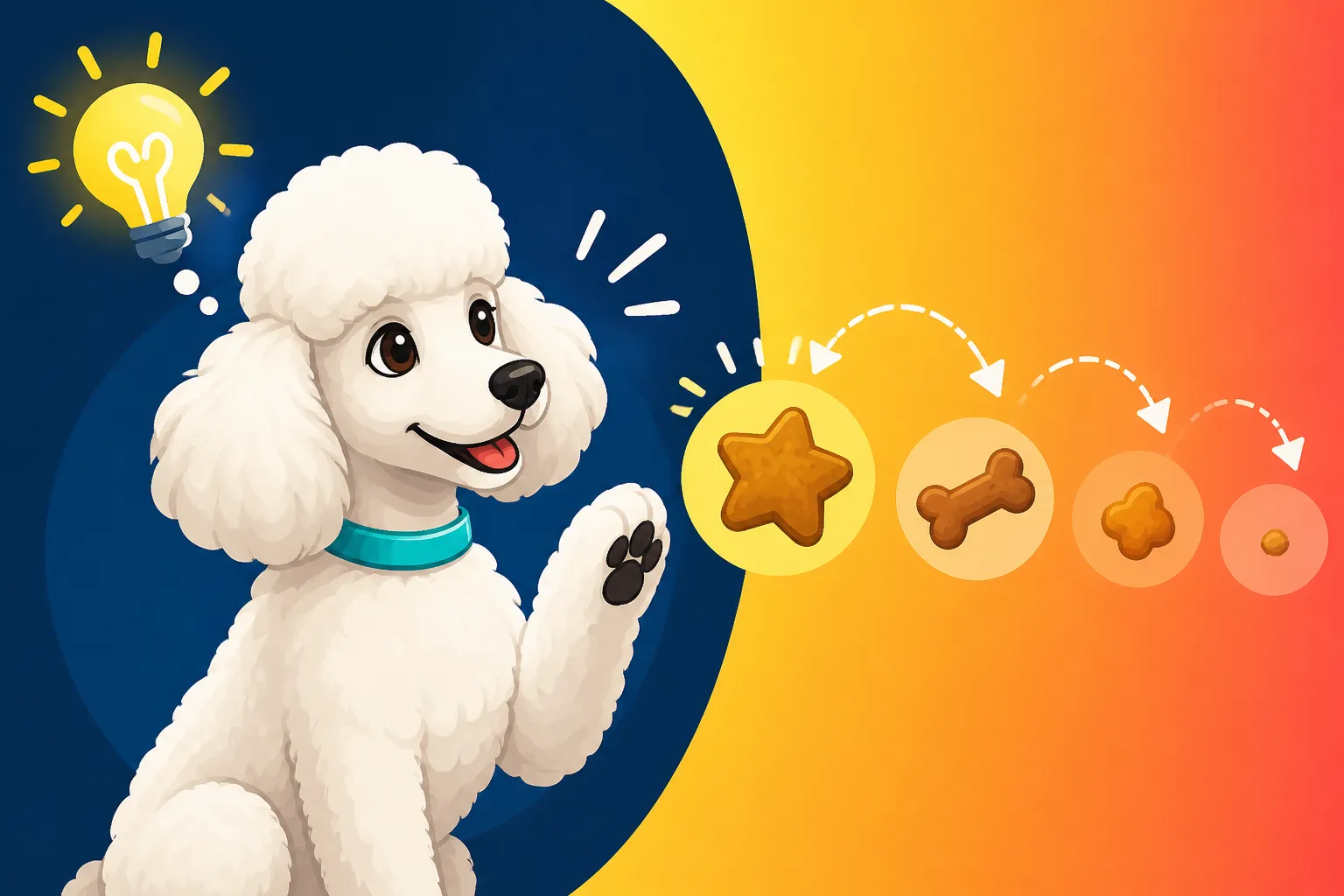
When you're ready to start actively fading food rewards, it’s not about suddenly stopping them entirely. That’s a sure way to demotivate your clever Poodle. Instead, it’s a strategic, gradual process involving both the value and frequency of the treats. Start by replacing some high-value treats (like boiled chicken or cheese) with lower-value options (like regular kibble or small, dry training treats you might find on Amazon). For example, if you're practicing "sit," maybe every third sit gets chicken, and the other two get a piece of kibble. Then, slowly shift to only kibble, and eventually, to just verbal praise or a quick pet for most routine behaviors.
The frequency reduction should also be gradual, as discussed in detail in Fading Rewards With a Quick-Learning Poodle. Once your Poodle reliably performs a behavior for lower-value treats, you can start asking for more repetitions before a reward is given. For instance, ask for two "sits" in a row, then reward. Then three. Then you might ask for a "sit," then a "down," then a "stay," and then reward the entire sequence. This teaches duration and chaining of behaviors. The goal is to move towards a point where basic, well-known commands in a low-distraction environment can be performed simply for praise and a happy tone of voice, saving your higher-value treats for new learning, proofing in challenging environments, or particularly excellent efforts.
| Reward Type | Description | When to Use It | Example for Poodle Owners |
|---|---|---|---|
| High-Value Treats | Extremely palatable, rare treats (e.g., chicken, cheese). | Initial learning, high-distraction environments, proofing, "jackpots." | Teaching a new trick; getting a solid recall at the dog park; rewarding a perfect "stay" during a bustling family gathering. |
| Low-Value Treats | Everyday kibble, plain biscuits, small training treats. | Practicing known behaviors, variable reinforcement schedules, less distracting settings. | Daily obedience practice in the living room; rewarding a calm greeting for a familiar visitor; a quick "sit" before dinner. |
| Verbal Praise | Enthusiastic, happy words ("Good dog!", "Yes!"). | Most common reward, foundational for all training, always available. | Reinforcing any desired behavior; acknowledging effort; maintaining morale when treats aren't available. |
| Physical Affection | Gentle pets, scratches, cuddles (if dog enjoys them). | Alongside verbal praise, strengthens bond, calming, appropriate for calm behaviors. | Rewarding a "down-stay" in front of the TV; a quiet "place" command; after a successful grooming session. |
| Play/Toys | A quick game of tug, fetch, or chase. | For energetic Poodles, as a jackpot, after a successful sequence of commands. | After a focused training session; for a reliable "come" during off-leash play; as a reward for a good retrieve. |
| Life Rewards | Access to something the dog wants (e.g., door, toy, sniff). | Everyday situations, teaching impulse control, natural motivators. | "Sit" before going outside; "wait" before eating; "heel" to get to the dog park; "look" before greeting a person. |
Handling Setbacks and Advancing Your Poodle's Training
It's tempting to think that once you start fading rewards, it's a linear path to perfection. But Poodles are sentient beings, not robots, and setbacks are a normal part of the process. Your Poodle might test the boundaries, or appear to "forget" a command. The key is to be patient, consistent, and know when to adjust your approach. Remember, the goal is always to build a stronger, more reliable partnership, not just to eliminate treats.
When Your Poodle "Checks Out": Re-engaging a Demotivated Learner
One common frustration when fading rewards is that your Poodle might suddenly seem demotivated, or "check out" entirely. You ask for a behavior, and instead of performing it, they might stare blankly, sniff the ground, or even walk away. This isn't stubbornness; it's often a sign that you've faded the rewards too quickly, or that the current reward value isn't high enough for the task at hand. The intelligent Poodle, as explored in Why a Bright Poodle Gets Bored, might decide it's not worth their mental effort if the payoff isn't there.
If this happens, don't get angry or frustrated. Simply go back a step. Increase the frequency of rewards again for that specific behavior, or switch back to higher-value treats. Make sure your timing is impeccable – the reward should come within 1-2 seconds of the desired action. Sometimes, even just reintroducing a clicker (if you use one, see Clicker Timing With a Fast-Learning Poodle) can help re-establish that precise communication link and inject new enthusiasm. The idea is to make success easy and rewarding again, rebuilding their confidence and motivation before trying to fade the rewards more gradually.
Building Reliability: Proofing Skills in Real-World Scenarios
True reliability means your Poodle performs a command not just in your quiet kitchen, but also at the park, at the vet's office, or when a squirrel runs by. This is where reward fading really shines, because it teaches your Poodle to perform without needing you to be a walking vending machine. However, proofing skills in distracting environments requires a careful approach. Start small. Practice a "sit" at the edge of the park before moving closer to the playground. Ask for a "stay" for a shorter duration when there are more people around.
When practicing in these new scenarios, you'll likely need to reintroduce higher-value treats and a more frequent reward schedule temporarily. Think of it as investing in their learning for this new context. Once they reliably perform in the distracting environment with consistent rewards, then you can begin the fading process again for that specific environment. This graduated approach helps your Poodle generalize their understanding: "Oh, 'sit' means 'put my bottom on the ground' no matter where we are, and sometimes I get chicken for it, sometimes just a 'good dog!'" This generalization is key to having a truly bomb-proof Poodle, capable of focusing on you amidst the chaos of daily life.
Keeping the Spark Alive: Mental Stimulation Without Constant Food
Your Poodle's incredible brain isn't just for learning commands; it thrives on being challenged and engaged. If you only focus on fading food treats, you risk leaving a brilliant mind understimulated. This can lead to your Poodle finding their own jobs, which might include counter-surfing, excessive barking, or other undesirable behaviors, because, as the saying goes, Why a Poodle Needs a Job Rather Than a Walk. Incorporate plenty of mental stimulation into your Poodle’s day that doesn't always involve you doling out treats for every single correct response.
Puzzle toys, snuffle mats, and scent games are fantastic ways to engage their minds, often with their regular kibble, making mealtime an enriching experience. You can also teach them complex trick chains, or enroll in dog sports like agility, obedience, or rally. These activities offer inherent rewards – the joy of problem-solving, the thrill of working with you, the physical exertion, and the positive feedback from a trainer or judge. By providing a rich environment of mental and physical challenges, you ensure your Poodle remains a happy, engaged, and well-behaved companion, even as you gradually reduce their reliance on a constant stream of high-value edible rewards.
Disclaimer
This article is for general informational purposes only and does not constitute professional advice. Laws, prices and regulations vary by location and change over time. Consult a qualified professional for guidance on your specific situation.