Whether a Poodle Can Learn Object Names
It's incredibly frustrating when you know your Poodle is a genius, yet sometimes it feels like they don't quite grasp the simplest requests beyond "sit" or "stay." You see videos of dogs knowing hundreds of object names, and you wonder if your smart, curly companion has that same capacity, or if it's just a trick. Let me assure you, Poodles absolutely have the mental prowess to learn object names, and this guide will walk you through exactly how to tap into that incredible Poodle brain and teach them to identify their toys by name, building a deeper, more engaging relationship with your furry friend.
The Poodle's Innate Intelligence and Memory
Poodles consistently rank among the most intelligent dog breeds, often second only to the Border Collie in many intelligence studies. This isn't just about performing tricks; it's about their cognitive abilities, problem-solving skills, and remarkable memory. Their history as duck retrievers demanded quick thinking, excellent memory for locations, and the ability to understand complex commands, all of which lay a fantastic foundation for learning object names.
More Than Just "Sit": Recognizing Specifics
When we talk about a Poodle learning "sit" or "stay," we're teaching them a physical action tied to a verbal cue. Learning object names goes a step further; it requires your Poodle to associate a distinct sound (the object's name) with a specific physical item, differentiating it from all other items in their environment. This isn't a simple reflex; it's a higher-level cognitive function that Poodles are particularly well-equipped for. Their quick grasp of new concepts, often mastering a cue in as few as Why Poodles Learn a Cue in Five Repetitions, means they're ready for more complex mental exercises like this.
Think about it: when you ask your Poodle for "ball," you're asking them to recall the auditory pattern of "ball," scan their environment for an object matching that internal representation, and then act on it. This requires significant brainpower, something Poodles have in spades, placing them high on the cognitive scale when considering Where the Poodle Sits in Coren's Ranking.
The Power of Association
Poodles thrive on routine and association. From a young age, they start forming connections between words and actions, sounds and outcomes. This natural ability to link experiences is the cornerstone of object name learning. If you consistently use the word "rope" every time you play with their rope toy, your Poodle begins to build a strong neural pathway. Over time, that pathway becomes so ingrained that the word "rope" conjures an image of the toy in their mind, just like it does for you. This is also why their inherent The Poodle's Retrieving Instinct can be a huge asset; they're already motivated to interact with and bring objects.
This isn't just about retrieving; it's about the cognitive understanding that a specific sound refers to a specific item. It's a testament to their adaptability and their keen observation skills. They're constantly watching us, listening to our tone, and trying to understand what we want. This makes them excellent candidates for advanced verbal learning.
The Science Behind Object Name Learning
For dogs, learning object names is a fascinating blend of operant conditioning, classical conditioning, and discriminatory learning. It's not about them understanding the human concept of a "word," but rather forming an incredibly strong and specific association. They learn that this specific sound (the name) predicts a positive interaction with this specific object.
Learning Through Play and Repetition
Dogs learn best through positive, engaging experiences. When teaching object names, play becomes your primary tool. Every interaction with the designated object, paired with its name, reinforces the connection. This isn't tedious classroom learning; it's a fun game. You're not just saying "ball"; you're saying "ball!" with enthusiasm, throwing it, praising your Poodle for bringing it back, and maybe even offering a small, tasty treat. This creates a powerful positive emotional response to both the word and the object, making your Poodle eager to participate.
The key is consistency. Using the same name every single time, without variations, helps your Poodle solidify the connection. If one day you call it "ball" and the next day "orb," you're creating confusion. Stick to one simple, clear name for each item. This repeated exposure during joyful play sessions cements the association in their mind, building their "vocabulary" one object at a time.
Discriminatory Learning: The Critical Step
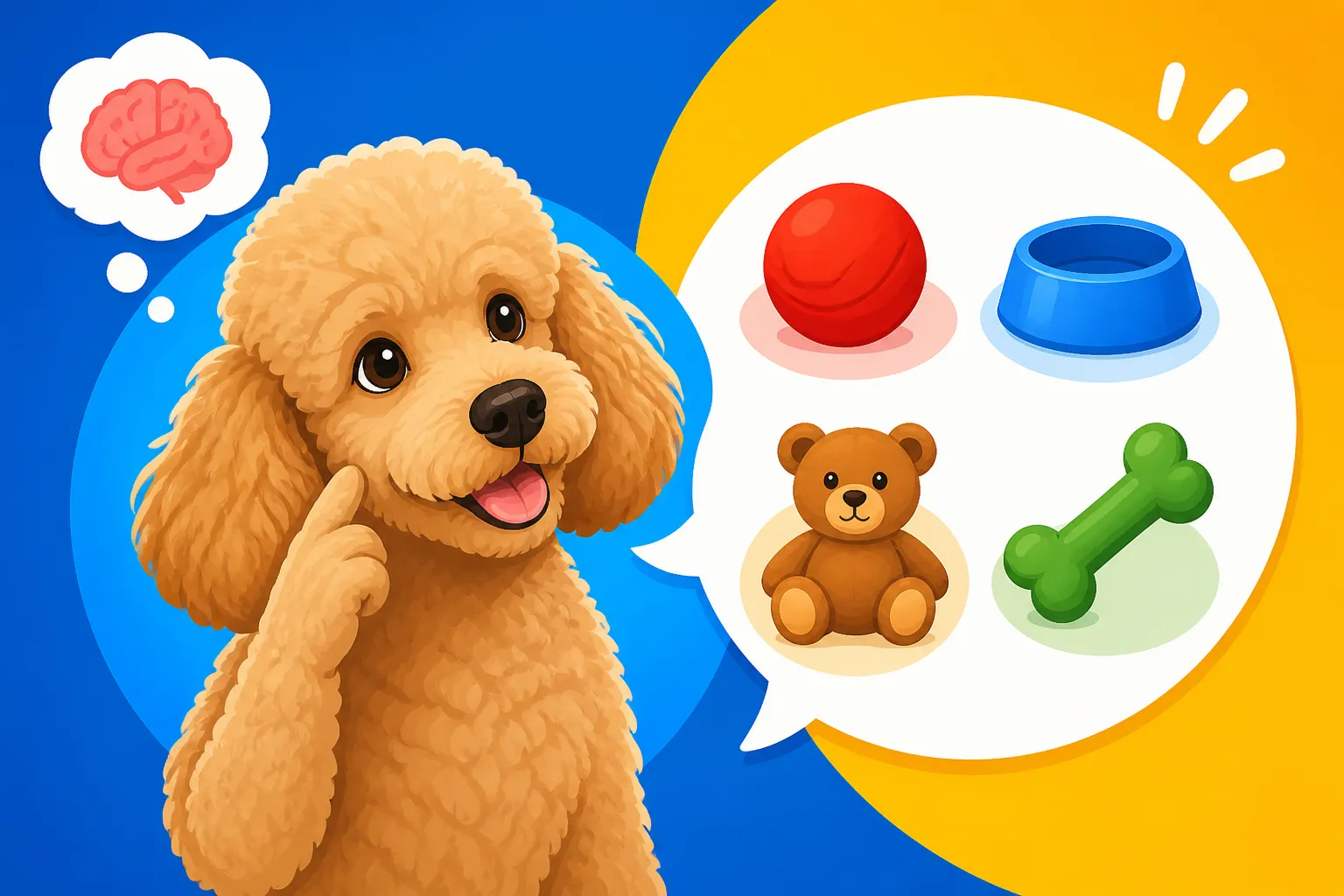
The real magic happens with discriminatory learning. It's one thing for your Poodle to learn "ball" when only the ball is present. It's another entirely for them to pick the ball out of a pile of toys when you ask for it. This is where they demonstrate true understanding of the individual object's name. They are not just responding to a general command to "get a toy"; they are discriminating between multiple objects based on your specific verbal cue.
This step proves that they aren't just reacting to context or your body language. When your Poodle correctly fetches the "rope" when the "ball" and "duck" are also on the floor, they are actively processing the verbal information, retrieving the correct mental image, and executing the desired action. This ability to differentiate is a hallmark of high canine intelligence and something Poodles excel at.
Practical Steps to Teach Your Poodle Object Names
Teaching your Poodle to recognize object names is a super rewarding journey, and it’s totally achievable with consistency and a bit of patience. Here’s a step-by-step approach to get you started.
Step 1: Choose Distinct Objects
Start small, with just one or two easily distinguishable toys. Don't try to teach "red ball" and "blue ball" at the same time. Pick a soft plush toy, a rope, or a squeaky ball – something with a unique texture, shape, or sound. If you're looking for new, distinct options, browsing for dog toys on Amazon can provide a wide variety of shapes and materials to help your Poodle differentiate visually and tactually.
It's tempting to want them to know all their toys instantly, but that's a recipe for overwhelm. Stick to one or two names until they've got them down pat. This initial success will build both your confidence and your Poodle's enthusiasm for the game.
Step 2: Consistent Naming and Presentation
Now for the fun part! Pick up the chosen toy and say its name clearly and enthusiastically, like "Ball! Here's the Ball!" Play with it, toss it, let your Poodle mouth it, all while repeating the name. Keep these sessions short and sweet, maybe 5-10 minutes. The goal here is to forge a strong link between the word and the object.
Do this several times a day over a few days. You want that name to be firmly imprinted in your Poodle's mind whenever they see or interact with that specific toy. If your Poodle already has a collection, ensure you're consistent about which toy gets which name. You might find some of your Poodle's existing toys already have a de-facto name they respond to, even if you hadn't consciously taught it.
Step 3: Play and Reward
Once you feel your Poodle is starting to connect the name with the object, it's time to test their recall. Place the named toy on the floor and ask, "Where's the [toy name]?" or "Go get the [toy name]!" When they engage with it, or even better, bring it to you, erupt with praise! "Yes! Good [Poodle's name]! You got the [toy name]!" Immediately follow with a high-value treat. Small, soft treats work best, especially for a Toy Poodle, so they don't get distracted chewing; finding Treats Small Enough for a Toy Poodle is crucial here.
If they don't get it, that's okay! Just pick up the toy, repeat its name, engage them in play with it again, and try the verbal cue later. Never scold; keep it positive and fun. This is about building a bond and a skill, not passing a test.
Step 4: Introduce Choices and Increase Difficulty
This is where true understanding begins to shine. Once your Poodle reliably identifies the first toy by name, introduce a second, distinctly different named toy. Place both toys a short distance away and ask for one specifically: "Go get the [first toy name]!"
If they choose correctly, massive praise and reward! If they pick the wrong one, calmly say "oops!" or "try again" (or a similar gentle phrase), guide them to the correct toy, name it, and praise them for interacting with it. Then, try again later. This is discriminatory learning in action. You'll see their brain working, trying to figure out which sound matches which object.
Gradually, you can increase the number of toys and the distance. Ask for a toy from another room, or mix it in with household items they shouldn't touch (but don't name those items). This is a great opportunity to explore how to Teaching a Poodle to Fetch and Deliver specific items on command.
Step 5: Diversify the Learning Environment
Don't limit the game to one spot. Practice in different rooms, in the yard, or even at a friend's house. This helps generalize the learning so your Poodle understands the name of the object, not just its location.
You can also incorporate these learned names into structured training. Programs like those offered by BAXTER & Bella often emphasize positive reinforcement and progressive learning, which can be fantastic for integrating object recognition into a broader training regimen. Consider creating simple obstacle courses where they have to retrieve a specific named toy at the end. This adds mental stimulation and reinforces their learning in a new, exciting way.
Challenges and Tips for Success
Even with a Poodle's impressive intellect, teaching object names isn't always a straight line. You might encounter some bumps along the way, but with the right approach, you can navigate them successfully.
Patience is Key
It's easy to get frustrated if your Poodle isn't picking things up as quickly as you'd hoped, especially since Poodles are known for being fast learners. Remember that every dog learns at their own pace. Some Poodles might click with object names in a few weeks, while others might take months. Celebrate every small victory – even just looking in the direction of the correct toy is progress! If you find yourself getting impatient, take a break. Your Poodle can sense your emotions, and frustration can make them shut down.
Keep it Fun and Engaging
If training feels like a chore to you, it will feel like a chore to your Poodle. The goal is to make this a joyful, interactive game. Use an excited tone of voice, lots of praise, and high-value rewards. Poodles thrive on engaging with their humans, and if they see this as a fun way to spend time with you, they'll be much more motivated to participate. If you notice your Why a Bright Poodle Gets Bored, switch up the game or end the session on a high note before they lose interest. Boredom is the enemy of learning for a Poodle.
Short, Frequent Sessions
Poodles are intelligent, but their attention spans aren't endless, especially when learning something new and complex. Keep your training sessions brief – 5 to 10 minutes at most, a few times a day. This ensures your Poodle stays engaged and doesn't get overwhelmed. Short, frequent bursts of learning are far more effective than one long, tedious session. This aligns with general advice on How Long a Poodle Training Session Should Run.
Avoid Frustration and Simplify the Task
If your Poodle is consistently getting it wrong, don't get angry. Instead, assess what might be going wrong. Are the objects too similar? Is your cue unclear? Are there too many distractions? Simplify the task. Go back to basics, perhaps with just one toy in a quiet room, and rebuild their confidence. Remember, Poodles are incredibly sensitive creatures, and harshness can lead to them Why a Poodle Shuts Down When Scolded.
| Stage of Learning | Goal for Your Poodle | Common Challenge | Troubleshooting Tip |
|---|---|---|---|
| Introduction | Associate name with object | Distraction, unclear name | Practice in quiet, use distinct name consistently |
| Recall (Single Object) | Fetch the named object | Doesn't respond to name | Ensure high-value reward, make it a fun game |
| Discrimination (Two Objects) | Choose one from two | Picks wrong object | Make objects very distinct, guide to correct one gently |
| Generalization | Identify objects in new places | Only knows objects in one spot | Practice in different rooms/environments, add more objects slowly |
| Advanced | Identify from multiple, retrieve from distance | Confusion, losing interest | Keep sessions short, vary toys, make it a fun "job" |
What if They Invent Shortcuts?
Poodles are smart, sometimes too smart. They might figure out that if they just bring any toy, they sometimes get a reward, or they might try to anticipate your next move. This is where Why a Poodle Invents Its Own Shortcuts comes into play. To counter this, ensure your praise and reward are only for the correct behavior. If they bring the wrong toy, calmly withhold the reward and reset the situation without judgment. You want them to think, not guess.
By understanding your Poodle's incredible mental capacity and applying these positive, consistent training methods, you'll soon have a Poodle who not only knows "sit" and "stay" but can also proudly bring you their "duckie," their "rope," or even their favorite squeaky "pig." This journey will not only expand their vocabulary but deepen the amazing bond you share.
Disclaimer
This article is for general informational purposes only and does not constitute professional advice. Laws, prices and regulations vary by location and change over time. Consult a qualified professional for guidance on your specific situation.