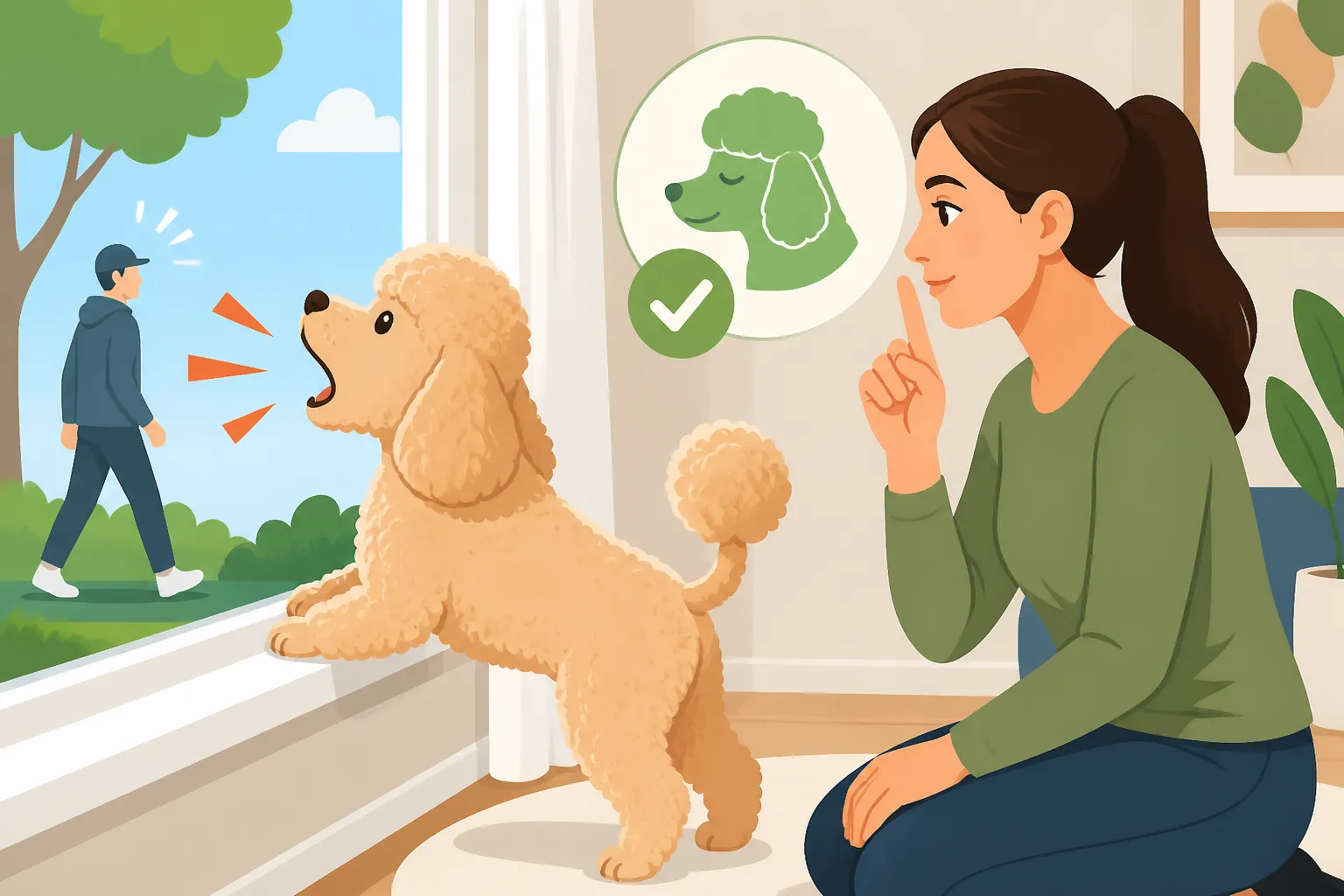
Quieting a Poodle That Barks at the Window
The incessant window barking can turn your peaceful home into a cacophony of canine complaints. It’s a common, incredibly frustrating problem for Poodle owners, and it can leave you feeling helpless, embarrassed, and thoroughly overstimulated. This guide dives deep into understanding why your Poodle feels the need to alert the neighborhood to every passing squirrel or leaf, and more importantly, offers practical, empathetic solutions to bring quiet back to your home.
Understanding Why Your Poodle Becomes a Window Warrior
Before we can even begin to tackle the "how," we need to get to the root of the "why." Poodles aren't barking just to annoy you, even if it feels that way in the moment. Their window barking stems from a complex mix of instinct, intelligence, and environmental factors. Ignoring these underlying reasons means any attempts at quieting them will likely be temporary at best.
The Poodle's Natural Alertness and Intelligence
Poodles are, without a doubt, incredibly smart dogs. They consistently rank high in canine intelligence surveys, which is often a point of pride for owners, but it also means they are highly observant and quick to connect cause and effect. Think about their history: while famous for retrieving waterfowl, they were also keen observers of their environment, needing to be aware of their surroundings to do their job effectively. This inherent alertness, coupled with their intelligence, means they notice everything that happens outside your window.
When a Poodle sees something move outside, their brain immediately processes it. Is it a person? A dog? A car? A blowing plastic bag? For many Poodles, this sighting triggers an alert. They bark, and lo and behold, the mail carrier walks away, the neighbor's dog disappears around the corner, or the car drives off. To your Poodle, a powerful association is formed: "My barking made it go away! I saved the house!" This self-reinforcing cycle is incredibly hard to break because, from their perspective, their barking is highly effective. They are, in essence, doing a very important job, as they see it. This acute awareness and propensity to react are deeply tied to Poodle Temperament and Sensitivity.
Territorial Instincts and Perceived Threats
Every Poodle, regardless of size, views your home as their territory. And just like their ancestors, they have an instinct to protect it. The window acts as a transparent, yet impermeable, barrier to their perceived domain. Anything moving beyond that boundary can be seen as an intrusion, a potential threat, or simply something that needs to be announced. It's not always aggression; often, it's a "hey, I see you!" announcement.
Consider the common targets of window barking: the mail delivery person, the dog walker, children playing, or even just another dog being walked down the street. Your Poodle doesn't understand that these people and animals pose no real threat to the sanctity of your living room sofa. To them, these are foreign entities entering their visual space. The intensity of their barking might correlate with how much of a "threat" they perceive. A tiny leaf might get a single "woof," while a large delivery truck might trigger a full-blown, ear-splitting barrage. Each perceived intrusion fuels their territorial drive, creating a cycle where they feel compelled to stand guard at the window, reinforcing the very behavior you're trying to stop.
Boredom, Loneliness, and Attention-Seeking
While alertness and territoriality are big players, sometimes window barking is simply a symptom of a Poodle who needs more engagement. Poodles are smart, and smart dogs get bored easily. If a Poodle isn't getting enough physical exercise or, perhaps more importantly, enough mental stimulation, they will absolutely find a "job" to do. And what's easier than sitting by the window and reporting on the comings and goings of the outside world? It provides a constant stream of novel stimuli and a clear, albeit self-appointed, purpose.
Furthermore, barking can also be a cry for attention. If your Poodle barks at the window and you rush over to tell them to stop, even a negative reaction from you can be perceived as a reward. "Ah, human noticed me! I'll do that again!" This is especially true for Poodles who are left alone for long periods or those who don't get enough interactive playtime. They thrive on companionship and mental engagement. A Poodle that feels lonely or under-stimulated might develop a habit of window barking simply because it gets a reaction from you, or because it's the most exciting thing happening in their day. Addressing Keeping a Poodle Mind Occupied and potential Separation Anxiety in a Velcro Poodle can often significantly reduce this type of barking.
Environmental Management: Removing the Triggers
Sometimes, the simplest solution is the most effective: if your Poodle can't see the triggers, they can't bark at them. Environmental management is about proactively changing your Poodle's access and view, rather than waiting for the barking to start and then reacting. This approach removes the opportunity for the behavior to occur, which is a crucial first step in breaking the habit.
Limiting Access to the "View"
The most direct way to stop window barking is to eliminate your Poodle's ability to look out the window. This isn't always glamorous, but it works.
- Physical Barriers: Baby gates or ex-pens can be your best friends here. By physically blocking access to the "prime viewing spots," you prevent your Poodle from settling in for their daily patrol. This might mean placing a gate across a hallway leading to a front room, or setting up an ex-pen in a more central part of the house where windows offer less direct street visibility. The key is to make these areas inaccessible before the barking starts, not after.
- Blinds, Curtains, and Window Film: This is often the easiest and most aesthetically pleasing solution. Keep blinds or curtains closed, especially in rooms where barking is a frequent problem. For windows that you don't want to keep fully covered, consider static cling privacy film. These films obscure the view from the outside and filter the view from the inside, often turning distinct shapes into blurry forms, which can be enough to reduce your Poodle's reactivity. You can find many options on Amazon that are easy to install and remove without damaging your windows.
- Furniture Rearrangement: Sometimes, simply moving a sofa or a favorite dog bed away from the window is enough. If your Poodle can't comfortably perch or rest while scanning the street, they might be less inclined to engage in window vigilance.
By systematically removing the visual triggers, you're not punishing your Poodle; you're simply changing the environment so they no longer feel the need to perform their self-appointed "guard duty."
Sound and Visual Distractions
While limiting the view is primary, sometimes sounds alone can trigger a Poodle's alert barking, or you might want to provide alternative stimulation in areas where the view is blocked.
- White Noise or Calming Music: The outside world is full of sounds – distant sirens, car doors slamming, children yelling, other dogs barking. Many Poodles are highly sensitive to these auditory cues. Introducing white noise machines or playing calming dog-specific music can help mask these external sounds, making them less likely to trigger a reaction. Position the sound source near the problem window or in the room where your Poodle spends the most time.
- TV or Radio On: A simple radio or TV left on can provide background noise that mimics human presence, making some Poodles feel less alone and potentially distracting them from outside sounds. The varied sounds of talk radio or a nature documentary can sometimes be enough to shift their focus.
- Scent Enrichment: While not strictly visual or auditory, scent can play a huge role in a dog's world. Placing a puzzle toy filled with treats, or a safe, dog-friendly scented item in a designated "calm spot" away from the window can redirect their focus. For example, a snuffle mat with hidden kibble can keep their nose and brain busy for a good chunk of time.
These distractions don't teach your Poodle not to bark, but they reduce the instances of barking, which in itself is a powerful step. Every moment your Poodle spends not barking is a moment you can reinforce quiet, calm behavior.
Training Strategies to Change the Barking Behavior
Once you've managed the environment to reduce initial triggers, it's time to teach your Poodle a new way to respond to external stimuli. This involves positive reinforcement and consistent redirection, focusing on what you want your Poodle to do rather than punishing what you don't.
The "Look At That" Game (Engage and Redirect)
This game is a fantastic way to change your Poodle's emotional response to triggers from "must bark!" to "oh, something interesting! Maybe I'll get a treat!" It's a classical counter-conditioning exercise.
Here's how it works:
- Identify a Trigger: Sit with your Poodle near a window (but far enough away that they notice things before they react with a full bark).
- Mark and Reward: The moment your Poodle sees a trigger (a person walking by, a car, another dog) and before they start barking, say "Yes!" or click a clicker, and immediately give them a high-value treat. Your goal is to interrupt the thought process that leads to barking.
- Repeat, Repeat, Repeat: The person walks past, your Poodle looks, you mark and treat. The car drives by, your Poodle looks, you mark and treat. You are essentially pairing the presence of the "trigger" with something wonderful (the treat).
- Increase Duration/Proximity: As your Poodle starts associating the trigger with good things, they'll look at the trigger, then turn to you expecting a treat. This is your goal! You can then slowly decrease your distance to the window or increase the duration they have to be quiet before the treat.
The key is timing. You want to reward the observation without reaction, not the barking itself. This game shifts their focus from reacting to the outside world to checking in with you for a reward. It helps build a new, positive association with previously "alarming" events.
"Quiet" Command and Desensitization
Teaching a "quiet" command gives you a tool to use when your Poodle does start barking. But it's not about silencing them through fear; it's about teaching them an alternative behavior that earns a reward.
- Teach "Speak" (Optional but Helpful): First, get your Poodle to bark on cue. This might sound counterintuitive, but it helps them understand that barking is a behavior they can control. Hold a treat, say "Speak!" and wait for a bark (you might need to tap on the window or ring the doorbell to encourage it at first). When they bark, mark and treat. Repeat until they bark reliably on "Speak."
- Introduce "Quiet": Once your Poodle can "Speak," say "Speak," let them bark once or twice, then hold a treat to their nose. Most dogs will stop barking to sniff the treat. The moment they are quiet, say "Quiet!" (or click) and give them the treat.
- Gradual Practice: Practice this sequence in a calm environment. Then, slowly introduce minor triggers. For example, have someone walk past the window at a distance. Let your Poodle bark once, then use your "Quiet" command. Reward instantly for silence.
- Desensitization: This involves controlled exposure to triggers. Start with triggers at such a great distance or low intensity that your Poodle barely notices them, or notices them without barking. Reward calm behavior. Gradually, very gradually, bring the trigger closer or make it more intense, always staying below the threshold where your Poodle feels compelled to bark. The aim is to create a new normal where passing stimuli are just part of the background, not an emergency. Poodles often pick up cues quickly, so Why Poodles Learn a Cue in Five Repetitions is very relevant here, making consistent practice effective.
Managing Reactivity with Structured Activities
When your Poodle starts barking, simply telling them "no" or "stop" often isn't enough. You need to give them something else to do – an incompatible behavior that they can't perform while barking.
- "Go to Your Mat" or "Place" Command: This is incredibly useful. Teach your Poodle to go to a specific spot (a mat, a bed) and stay there until released, regardless of distractions. When you anticipate a trigger (e.g., mail delivery time), preemptively send them to their mat and reward them for staying calm. If they start to bark, calmly redirect them back to their mat. This takes practice in low-distraction environments first, then gradually introducing distractions.
- Engaging Puzzle Toys: Keep a rotation of highly engaging puzzle toys on hand. When a trigger appears, instead of reacting to the barking, immediately present a pre-stuffed Kong or a favorite puzzle feeder. The act of solving the puzzle and eating the treat is often enough to divert their attention away from the window. Make sure these toys are high-value and only offered during barking-prone times, so they maintain their novelty.
- Command Chain Redirection: If your Poodle begins barking, immediately ask for a known command chain: "Sit, stay, down, shake, roll over." The mental effort of performing multiple commands can break their focus on the window and re-engage their brain with you. Reward heavily for compliance.
| Technique | Goal | Best For | Key Principle | Requires Consistency? |
|---|---|---|---|---|
| Environmental Control | Preventing triggers entirely | Immediate relief, setting up for training | Out of sight, out of mind | Yes |
| "Look At That" Game | Changing emotional response to triggers | Mild to moderate reactivity | Classical Counter-conditioning | High |
| "Quiet" Command | Teaching an alternative to barking | Poodles who already bark regularly | Operant Conditioning (rewarding silence) | High |
| Structured Redirection | Interrupting barking with a different task | When barking has already started, maintenance | Incompatible behaviors, mental engagement | Yes |
| Enrichment Activities | Reducing boredom and anxiety | Proactive prevention | Fulfilling Poodle's physical/mental needs | Yes |
Enriching Your Poodle's Life to Reduce Nuisance Barking
A well-exercised, mentally stimulated Poodle is generally a quieter Poodle. Often, excessive barking, including window barking, is a signal that your Poodle's needs for physical and mental engagement aren't being fully met. Think of it as their way of saying, "I'm bored! Entertain me!"
Increasing Physical Exercise and Mental Stimulation
Poodles are athletes in disguise, and they need more than a quick trip around the block. Their intelligence also demands significant mental work.
- Tailored Physical Activity: A standard Poodle needs brisk walks, jogs, or even off-leash play (in a safe, fenced area) for at least an hour a day, often more. Miniature and Toy Poodles still need daily walks and opportunities to run, even if their stamina is less. Consider activities like fetch in the yard, swimming (many Poodles love water!), or hiking on trails. A truly tired Poodle is far less likely to have the energy or inclination to stand guard at the window. When a Poodle is under-exercised, they tend to find their own ways to burn off that excess energy, and barking is a prime candidate.
- Daily Mental Work: This is where Poodles truly shine and where many owners fall short. Their brains are constantly whirring. Incorporate daily brain games:
- Puzzle Feeders: Instead of just putting kibble in a bowl, use puzzle feeders, snuffle mats, or treat-dispensing toys for meals. This makes them work for their food and engages their problem-solving skills. Amazon offers a wide variety of puzzle toys suitable for all Poodle sizes.
- Hide-and-Seek: Hide treats or their favorite toys around the house and encourage them to "find it!" This uses their natural scenting abilities.
- New Tricks: Dedicate 10-15 minutes a day to teaching new tricks. Poodles love learning and showing off! This engages their cognitive abilities and strengthens your bond. What a Poodle Does When Its Brain Is Idle is often quite destructive, so preemptive mental work is key.
Remember, mental stimulation can be just as tiring, if not more so, than physical exercise for a Poodle. Combining both will create a well-rounded and content companion less prone to nuisance behaviors.
Structured Training and Continued Learning
Poodles thrive on structure and routine. Engaging in formal or informal training regularly provides purpose, strengthens your bond, and keeps their clever minds active.
- Obedience Classes: Puppy classes are just the beginning! Consider enrolling in adult obedience classes, advanced classes, or even exploring dog sports like agility, rally, or canine freestyle. These activities provide an outlet for their intelligence and energy. Poodle Obedience and Rally Titles are well within reach for dedicated teams.
- Online Training Programs: For those with busy schedules, online platforms offer structured training. Resources like BAXTER & Bella provide comprehensive online training programs that can guide you through various obedience commands, trick training, and even behavior modification techniques from the comfort of your home. This allows for consistent learning at your own pace.
- "Job" Assignments: Give your Poodle a specific job around the house. This could be fetching your slippers, carrying a lightweight basket, or putting their toys away (with appropriate training, of course!). Poodles were bred to work alongside humans, and giving them a purpose, even a small one, can be incredibly fulfilling for them.
Consistent, positive reinforcement training builds confidence and gives your Poodle appropriate ways to channel their energy and intelligence. It shifts their focus from independent "guard duty" at the window to cooperative engagement with you.
Addressing Underlying Anxiety or Fear
Sometimes, window barking isn't just about territoriality or boredom; it can be rooted in underlying anxiety or fear. A Poodle might be barking because they genuinely feel threatened or overwhelmed by what they see outside.
- Recognizing Anxiety Signals: Look for other signs of anxiety beyond barking: excessive panting, pacing, drooling, lip licking, yawning, tucked tail, flattened ears, or attempts to hide. If your Poodle seems genuinely distressed by outside stimuli, the barking is a symptom of that distress.
- Creating a Safe Space: Ensure your Poodle has a quiet, comfortable "den" or crate away from windows where they can retreat and feel safe. This space should be positively associated with calm and relaxation.
- Calming Aids: For some Poodles, calming aids can be beneficial when used in conjunction with behavior modification. This might include pheromone diffusers, calming supplements (always discuss with your vet first), or thunder shirts for particularly noise-sensitive Poodles. These are tools to support training, not replace it.
- Professional Consultation: If you suspect your Poodle's window barking is driven by significant anxiety, fear, or if traditional training methods aren't yielding results, it's time to consult a professional. A certified professional dog trainer or a veterinary behaviorist can assess your Poodle's specific situation, identify underlying causes, and develop a tailored behavior modification plan. They can also help determine if medication might be appropriate as part of a comprehensive strategy. Remember, Reading Pain in a Sensitive Poodle is crucial; what looks like naughtiness could be distress.
Addressing anxiety requires patience and often a multi-faceted approach, but it's essential for your Poodle's overall well-being and for achieving a quieter home.
Common Mistakes and What Not to Do
When faced with persistent window barking, it's easy to fall into traps that, while seemingly intuitive, actually worsen the problem. Understanding these pitfalls is as important as knowing what to do.
Yelling or Punishing the Barking
This is perhaps the most common, and most detrimental, mistake Poodle owners make. When your Poodle is barking at the window, your immediate, understandable reaction might be to yell "No!" or "Quiet!" or even clap your hands loudly. While this might stop the barking in the short term, it creates several problems in the long run:
- Attention Reinforcement: From your Poodle's perspective, your yelling is attention. Even negative attention is still attention. They learn that barking brings you over, and that's a reward in itself, especially if they are bored or seeking interaction.
- Increased Anxiety: A sensitive Poodle, which many Poodles are, can become confused and anxious when yelled at. They don't necessarily understand why you're yelling, only that your sudden, loud voice is scary. They might associate your anger with the presence of the perceived "threat" outside the window, making them even more reactive and fearful when they see a passerby. This can lead to a breakdown of trust and may even cause your Poodle to start Why a Poodle Shuts Down When Scolded.
- Suppression, Not Resolution: Punishment suppresses the symptom (the barking) but doesn't address the underlying cause (territoriality, boredom, fear). Your Poodle might stop barking when you're present, but the moment you leave, the behavior will likely resume, often with even more intensity due to pent-up frustration or anxiety.
Instead of punishment, focus on redirection and positive reinforcement. Reward the quiet, calm behavior you want to see, rather than scolding the barking you don't.
Inconsistency and Giving Up Too Soon
Quieting window barking is not a quick fix; it's a marathon, not a sprint. One of the biggest reasons people fail is inconsistency and giving up prematurely. Your Poodle has likely been practicing this behavior for a long time, and habits, good or bad, are deeply ingrained.
- Every Time Counts: If you allow your Poodle to bark at the window some days but not others, or if different family members have different rules, your Poodle will be utterly confused. They'll never truly understand what is expected of them, and the barking will persist because it's intermittently reinforced. Everyone in the household must be on the same page, consistently applying the management and training techniques.
- Patience is Key: You might see small improvements initially, then hit a plateau, or even experience a "extinction burst" where the barking gets worse before it gets better (your Poodle tries harder to get the old response). This is not the time to give up! It's a sign that your Poodle is trying to figure out the new rules. Stick with it, even when it feels like you're making no progress. Celebrate tiny victories, like a shorter barking session or a faster "quiet" response.
- It Takes Weeks, Even Months: Depending on how long the behavior has been established and its intensity, it can take weeks or even months of consistent effort to significantly reduce window barking. Don't expect miracles overnight, but trust that consistent effort will eventually pay off.
Relying Solely on Gadgets or "Quick Fixes"
In a world full of promises, it's tempting to look for a magic bullet to stop barking. There are many gadgets on the market, some readily available on Amazon, that claim to instantly solve barking problems: ultrasonic devices, citronella collars, or even static shock collars. While these tools might provide immediate suppression, they rarely, if ever, address the root cause of the barking and often come with significant drawbacks.
- Suppression Without Understanding: These tools simply create an unpleasant consequence for barking. Your Poodle learns to associate the barking with the unpleasant sensation or sound, but they don't learn why they shouldn't bark or what they should do instead. The underlying anxiety, territoriality, or boredom remains unresolved.
- Risk of Aversion: Your Poodle might start to associate the unpleasant experience not just with barking, but with the triggers themselves (e.g., the mail carrier, other dogs). This can create a deeper fear or aversion, potentially leading to more complex behavioral issues like aggression or fear-based reactivity.
- Ethical Concerns: Many trainers and veterinarians have serious ethical concerns about the use of punishment-based tools, especially static shock collars, due to their potential for pain, fear, and long-term psychological harm. Poodles, with their sensitive nature, are particularly susceptible to the negative effects of harsh training methods. Why Harsh Handling Breaks a Poodle is a critical consideration.
Instead of relying on these devices, invest your time and effort in positive reinforcement training, environmental management, and enrichment. These methods foster a better relationship with your Poodle and lead to lasting behavioral change built on understanding and trust, rather than fear.
Disclaimer
This article is for general informational purposes only and does not constitute professional advice. Laws, prices and regulations vary by location and change over time. Consult a qualified professional for guidance on your specific situation.