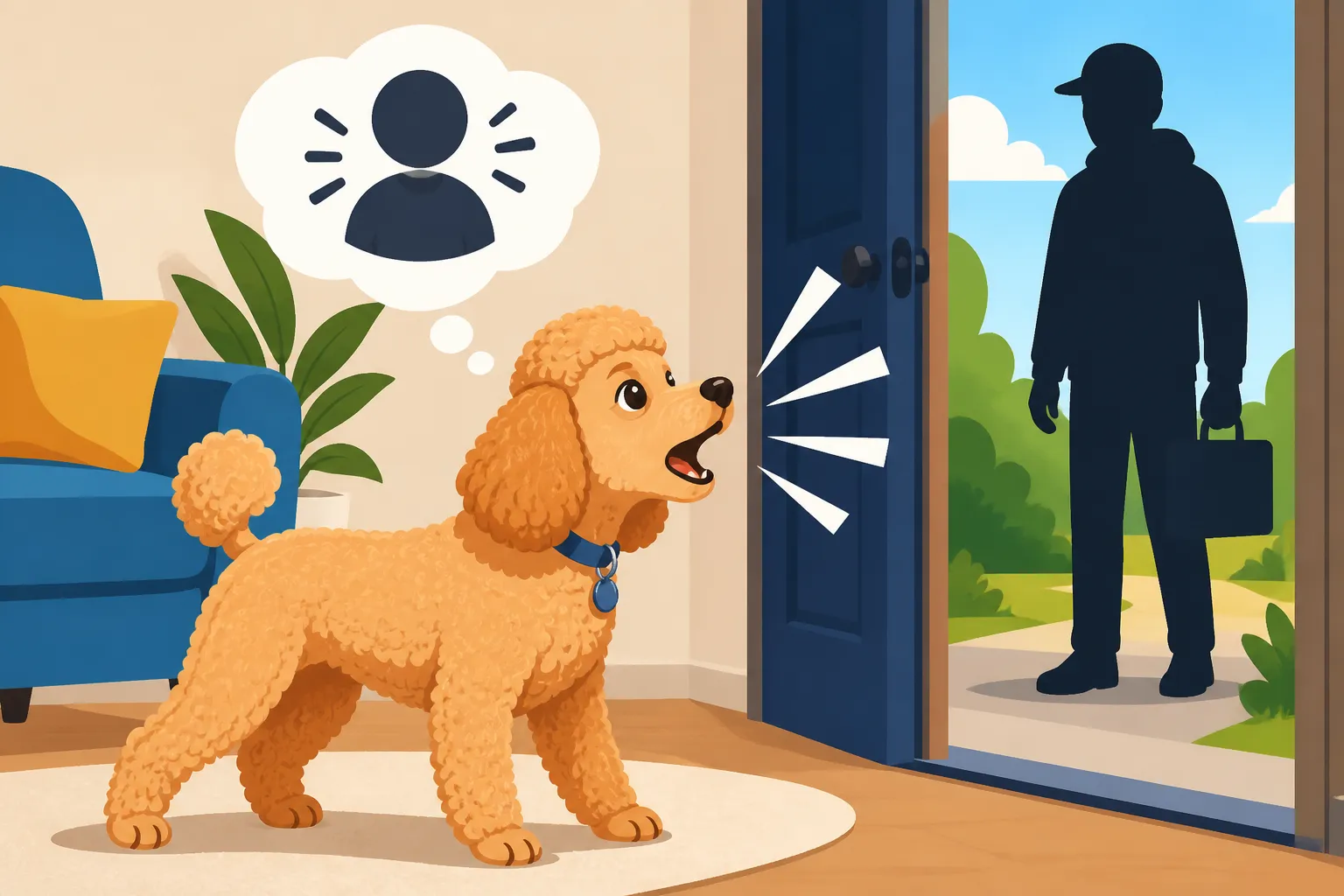
Why Poodles Bark at Visitors
It can be incredibly frustrating when your Poodle, a breed known for its elegance and intelligence, transforms into a barking machine the moment a guest steps through the door. This guide is here to help you understand the deep-rooted reasons behind your Poodle's vocal protests and provide actionable, empathetic strategies to teach them a calmer, more polite way to greet visitors.
The Poodle's Innate Watchdog Tendencies and Sensitivity
Beneath that perfectly coiffed exterior lies a dog with a rich history of work and purpose, far beyond simply looking pretty. Poodles, regardless of their size, possess a keen intellect and a sensitive nature that can contribute significantly to their vocal reactions to strangers entering their territory.
These aren't just decorative dogs; Poodles were originally water retrievers, tasked with flushing and fetching waterfowl for hunters. This job required them to be observant, alert, and often, quite vocal to communicate with their handlers. While the modern pet Poodle rarely sees a duck blind, those ancestral instincts for observation and communication remain. They are naturally attentive to their environment and quick to notice any perceived changes or intruders. Their highly intelligent minds are always processing, always taking note, and sometimes, this can lead to an overreaction when something new or unexpected occurs, like the arrival of an unfamiliar face.
What often surprises new Poodle owners is the breed's profound sensitivity. Poodles are incredibly attuned to the moods and energy within their household. They can pick up on subtle cues, changes in routine, and even the emotional state of their people. This sensitivity, while making them wonderfully empathetic companions, also means they can be easily startled or overwhelmed by new experiences, especially if not introduced carefully. A stranger at the door isn't just a new person; it's a disruption to their perceived calm, a potential threat, or an exciting new variable that demands a vocal response. Understanding this innate Poodle Temperament and Sensitivity is crucial to addressing their barking. They aren't trying to be difficult; they're reacting from a place of strong instinct and deep connection to their home and family.
Furthermore, many Poodles develop a strong sense of territoriality, even the smallest Toy Poodles. Their home is their castle, and their family is their pack. When a visitor approaches, their barking isn't necessarily aggressive; it's often an alert. They are, in their minds, informing you, their pack leader, that an outsider is present. They're doing their job, as they see it. This natural tendency to act as an alarm system is why we often refer to it as Poodle Alarm Barking. The challenge, then, isn't to silence them entirely, but to teach them how to alert appropriately and then settle, rather than continuing an endless barrage of barks.
Decoding the Triggers: Why Your Poodle Barks at Guests
Poodle barking at visitors isn't usually a one-size-fits-all problem; it stems from a variety of potential triggers, and often, a combination of them. Pinpointing why your Poodle barks is the first step toward effective management and training.
One of the most common underlying reasons for barking at visitors is actually fear or anxiety. It might not look like fear to us – it might seem aggressive or confrontational – but for many Poodles, a new person in their space can be genuinely intimidating. This can be exacerbated by a lack of proper socialization during their formative weeks and months. If a Poodle puppy wasn't exposed to a wide variety of people (different ages, genders, appearances), sounds, and environments in a positive way, they might grow up with an inherent wariness. When that doorbell rings, their instinct might be to sound the alarm, hoping the "threat" will retreat, or to create distance. A fearful Poodle might back away while barking, tuck their tail, or try to hide behind you. Recognizing these subtle signs of fear, rather than anger, is vital for responding appropriately.
On the flip side, some Poodles bark out of sheer excitement and overstimulation. They might associate visitors with happy greetings, extra attention, or even the chance of a dropped treat. When the doorbell rings, their internal excitement meter shoots through the roof, and barking becomes their outlet for all that pent-up anticipation. These Poodles might jump, wag their entire bodies, and generally behave like an enthusiastic (but chaotic) greeting committee. While this seems more positive than fear, it’s still an uncontrolled and often unwelcome behavior. The goal here is to teach them to channel that excitement into a calmer, more appropriate greeting.
A critical factor, as mentioned, can be a lack of adequate socialization. The crucial developmental period for puppies, often called the "fear period," occurs roughly between 8 and 16 weeks of age. During this time, every new experience can profoundly shape their adult personality. If a Poodle puppy misses out on positive, gentle introductions to a diverse range of people, sights, and sounds during The Weeks That Set a Poodle's Nerve, they may develop anxieties or wariness that manifest as barking later in life. Even an adult Poodle who wasn't well-socialized as a puppy can struggle, viewing new people as potential threats rather than opportunities for positive interaction.
Adding to these reasons, many owners inadvertently reinforce the barking behavior. Think about it: when your Poodle starts barking, what do you do? You probably try to quiet them, pick them up, or give them attention. Even negative attention can be perceived as a reward by a dog seeking interaction. If the barking also causes the visitor to pause, look away, or even leave (as they might if the barking is too intense), the Poodle learns that their vocalizations are effective at controlling the environment. This accidental reinforcement can make the behavior incredibly persistent, making it even more challenging to stop.
Finally, a lesser-known trigger can be barrier frustration. If your Poodle sees guests arriving but is confined behind a baby gate, on a leash, or in a crate, they might become frustrated that they can't investigate or greet properly. This frustration often boils over into barking. They might want to say hello (or investigate, or tell them off!), but the barrier prevents them, leading to a vocal display of annoyance and pent-up energy. Understanding these various motivations helps tailor your training approach, moving beyond simply telling them "no."
Practical Strategies to Cultivate Calm Greetings
Once you've started to understand why your Poodle barks, it's time to put practical strategies into action. Remember, consistency and patience are your best friends here. You’re teaching a new way of interacting, not just suppressing a behavior.
The very first step is often management. Before you even begin formal training, can you prevent the barking from happening? This might mean putting your Poodle in a separate room with a high-value chew toy or a puzzle feeder when you know guests are arriving. Or, perhaps, using a baby gate to keep them in a different area of the house where they can still hear and see, but are at a comfortable distance. This prevents the rehearsal of the unwanted barking behavior, which is crucial. Every time they bark at a guest, they're practicing and reinforcing that behavior. By managing the situation, you break that cycle.
Next, we move into desensitization and counter-conditioning. This is about changing your Poodle’s emotional response to visitors. Start small: have a friend or family member who your Poodle knows well, approach your front door (but not enter). As soon as your Poodle notices them but before they start barking, calmly give them a high-value treat. Repeat this many times. Gradually, have the friend knock lightly, then open the door slightly, always rewarding quiet behavior. The goal is for your Poodle to associate the sight and sound of an arriving visitor with delicious treats and positive feelings, rather than anxiety or over-excitement.
A game-changer for many Poodle owners is teaching a "Place" command. This involves training your Poodle to go to a specific spot – like a dog bed or mat – and stay there until released. This gives them a clear job to do when guests arrive. Start by simply luring them to their bed and rewarding them for sitting or lying down. Gradually increase the duration they stay, and then introduce distractions. Many owners find a comfortable, durable dog bed from a retailer like Amazon to be ideal for this purpose, providing a clear boundary for their "place." Once they reliably go to their "place" and stay, you can practice having guests arrive while your Poodle remains calmly on their spot, earning rewards for their good behavior. This teaches Teaching a Poodle to Wait Rather Than Guess, fostering impulse control.
When a visitor actually comes over, implement controlled introductions. Keep your Poodle on a leash initially, even if they're usually off-leash indoors. Ask your guest to completely ignore your Poodle when they first arrive – no eye contact, no talking, no petting. This lowers the pressure on your Poodle. Once your Poodle has settled and is quiet, then your guest can calmly offer a treat or a gentle pet. This teaches your Poodle that calm behavior is what gets them the desired interaction and rewards, not frantic barking.
Don't underestimate the power of addressing excess energy. A Poodle who hasn't had enough physical or mental stimulation is often more prone to barking and other undesirable behaviors. Before guests arrive, make sure your Poodle has had a good walk, a vigorous play session, or a brain-stimulating puzzle game. A tired Poodle is generally a more relaxed and quiet Poodle. Engaging their minds can be just as effective as physical exercise; activities like nose work or retrieving games can really help expend their mental energy. Giving their brilliant minds a job can also prevent unwanted behaviors, as a Poodle whose brain is idle can often find trouble. What a Poodle Does When Its Brain Is Idle can be a recipe for mischief and excessive barking.
Above all, consistency is absolutely vital. Every person in your household, and even frequent guests, needs to be on board with your training plan. If one person lets the barking slide or inadvertently reinforces it, it will undermine all your hard work. This can be challenging, but clear communication with your family and friends is key. For those who need a structured, step-by-step approach, an online training program like BAXTER & Bella can provide comprehensive guidance and consistent methods that everyone can follow, ensuring your Poodle gets the clear communication they need to succeed.
Here's a quick guide to some common barking motivations and how to approach them:
| Reason for Barking | Poodle's Motivation | Immediate Action | Long-Term Training Goal |
|---|---|---|---|
| Fear/Anxiety | Threat perception, insecurity | Create distance, block view, gentle reassurance | Counter-conditioning, confidence building |
| Excitement/Overstimulation | Seeking attention, joy | Ignore until calm, redirect to a "place" | Teach calm greetings, impulse control, "place" command |
| Territoriality | Protecting home/family | Manage view, strong "leave it" command, redirect | Desensitize to arrivals, reinforce quiet alerts |
| Lack of Socialization | Unfamiliarity, caution | Supervised, positive introductions, gradual exposure | Broaden positive experiences, build trust, "meet & greet" protocols |
| Barrier Frustration | Desire to interact, inability to reach | Remove barrier, allow controlled greeting, redirect | Teach polite greetings, "wait" command, "go say hello" cue |
When to Seek Professional Help and Why
While many Poodle barking issues can be managed with consistent home training, there are times when seeking professional guidance isn't just helpful, but essential. Knowing when to call in the cavalry can save you a lot of frustration and ensure your Poodle gets the best possible support.
You should seriously consider professional help if the barking is escalating or is accompanied by other concerning behaviors. If your Poodle's barking at visitors also includes growling, lunging, snapping, or attempts to bite, it's moved beyond a nuisance and into a more serious behavioral problem. These are clear signs of significant fear, anxiety, or aggression that require the expertise of a professional. Don't try to manage these behaviors on your own, as you could inadvertently make them worse or put yourself or others at risk.
The value of a certified professional dog trainer or a veterinary behaviorist cannot be overstated in these situations. A skilled professional can observe your Poodle's specific body language, identify subtle triggers, and accurately assess the underlying cause of the barking. They will develop a tailored training plan that uses positive, force-free methods, which are crucial for a sensitive breed like the Poodle. Harsh corrections or punishment can actually exacerbate fear and anxiety in Poodles, often leading them to shut down or become more reactive. As many Poodle owners know, Why a Poodle Shuts Down When Scolded is a common pitfall. A good trainer understands this and will guide you to build trust and confidence. If you're struggling to find the right expert, look for someone who prioritizes positive reinforcement and humane methods, ensuring you're Finding a Trainer Who Uses No Force on a Poodle.
In some severe cases, particularly when barking is driven by intense anxiety or phobias, a veterinary behaviorist might suggest medication as a tool to aid behavioral modification. It's important to understand that medication is rarely a standalone solution; it's typically used in conjunction with a comprehensive training and management plan. The goal of medication is to lower your Poodle's overall anxiety levels, making them more receptive to learning and less overwhelmed by their triggers. This allows the behavioral modification techniques to be more effective.
Finally, always rule out underlying health issues. Sometimes, what seems like a behavioral problem can actually be rooted in a physical ailment. Excessive barking, especially if it's a new behavior in an older Poodle, could be a sign of pain, discomfort, hearing loss, or even cognitive decline. A thorough check-up with your veterinarian is always a wise first step to ensure there isn't a medical reason for the change in your Poodle's behavior. Particularly as they age, Poodles can develop various conditions, and understanding Caring for an Aging Poodle means paying attention to subtle behavioral shifts that could indicate health concerns. Don't hesitate to consult with your vet to rule out any physical causes before diving deep into behavioral training.
Disclaimer
This article is for general informational purposes only and does not constitute professional advice. Laws, prices and regulations vary by location and change over time. Consult a qualified professional for guidance on your specific situation.