Whether Class Teaches a Poodle Anything New
If you're a Poodle owner, or considering becoming one, you've probably heard all about how incredibly smart these dogs are. It's true! Poodles are often ranked among the most intelligent breeds, and they pick things up at lightning speed. This often leads to a common question: if my Poodle is so clever and learns things so quickly at home, do formal training classes really teach them anything new? Or are they just a glorified review session, perhaps more for my benefit than theirs? This guide aims to explore just that, delving into the unique ways classes contribute to a Poodle's development, even when they seem to have the basics down pat.
The Poodle Brain: Already a Learning Machine
It's absolutely valid to wonder if a formal class can offer new insights to a Poodle. These dogs are practically born with a textbook in their paw, absorbing information from their environment like sponges. They observe, they deduce, and they are incredibly adept at figuring out what gets them what they want.
Poodle Intelligence and Its Double-Edged Sword
Poodles consistently rank near the top of canine intelligence lists, often second only to the Border Collie in studies like Dr. Stanley Coren's "The Intelligence of Dogs." What does this mean in real life? It means they can learn a new command or trick in a remarkably small number of repetitions – sometimes just a handful. They connect cause and effect rapidly. You might find yourself saying a new word once or twice, and suddenly your Poodle is offering the associated behavior. This quick uptake is fantastic for initial training, making Poodles a joy to work with. You'll often find that your Poodle knows what you want long before you've even fully articulated the cue.
However, this high intelligence can also be a double-edged sword. A smart Poodle who isn't sufficiently challenged can get bored. And a bored Poodle is often a creative Poodle, inventing its own games and shortcuts that might not align with your household rules. They might figure out how to open cabinets, or develop ingenious ways to counter-surf. Their ability to problem-solve can sometimes be directed towards things we'd rather they didn't do, simply because their brains are hungry for stimulation. It’s not uncommon for Poodle owners to describe their dogs as "too smart for their own good," and there’s a kernel of truth to that. You can read more about this in Why a Bright Poodle Gets Bored.
What a Poodle Picks Up at Home (and How Fast)
Even without structured training, Poodles are constantly learning. They learn your routines: the sound of your alarm means breakfast is coming, the jingle of keys means a walk, the rustle of a treat bag means a reward. They learn about the subtle shifts in your body language, your tone of voice, and even your mood. They are masters of observation, often anticipating your next move before you even make it. This innate ability to learn from their environment means that many Poodles come into a class already knowing a good chunk of the basic cues like sit, stay, and come, simply because their owners have been consistent in their daily interactions.
Many owners can teach their Poodles a solid "sit" or "down" in the quiet comfort of their living room with minimal effort. Their keen intelligence allows them to grasp the concept quickly. The challenge isn't necessarily getting them to understand what the cue means, but rather ensuring they generalize that understanding across different situations and distractions. This is where the home environment can sometimes fall short, and a class can step in to bridge that gap.
Beyond Basic Cues: The True Value of a Good Class
So, if your Poodle already knows "sit" and "stay," what more could a class possibly offer? A lot, actually. The value often isn't in teaching an entirely new behavior, but in strengthening, refining, and generalizing behaviors in ways that are difficult to replicate at home.
Proofing and Generalization in Distracting Environments
Imagine your Poodle, Percy, can flawlessly "stay" for three minutes in your quiet backyard. That's fantastic! But what happens when you ask Percy to "stay" at the local park, with squirrels chattering, children playing, and other dogs trotting by? Suddenly, that rock-solid stay might crumble. This isn't because Percy forgot the cue or isn't smart enough; it's because he hasn't generalized the behavior to a high-distraction environment. This is where a formal class truly shines.
Training classes provide a safe, controlled setting with built-in distractions: other dogs, new people, novel sounds, and smells. These elements are invaluable for "proofing" commands. Proofing means ensuring your dog can perform a cue reliably under various conditions, distances, durations, and distractions. A good instructor will guide you through exercises that gradually increase the level of distraction, helping your Poodle learn that "sit" means "sit," no matter if a squeaky toy is bouncing nearby or another Poodle is doing zoomies. This makes the training practical and dependable in real-world scenarios, which is essential for a well-behaved companion. For instance, Why Poodles Learn a Cue in Five Repetitions often refers to learning a new cue, but classes help make those quickly learned cues stick in all situations.
Addressing Specific Behavioral Challenges (and Owner Skill Gaps)
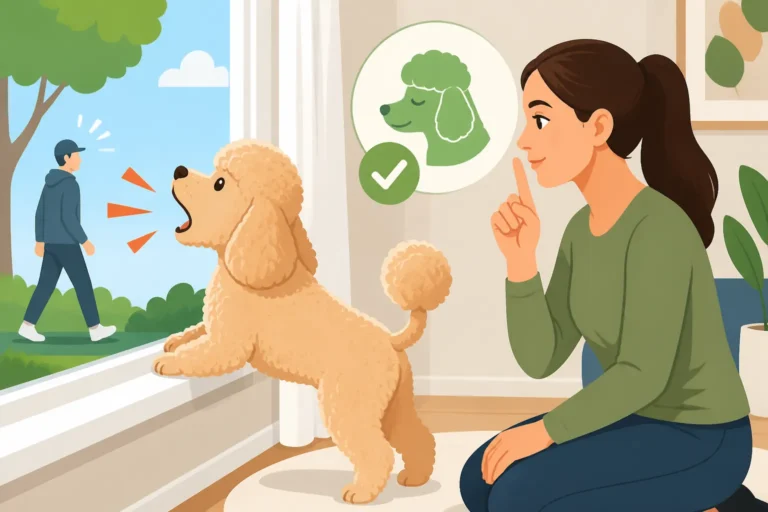
While Poodles are intelligent, they aren't perfect, and like all dogs, they can develop specific behavioral challenges. Maybe your Standard Poodle pulls like a freight train on the leash, or your Toy Poodle barks incessantly at every passing shadow. Perhaps your Miniature Poodle gets overly excited around other dogs and jumps on them. These aren't usually signs of a lack of intelligence; they're often habit-based behaviors or reactions stemming from underdeveloped social skills, excitement, or anxiety.
A skilled trainer in a class setting can help diagnose the root cause of these issues and provide targeted strategies. They can observe your Poodle's Reading a Poodle's Body Language and give you immediate feedback on your handling, timing, and consistency, which are crucial for effective training. For example, if your Poodle is reactive, the class might focus on counter-conditioning and desensitization techniques in a controlled environment, something very difficult to set up effectively on your own. They might introduce specific exercises for impulse control, like waiting patiently at a door or leaving a tempting treat. These aren't always about teaching a brand-new "trick," but about modifying ingrained responses and filling in the gaps in an owner's practical application of training principles.
The Social Arena: Learning Beyond Commands
Beyond the technical aspects of obedience, classes offer profound social and emotional benefits for Poodles, a breed known for its sensitivity and connection to its people.
Structured Socialization: Why a Poodle Needs More Than Just Dog Park Visits
Poodles, especially as puppies, thrive on appropriate socialization. While dog parks can be an option, they're often a free-for-all that can overwhelm sensitive Poodles or teach them bad habits. A structured class, however, provides a safe and controlled environment for Poodles to interact with other dogs and people. This isn't just about letting them run wild; it's about teaching them how to interact appropriately.
In a class, puppies learn bite inhibition during supervised play, and adult dogs learn to coexist and focus on their owners despite the presence of other canines. For a Toy Poodle around larger dogs, this controlled exposure is invaluable for building confidence and good manners. This structured environment is particularly helpful for Poodles who can be naturally wary of strangers or new situations if not properly introduced. They learn to associate other dogs and people with positive experiences, under the watchful eye of an instructor who can step in if interactions become too intense or fearful. This foundational social skill set is something you simply can't replicate reliably at home. The early weeks of a Poodle's life are critical for this, and a good puppy class helps set The Weeks That Set a Poodle's Nerve for future interactions.
Building the Handler-Dog Bond in a New Way
Training is a language, and a class provides a shared vocabulary for you and your Poodle. Working together in a new, stimulating environment strengthens your bond in unique ways. Your Poodle learns to look to you for guidance and reassurance amidst distractions, reinforcing your role as a trusted leader. You, in turn, learn to trust your Poodle's ability to focus on you even when the world is full of tempting smells and sounds.
The consistent, positive reinforcement methods used in modern dog training classes help build a strong, cooperative relationship based on mutual respect and understanding. This is especially vital for Poodles, who are often described as "Velcro dogs" due to their strong desire to be close to their people. The focused attention and teamwork required in a class deepens that connection, making your Poodle feel more secure and understood, and making you a more confident handler. This enhanced bond can be invaluable when dealing with more complex behaviors or simply enjoying a richer daily life with your intelligent companion.
The Human Element: Training the Trainer
Perhaps the most significant, often overlooked, benefit of dog training classes is that they aren't just for the dogs. They are equally, if not more so, for the humans at the other end of the leash. Even the most seasoned Poodle owner can gain new insights.
Decoding Poodle Cues and Intent
Poodles are expressive creatures, and they communicate constantly through their body language, vocalizations, and subtle actions. However, without guidance, it's easy for owners to misinterpret these signals. A class instructor can teach you how to better read your Poodle's cues, distinguishing between a polite request, a sign of stress, or a clever attempt to manipulate the situation. Learning to recognize Reading a Poodle's Body Language when they are uncomfortable, overly excited, or simply confused can prevent misunderstandings and build trust.
For example, a Poodle who stares intently might not just be "polite"; they could be engaging in a subtle form of resource guarding, or conversely, waiting for their next cue with eager anticipation. Understanding the nuances of their tail wags, ear positions, and even their gaze can profoundly improve your communication and responsiveness. This heightened awareness allows you to intervene proactively, addressing potential issues before they escalate, and rewarding desirable behaviors at precisely the right moment.
Refining Timing and Consistency
Training, at its heart, is about timing and consistency. You might know what to do, but when and how you do it makes all the difference. In a class, you receive immediate, constructive feedback from an experienced instructor. They can point out when your reward delivery is a fraction of a second too late, or when your body language is inadvertently giving your Poodle mixed signals. This kind of nuanced feedback is almost impossible to get when you're just training at home alone.
Poodles, being so intelligent, are quick to pick up on inconsistencies. If your timing is off, they might start "inventing their own shortcuts," trying different behaviors until they stumble upon the one that gets the reward, rather than consistently performing the correct one. Or, if you're not consistent with your cues, they might decide that a command is optional. A class helps you refine your mechanics, ensuring your cues are clear, your timing is precise, and your expectations are consistent. This precision empowers you to communicate more effectively with your Poodle, leading to faster learning and more reliable responses, even for things like Building Reliable Recall in a Standard Poodle.
Home Training vs. Structured Class Training for Poodles
To illustrate the distinct benefits, let's look at a comparison between what you can typically achieve with home training versus what a structured class adds to the equation for a Poodle.
| Feature / Benefit | Home Training (Self-Directed) | Structured Class Training (Instructor-Led) |
|---|---|---|
| Poodle's Learning | Quickly grasps basic cues; learns routines and expectations. | Generalizes cues to distractions; refines existing behaviors; builds confidence. |
| Environment | Low distraction; familiar and comfortable. | Controlled distractions (other dogs, people, sounds); novel scents. |
| Behavioral Focus | Basic obedience, house manners, individual tricks. | Proofing behaviors, impulse control, addressing reactivity, structured play. |
| Socialization | Limited to household members and planned interactions. | Supervised exposure to diverse dogs and people, teaching polite greetings. |
| Owner Skill Dev. | Self-taught, relies on videos/books; limited immediate feedback. | Expert guidance, immediate feedback on timing and mechanics; learning to read Poodle's cues. |
| Problem Solving | Trial-and-error; internet searches for advice. | Trainer helps diagnose issues, offers tailored solutions and demonstrations. |
| Bond Building | Strengthens through daily interactions and positive experiences. | Enhances bond through cooperative problem-solving and shared new experiences. |
| Motivation/Focus | Can become routine or boring without new challenges. | Keeps Poodle mentally engaged with new scenarios and challenges. |
Conclusion
So, does a training class teach a Poodle anything new? The answer is a resounding yes, though perhaps not always in the way you might initially think. While your Poodle might already be a whiz at basic commands in the calm of your home, a class provides the crucial elements of generalization, proofing, and structured socialization that are incredibly difficult to replicate on your own. It offers a "real-world" laboratory where those swiftly learned cues are tested and solidified under distraction.
More profoundly, a good class focuses as much on the human as it does on the canine. It teaches you, the owner, to be a more effective communicator, to understand your Poodle's subtle signals, and to refine your training mechanics for maximum impact. You might pick up new training tools and resources, like specialized puzzle toys or long lines you find on Amazon, or even discover online academies like BAXTER & Bella that supplement the in-person experience, but the direct feedback from an instructor is irreplaceable.
Ultimately, training classes don't just add a few more commands to your Poodle's already impressive repertoire. They build confidence, reinforce good manners in complex environments, and forge an even deeper, more nuanced partnership between you and your incredibly intelligent, sensitive Poodle. It's an investment in a lifetime of happy, well-adjusted companionship.
Disclaimer
This article is for general informational purposes only and does not constitute professional advice. Laws, prices and regulations vary by location and change over time. Consult a qualified professional for guidance on your specific situation.