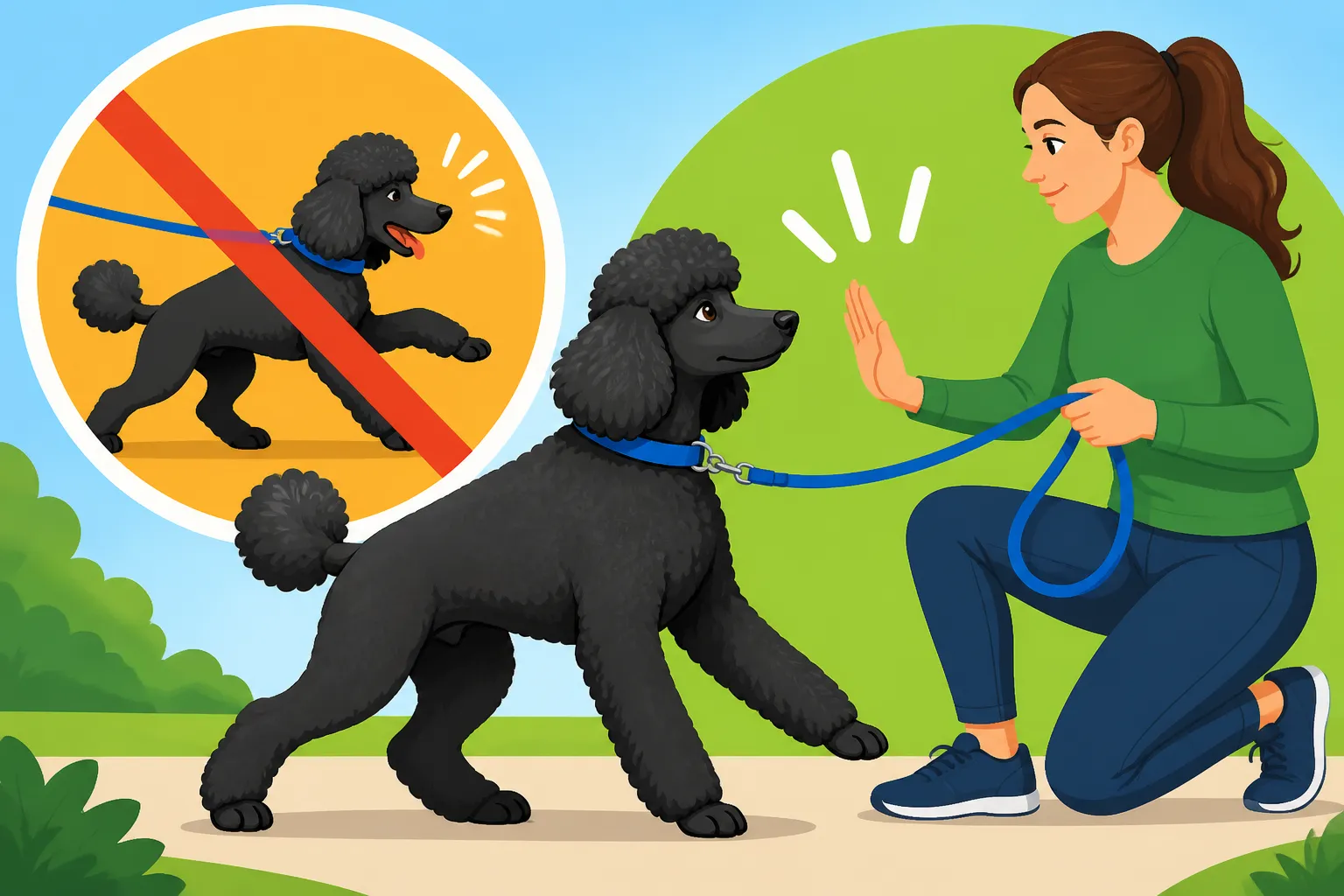
Stopping a Standard Poodle Pulling on Leash
One of the biggest frustrations for any Poodle owner is feeling like you're being dragged down the street by a freight train, especially if you have a powerful Standard Poodle. That daily walk, which should be a joy, can quickly turn into a wrestling match, leaving you with sore shoulders and a sense of dread instead of relaxation. This guide is here to walk you through proven, gentle methods to help your Standard Poodle learn to walk politely on a leash, making every outing a pleasure for both of you.
Understanding Why Your Standard Poodle Pulls
Before we can fix the pulling, it helps to understand why your Poodle is doing it. It’s rarely out of malice or defiance; more often, it's a combination of natural instincts, learned behaviors, and sheer excitement. Your Poodle isn't trying to be difficult, they're simply responding to the world in a way that makes sense to them.
The Poodle's Natural Drive and Energy
Let's be real: Standard Poodles are athletes. They were originally bred to be retrieving water dogs, which means they possess incredible stamina, intelligence, and a strong prey drive. When you step outside, the world is a symphony of smells, sights, and sounds, and your Poodle's natural instinct is often to investigate, to move, and to go. This isn't laziness on your part; it's simply their genetic programming kicking in. They have boundless energy that needs an outlet, and if the leash is the only thing dictating their pace, they're going to try and set it themselves. This can sometimes feel like your brilliant Poodle is just ignoring you, but it’s more likely their drive overriding their training in that moment. Understanding The Poodle Character can shed light on these inherent traits.
Lack of Early Leash Training Foundations
Often, the problem starts subtly when they're puppies. A tiny Toy Poodle or even a smaller Standard Poodle puppy pulling on a leash isn't a big deal; they're small, and it feels manageable. We often unwittingly reinforce the pulling by allowing them to get to where they want to go while dragging us. Then, they grow into magnificent, strong adults, and suddenly that cute little tug has become a full-body workout. If they were never explicitly taught not to pull, why would they stop? They've learned that pulling gets them closer to that interesting smell, that squirrel, or that person they want to greet. This is a common oversight, and it’s completely reversible with consistent training. For further insights on how their cleverness plays a role in training, consider Training the Second Smartest Dog Breed.
Excitement and the Environment
The world is a very exciting place for a Poodle. Every blade of grass has a story, every rustle in the bushes could be a rabbit, and every new person is a potential friend. When a Poodle is overwhelmed by stimuli – whether it's the smells from the park, the sound of traffic, or another dog walking by – their excitement levels can spike, making them forget all their good manners. They might pull with all their might just to get to that interesting thing, or to move away from something they perceive as scary. It’s not just about energy, it's about managing their emotional responses to their environment. Learning Reading a Poodle's Body Language can help you spot when they're getting overstimulated before the pulling truly starts.
Essential Tools for Leash Training a Standard Poodle
Choosing the right equipment isn't just about fashion; it's about safety, comfort, and providing you with the leverage and communication tools you need to effectively train your Poodle. There are a lot of options out there, and what works for one Poodle might not be ideal for another, so be prepared to try a couple of things to find your perfect fit.
Choosing the Right Leash and Collar
For a Standard Poodle, you’ll want a sturdy leash that's comfortable for you to hold. A 6-foot nylon or leather leash is a great standard choice, offering enough length for exploration without too much slack. Avoid retractable leashes, as they teach a dog that pulling extends their range, which is the opposite of what we want. They also offer very little control and can be dangerous if the dog bolts.
When it comes to collars, a flat buckle collar is perfectly fine for Poodles who already walk nicely. However, for a Poodle who pulls, it can put a lot of pressure on their delicate throat and trachea, which is uncomfortable and potentially harmful. You might consider a martingale collar, especially if your Poodle has a slender Poodle neck. These collars tighten just enough to prevent your Poodle from backing out of it, but unlike choke chains, they don't continuously apply pressure. They're a humane alternative that offers more control than a flat collar without causing pain. Always ensure any collar fits snugly but allows two fingers to slip underneath comfortably.
Harnesses: Front-Clip vs. Back-Clip
Harnesses distribute pressure across your Poodle's chest and shoulders, rather than their neck. This can be much more comfortable for a strong puller. But not all harnesses are created equal when it comes to leash manners.
- Back-Clip Harnesses: These are popular for casual walks and are generally comfortable. However, for a strong puller, a back-clip harness can actually engage their natural sled-dog instinct. When you pull back on the leash attached to their back, they can lean into it and pull even harder, using their full body strength. Many Poodles will find these harnesses don't do much to discourage pulling.
- Front-Clip Harnesses: These are often a game-changer for pullers. The leash attaches to a ring on your Poodle's chest. When your Poodle tries to pull forward, the leash connection redirects them gently to the side, turning their body back towards you. This makes it very difficult for them to get leverage to pull, and it discourages them from surging ahead. Brands like Blue-9 Balance Harness or the Easy Walk Harness are popular choices found easily on platforms like Amazon. They provide a much more effective way to manage a strong-willed Poodle while you're actively working on loose-leash training.
Here's a quick comparison:
| Equipment Type | Pros | Cons | Best For |
|---|---|---|---|
| Flat Collar | Simple, common, good for ID tags. | Can cause tracheal strain if dog pulls; easy to slip out of for some Poodles. | Poodles who already walk well on a leash. |
| Martingale Collar | Prevents slipping out; less pressure than choke chains. | Still applies pressure to the neck if pulling; must be fitted correctly. | Poodles prone to backing out of collars; moderate pullers. |
| Back-Clip Harness | Comfortable, distributes pressure, good for dogs who don't pull much. | Can encourage pulling by engaging opposition reflex; less control for strong pullers. | Casual walks for non-pullers; good for smaller dogs or seniors. |
| Front-Clip Harness | Discourages pulling by redirecting dog; no pressure on neck or trachea. | Can sometimes tangle legs if not fitted well; might require an adjustment period for some dogs. | Strong pullers of any size, especially Standard Poodles. |
| Head Halter | Excellent control, gently steers the dog's head. | Can be initially resisted by some dogs; requires careful introduction. | Very strong pullers; dogs with neck/tracheal issues. |
Long Lines for Safe Practice
A long line, typically 15 to 30 feet in length, isn't for your everyday neighborhood walk, but it's an invaluable tool for certain aspects of loose-leash training and recall. It allows your Poodle to have more freedom to explore in a safe, open area like a park, while you still maintain a connection. This is fantastic for practicing recall in a controlled environment, letting them sniff and run a bit without ever truly being off-leash.
Using a long line can also help bridge the gap between structured leash work and more natural exploration. Just remember to attach it to a harness, not a collar, to prevent neck injuries if your Poodle suddenly hits the end of the line at a run. Long Line Work With a Poodle can offer more guidance on how to use this tool effectively.
Step-by-Step Training for a Loose Leash Walk
Now for the fun part: the actual training! Remember, consistency and patience are your best friends here. Your Poodle is smart, but they need clear communication and plenty of positive reinforcement to understand what you're asking.
Starting in a Low-Distraction Environment
Rome wasn't built in a day, and loose-leash walking isn't learned on a bustling city street. Start your training in a place where your Poodle can focus on you without too many exciting distractions. This might be your living room, a quiet backyard, or a cul-de-sac during off-peak hours. The goal is to set your Poodle up for success.
Begin by simply walking a few steps. As soon as the leash is loose – meaning there's a gentle curve in it, not a taut line – mark the behavior with a verbal cue like "Yes!" or a clicker, and immediately reward with a high-value treat. Then, take a few more steps. If your Poodle pulls, simply stop. Don't yank or scold; just become a tree. They'll eventually turn to look at you, or the leash will slacken. The moment it's loose, praise and treat, then start walking again. This teaches them that a loose leash earns movement and rewards, while a tight leash means nothing happens.
The "Stop-Start" Method for Poodles
This is perhaps the most effective method for teaching a Poodle that pulling gets them nowhere. It’s exactly what it sounds like, and it leverages your Poodle's desire to keep moving.
- Start Walking: Begin your walk in a straight line.
- Poodle Pulls: The very instant your Poodle pulls ahead and the leash becomes taut, stop dead in your tracks. Don't say anything, don't yank. Just stop.
- Wait for Slack: Wait for your Poodle to realize that forward motion has ceased. They might turn to look at you, sniff the ground, or simply stand there. The key is to wait for any amount of slack to return to the leash.
- Reward and Resume: The moment the leash goes slack, even for a second, say "Yes!" or click, give a high-value treat, and immediately start walking again.
- Repeat: Do this every single time your Poodle pulls. It requires immense patience on your part, especially in the beginning, but your Poodle will quickly connect the dots: pulling stops the fun, a loose leash keeps the walk going.
This method is incredibly clear and consistent. Your Poodle, with their remarkable intelligence, will soon understand the pattern. Remember, a Standard Poodle needs consistent Daily Exercise for a Standard Poodle, so making these training walks part of their routine is crucial.
Rewarding the Right Behavior
Positive reinforcement is paramount with sensitive Poodles. They respond beautifully to praise, treats, and affection. Keep a pouch full of small, high-value treats – something truly irresistible like tiny pieces of cooked chicken, cheese, or specialized training treats (you can find a huge variety on Amazon).
- Frequency is Key: In the beginning, reward constantly for a loose leash. Every few steps if they're doing well.
- Vary Rewards: Don't just rely on treats. Sometimes a "Good dog!" and a happy tone of voice is enough. Sometimes a brief moment to sniff something interesting can be a reward for a period of loose-leash walking.
- Focus on the "Sweet Spot": Reward your Poodle when they are walking nicely by your side, not just when they stop pulling. This teaches them where you want them to be, not just what not to do.
You can also incorporate a verbal cue like "Let's go!" or "Heel!" as you reward them for walking by your side. This helps build a positive association with that position. Companies like BAXTER & Bella offer online training programs that can provide structured guidance and video examples for these techniques, which can be invaluable.
Gradually Increasing Distractions
Once your Poodle is consistently walking nicely in a low-distraction environment, it's time to slowly introduce more challenges. This is where many owners go wrong, jumping from the quiet living room to the busy dog park.
- Slightly Busier Areas: Move to a slightly busier street, but still avoid peak times.
- Introduce Sights and Sounds: Walk past an area where there might be other dogs behind a fence, or where children are playing at a distance.
- Controlled Greetings: If your Poodle is a strong puller towards other dogs or people, work on their focus on you first. Practice "look at me" exercises before allowing greetings. If you do allow greetings, ensure the leash is slack before they approach.
- Practice Leash Manners for a Standard Poodle in varied environments: The more places you practice, the more generalized the behavior becomes. Your Poodle needs to learn that loose-leash walking applies everywhere.
Remember to always revert to an easier environment if your Poodle struggles. It's better to end a session on a high note in a less distracting place than to push too hard and get frustrated.
Common Challenges and Troubleshooting
Even with the best tools and methods, training isn't always a smooth, straight line. There will be days when your Poodle seems to forget everything you've taught them. Don't despair! This is normal, and troubleshooting these challenges is part of the journey.
When Your Poodle Ignores You on Walks
It can feel disheartening when your brilliant Poodle, who can learn a new trick in minutes, seems completely oblivious to your existence the moment you step outside. This isn't usually defiance; it's often over-arousal or simply that the environment is far more rewarding than you are in that moment.
- Increase Your Value: Are your treats high enough value? Is your praise enthusiastic enough? In a distracting environment, a dry kibble won't cut it. You need something truly irresistible.
- Reconnect Regularly: Make it a habit to check in with your Poodle every few steps. Call their name, wait for eye contact, reward. This builds a strong bond and teaches them to look to you even amidst distractions.
- Change Direction Frequently: If your Poodle is forging ahead, simply turn and walk the other way. This forces them to pay attention to you to avoid getting left behind. It's a gentle, non-aversive way to make them focus.
- Pre-Walk Play: Sometimes, a quick game of fetch in the yard before a walk can help burn off some of that initial excess energy, making them more capable of focusing during the actual training walk. A Standard Poodle often needs more than just a walk; they need mental and physical stimulation to prevent boredom and undesirable behaviors. Find out more about Poodle Energy by Size to tailor activities.
Dealing with Reactive Pulling
Some Poodles don't just pull because they want to sniff something; they pull and lunge because they are reacting to other dogs, people, or even cars. This is a more complex issue that often stems from fear, excitement, or frustration. Simply stopping won't always work here, as the Poodle's emotional state is too high.
- Management First: Use a front-clip harness or a head halter for better control, especially if your Poodle is strong. This ensures safety for both of you.
- Increase Distance: The most crucial step is to identify your Poodle's "threshold." This is the distance at which they can see their trigger (e.g., another dog) without reacting negatively. Start far away, where they barely notice the trigger.
- Positive Association: When your Poodle sees their trigger at a comfortable distance, immediately start feeding them high-value treats. The goal is to change their emotional response from "OMG, a dog!" to "OMG, a dog means chicken!"
- Gradual Approach: Slowly, over many sessions, decrease the distance as long as your Poodle remains calm and focused on you. If they react, you've pushed too close, too fast. Increase the distance again.
- Seek Professional Help: If reactivity is severe or you're feeling overwhelmed, don't hesitate to consult a certified professional dog trainer or behaviorist. They can provide tailored guidance.
Consistency is Key
This can't be stressed enough: everyone who walks the Poodle must be on the same page. If one family member lets them pull, and another tries to enforce loose-leash walking, your Poodle will be confused and progress will be slow, if it happens at all.
- Family Meeting: Get everyone together and agree on the training methods and rules.
- Practice Short Sessions: You don't need an hour-long training session every day. Short, frequent sessions (5-10 minutes) several times a day are often more effective, especially in the beginning.
- Don't Give Up: There will be setbacks. Some days will be frustrating. But with consistent effort, your intelligent Poodle will learn. Your shared walks will transform from a chore into a truly enjoyable experience for both of you. This consistent approach is also vital for general Poodle Recall Training and other obedience skills.
Disclaimer
This article is for general informational purposes only and does not constitute professional advice. Laws, prices and regulations vary by location and change over time. Consult a qualified professional for guidance on your specific situation.