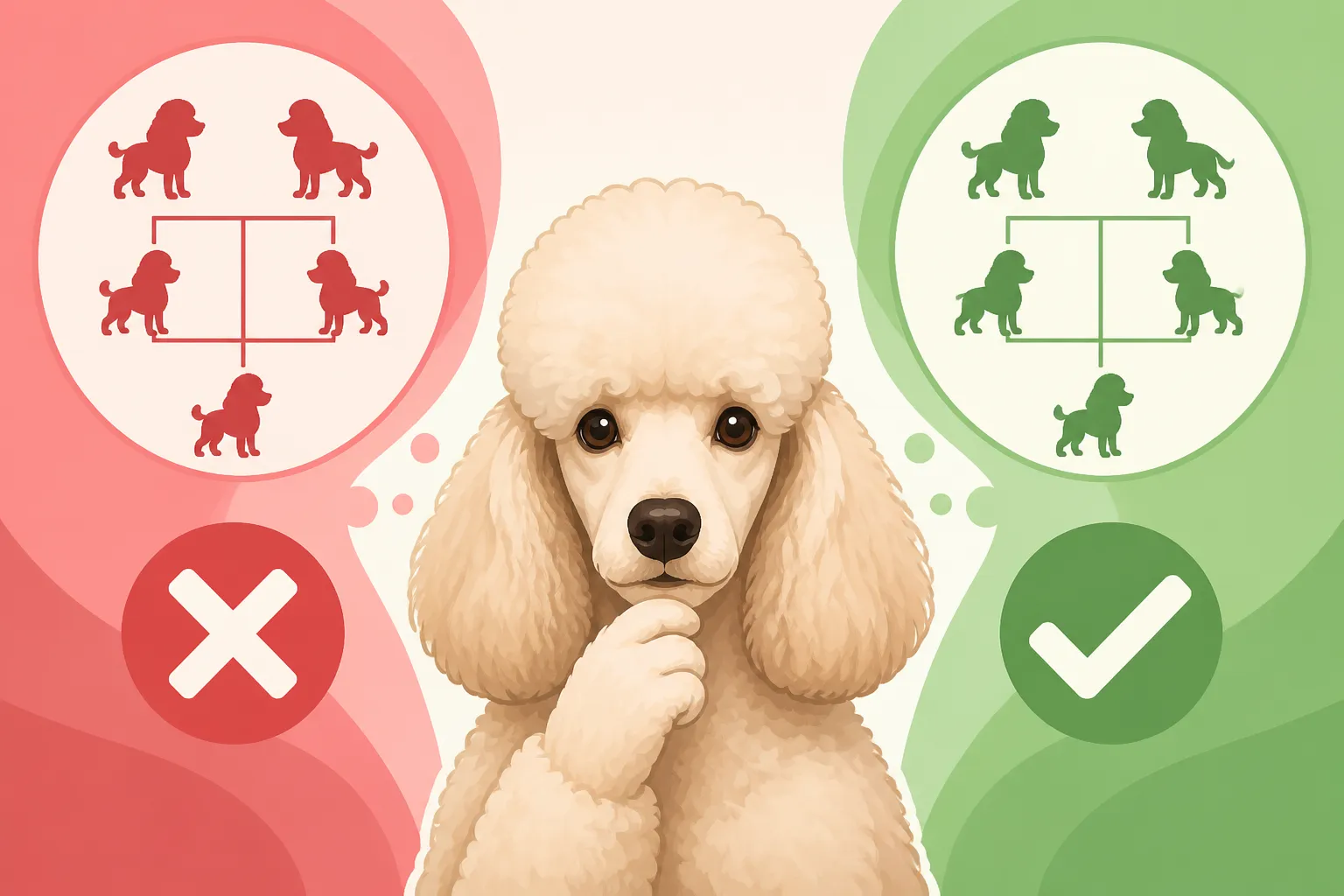
Whether a Coefficient of Inbreeding Matters in Poodles
It’s a deeply unsettling feeling when you’re trying your absolute best to find a healthy Poodle puppy, doing all your research, and then you stumble upon complex terms like “Coefficient of Inbreeding” or "COI." Suddenly, what seemed like a straightforward quest for a furry family member feels like a genetics exam. You just want a healthy dog, but the worry about hidden health problems is real. This guide aims to demystify the Coefficient of Inbreeding, explain why it matters so much for Poodles, and empower you with the knowledge to make informed decisions for your future companion.
Understanding the Coefficient of Inbreeding (COI)
When we talk about a dog's health and potential genetic predispositions, the Coefficient of Inbreeding often comes up. It sounds incredibly scientific, perhaps even intimidating, but at its heart, it's a simple concept that has profound implications for the well-being of our beloved Poodles.
What COI Actually Means
In plain language, the Coefficient of Inbreeding (COI) is a fancy way of expressing the probability that a dog has inherited identical genes from both its mother and father, simply because those parents are related. Think of it like this: if you have a family tree, and you notice the same ancestor appearing on both your mother's and father's sides, then you have some degree of inbreeding in your lineage. The COI calculates the percentage chance that a random gene selected from your dog's DNA came from the same ancestor on both sides of their family tree. A COI of 0% means there are no common ancestors in the known pedigree, implying no inbreeding. A higher percentage indicates a closer relationship between the parents, and thus a greater likelihood of homozygous genes (meaning the dog has two identical copies of a particular gene).
This isn't just about "bloodlines" or abstract genetic concepts; it directly translates to what's happening inside your dog's cells. When a dog inherits two identical copies of a gene from each parent, it becomes homozygous for that gene. If that gene happens to carry a detrimental recessive trait – like one for a specific disease – and the dog gets two copies, it will express that disease. If the parents are closely related, the chances of both passing on that same problematic recessive gene are significantly higher.
Why COI is Crucial for Poodles
For Poodles, understanding COI is not just important, it's critical. The Poodle breed, across all three sizes, has a history that, while leading to their remarkable intelligence and beauty, also created some genetic bottlenecks. The breed's popularity over decades, coupled with practices like line breeding (a controlled form of inbreeding often used to fix desired traits), has inadvertently led to a narrowing of the gene pool in certain lines. This reduced genetic diversity means there's less variation in the genes within the breed as a whole. You can learn more about Why the Standard Poodle Gene Pool Narrowed in our other resources.
When a gene pool shrinks, the undesirable recessive genes that might normally be hidden within a diverse population suddenly have a higher chance of pairing up. This is why Poodles, unfortunately, are susceptible to a range of inherited conditions, some of which are thought to be exacerbated by generations of tight breeding. Diseases like Sebaceous Adenitis and the Poodle Coat, a painful skin condition, or Addison's Disease in Standard Poodles, an autoimmune disorder, are examples where a narrowed gene pool is suspected to play a significant role. Without sufficient genetic diversity, the breed struggles to adapt and throw off these challenges, making the COI a vital metric for assessing potential genetic vulnerability.
Interpreting COI Scores for Poodles
So, you understand what COI means, but what do those numbers actually tell you? It's not enough to just know a number; you need to understand its context, especially when it comes to a breed like the Poodle.
What is a "Good" COI Score?
There isn't a universally "perfect" COI score, but the general consensus among geneticists and responsible breeders is that lower is better. Many breed clubs and geneticists suggest aiming for a COI below 10% over five generations, and ideally even lower, like below 6.25%. Some experts, particularly from institutions like UC Davis Veterinary Genetics Lab, advocate for a COI below 5% for optimal health.
To give you some perspective:
- 0% COI: Indicates no common ancestors within the traced pedigree. This is rare and often means the pedigree isn't very extensive, or it's a true outcross.
- Below 5% COI: Generally considered excellent. This level typically indicates a healthy degree of genetic diversity.
- 5-10% COI: This range is often seen as acceptable by many, especially if the pedigree is extensive and includes many generations with no common ancestors. It shows a thoughtful approach to breeding that balances type with genetic health.
- 10-20% COI: This starts to enter a concerning territory. While not an immediate red flag if the ancestors were incredibly healthy and longevity was proven, it signals a significantly higher risk for recessive genetic diseases and potentially compromised immune systems.
- Above 20% COI: This is considered very high and carries substantial risks. Breeding at this level often indicates close family relationships (e.g., father-daughter, full sibling pairings) in the recent generations, which can have severe health consequences.
It's important to remember that a COI score is calculated based on the known pedigree. If a pedigree only goes back three generations, the COI might appear lower than it truly is if there are shared ancestors further back that aren't included in the calculation. Always ask breeders how many generations their COI calculation covers.
The Impact of High COI on Poodle Health
A high Coefficient of Inbreeding isn't just a number; it's a warning sign for potential health complications. The most significant impact of high COI is the increased likelihood of expressing recessive genetic diseases. Every dog carries some recessive genes that, if paired with another copy, can lead to serious health issues. Inbreeding dramatically increases the chances of this pairing. For Poodles, this can mean a higher incidence of conditions we already mentioned, such as:
- Autoimmune diseases: Poodles are prone to several, including Addison's disease and sebaceous adenitis. A compromised immune system, often a consequence of high COI, can make them more vulnerable. You can learn more about Why Standard Poodles Carry Two Autoimmune Diseases.
- Eye conditions: Certain forms of inherited blindness, like Progressive Retinal Atrophy in Miniature Poodles, are recessive. High COI increases the risk of these genes pairing up.
- Cancer: Some studies suggest a correlation between higher inbreeding levels and increased cancer rates in various dog breeds, including Poodles.
- Reduced overall vitality: Dogs with high COI may also suffer from a general lack of vigor, smaller litter sizes, lower fertility, and a reduced lifespan. Their immune systems can be weaker, making them more susceptible to common infections or making recovery from illness more challenging.
When looking at a puppy from a litter with a high COI, you're essentially taking on a greater statistical risk that your Poodle will face one or more of these genetic challenges during their lifetime. While responsible pet insurance providers like Healthy Paws can certainly help mitigate the financial burden should a genetic condition arise, preventing it through thoughtful breeding is always the primary goal.
How Responsible Breeders Use COI (and How You Can Too)
Finding a healthy Poodle isn't just about luck; it's about diligence, asking the right questions, and understanding the tools responsible breeders use. COI is one of the most powerful tools in a breeder's arsenal, and as a prospective owner, it should be in yours too.
Researching a Poodle's Pedigree and COI
A reputable Poodle breeder will be transparent about the COI of their litters and the breeding pair. They'll often provide access to comprehensive pedigree databases, or use resources like the Orthopedic Foundation for Animals (OFA) website, which might contain information on registered Poodles and their health testing, sometimes including COI calculations. Breed club databases or even online tools like the Poodle Health Registry can also be invaluable.
When speaking with a breeder, don't be shy about asking:
- "What is the Coefficient of Inbreeding for this litter?"
- "How many generations does that calculation cover?"
- "Can I see the pedigrees for both parents, going back at least five generations?"
A breeder who understands and prioritizes genetic health will not only have these answers readily available but will also be able to explain their breeding choices in relation to COI. They might discuss how they balance the desire to maintain specific breed characteristics (like temperament or conformation) with the necessity of maintaining genetic diversity.
Balancing COI with Other Health Screenings
While COI is a critical piece of the puzzle, it's not the only piece. It works hand-in-hand with other vital health screenings. A low COI doesn't guarantee a healthy dog if the individual parents carry known genetic issues that aren't being screened for. Conversely, a slightly higher COI might be acceptable if the parents have exceptionally clean health records and excellent longevity in their lines.
Responsible breeders will go beyond just COI and conduct a battery of tests for common Poodle ailments, relevant to the specific Poodle size they breed. This includes:
- OFA (Orthopedic Foundation for Animals) certifications: For hips, elbows, and sometimes patellas (especially for Toy and Miniature Poodles to check for Luxating Patella in Toy and Miniature Poodles).
- Eye exams: By a board-certified veterinary ophthalmologist to screen for conditions like Progressive Retinal Atrophy.
- Thyroid panels: To check for Thyroid Disease in Poodles.
- Von Willebrand disease (vWD) testing: For bleeding disorders.
- Genetic panels: Many breeders now run comprehensive Genetic Panels for the Three Poodle Sizes through labs like Embark or Paw Print Genetics, which screen for dozens of specific conditions.
Think of it this way: COI is about overall genetic risk, while individual health tests are about specific known risks. You want a breeder who addresses both, aiming for a robust, healthy Poodle from every angle. Understanding What a Poodle Breeder Must Test For will empower you to ask the right questions.
The Role of Outcrossing and Linebreeding
Breeders manage COI through different strategies. Linebreeding is a form of inbreeding where ancestors appear multiple times further back in a pedigree, but not in the immediate generations. It's used to concentrate desired traits and "fix" them within a line. When done carefully and thoughtfully, with extensive health testing and an eye on COI, it can produce excellent dogs. However, if done carelessly or too intensely, it can quickly elevate COI and genetic risk.
Outcrossing, on the other hand, involves breeding two unrelated individuals. This is the primary way to reduce COI and introduce new genetic diversity into a line, helping to dilute recessive genes and improve overall health and vigor. A responsible breeder will use a combination of these techniques, sometimes strategically outcrossing to bring down the COI of a particular line, then carefully linebreeding on the healthier, more diverse stock. This dynamic approach helps ensure the longevity and health of the Poodle breed for generations to come.
Long-Term Implications of COI for Poodle Health
The decisions made by breeders today, particularly regarding COI, have ripple effects that extend far beyond a single litter. They impact the entire breed's health for decades, even centuries. As a Poodle enthusiast, understanding these long-term implications helps you become a more informed advocate for the breed.
The Importance of a Diverse Gene Pool
A healthy, diverse gene pool acts as a biological safety net. It means that within the breed, there's a wide variety of genetic material available. This diversity is crucial for several reasons:
- Resilience against disease: With a diverse gene pool, it's less likely that a significant portion of the breed will be susceptible to the same new disease or pathogen. Different individuals will have different genetic defenses, allowing some to survive and pass on their resistance.
- Adaptability: Over time, environments change, and so do the challenges dogs face. A diverse gene pool provides the raw material for natural selection to work with, allowing the breed to adapt and remain robust.
- Avoiding genetic 'drift': Without conscious effort to maintain diversity, a breed can unintentionally lose valuable genes over generations, simply due to chance or selection for aesthetic traits over health.
When we prioritize low COI and broad genetic diversity, we're not just looking at the health of one puppy; we're contributing to the overall health and future viability of the entire Poodle breed. It's a commitment to ensuring that Poodles remain healthy, happy companions for many more generations.
Advocating for Lower COI in the Breed
As a prospective Poodle owner, you have a powerful role to play in advocating for healthier breeding practices. By asking questions about COI, demanding transparency, and choosing breeders who prioritize genetic diversity, you send a clear message. You are supporting breeders who are making tough, responsible choices for the long-term health of the breed, rather than those who might prioritize convenience, rapid production, or extreme conformation traits without considering the genetic consequences.
Don't be afraid to walk away from a breeder who can't or won't discuss COI, or who presents high COI numbers without a clear, reasoned explanation and a history of exceptional health in their lines. Your choice directly influences the market, encouraging more breeders to adopt practices that benefit the Poodles we all love. It's about being an educated consumer and a responsible pet parent, ensuring that your Poodle has the best possible start to a long, healthy life.
Navigating COI: A Quick Reference
To help you remember these key points about COI, here's a handy table summarizing what different percentages might indicate:
| COI Range (5-7 Generations) | General Interpretation | Potential Implications for Poodles | Action for Prospective Owners |
|---|---|---|---|
| 0% | Ideal, but often indicates incomplete pedigree or true outcross. | Excellent genetic diversity. | Inquire about completeness of pedigree. |
| < 5% | Excellent, low risk. | Very good genetic diversity, lower risk of recessive diseases. | Highly desirable. |
| 5% – 10% | Acceptable to good. | Managed risk, often balancing type with diversity. | Inquire about parental health and longevity. |
| 10% – 20% | Moderately high risk. | Increased risk for recessive diseases, potentially weaker immune system. | Proceed with caution, strong inquiry into specific health testing and lineage. |
| > 20% | High to very high risk. | Significant risk for serious genetic health issues. | Avoid or require extensive, proven health track record over many generations. |
Disclaimer
Please remember that the information provided in this guide is intended for educational purposes only and should not be considered a substitute for professional veterinary advice. Always consult with a qualified veterinarian regarding your Poodle's specific health concerns.