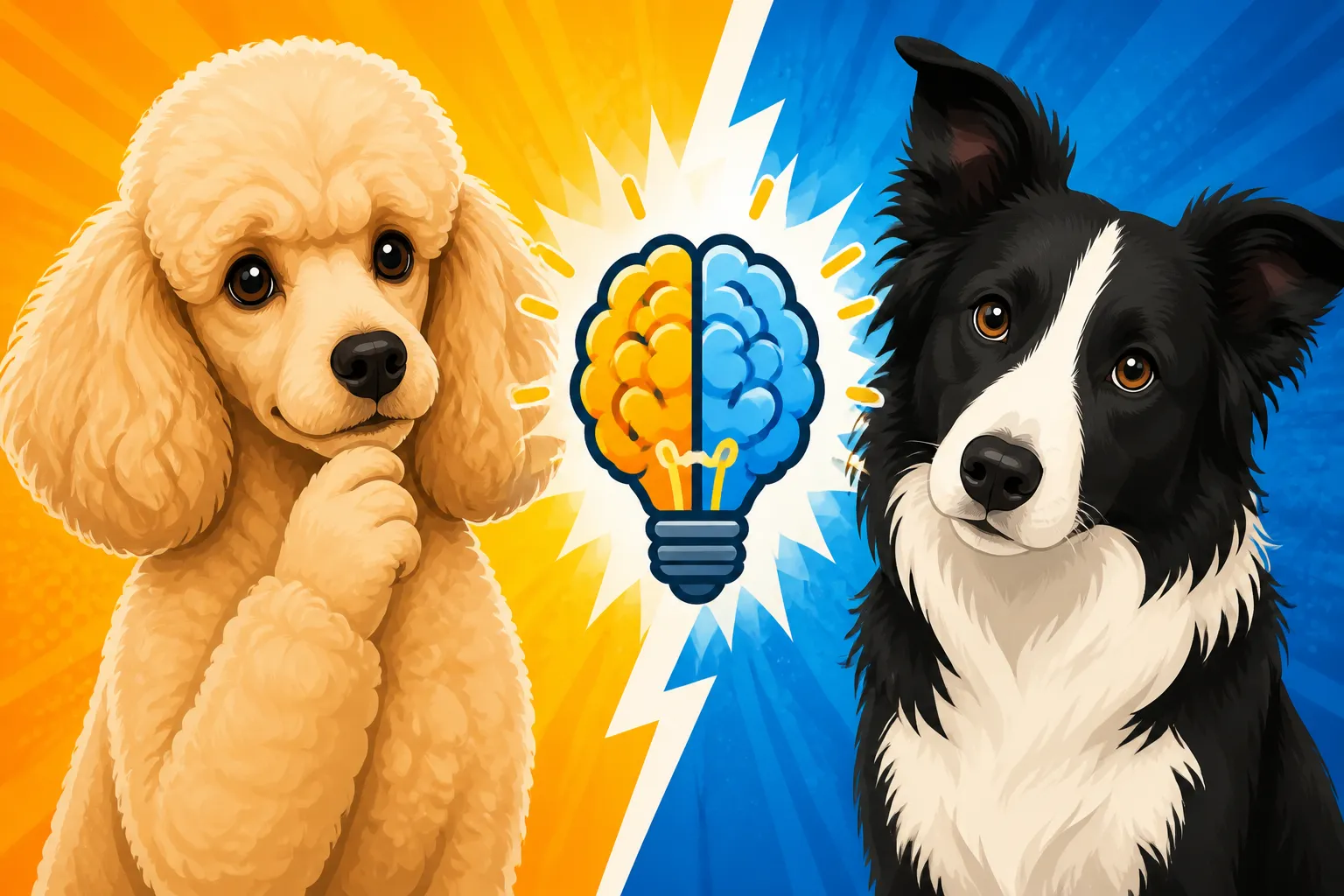
Whether a Poodle Is Smarter Than a Border Collie
It's a question that dog lovers and potential owners often ponder: just how smart is my chosen breed, especially when pitted against another notoriously brainy canine? The idea of comparing a Poodle's intelligence to that of a Border Collie often sparks lively debates, and frankly, it's easy to get caught up in the numbers and rankings, feeling like you need the "smartest" dog to truly connect. This guide will unpack the fascinating ways both Poodles and Border Collies display their impressive intellect, helping you understand not just how they're different, but why their unique brains make them such wonderful, if sometimes challenging, companions.
Understanding Canine Intelligence Rankings
When we talk about dog intelligence, many people immediately think of scientific studies or those popular lists that rank breeds from one to 100. While these rankings offer an interesting starting point, they don't tell the whole story. Canine intelligence is a complex tapestry, and how a dog expresses its smarts can vary wildly based on its breed, upbringing, and individual personality. It's not a single, measurable quantity like height or weight.
Coren's Rankings and Their Limitations
The most widely cited intelligence ranking comes from Dr. Stanley Coren, a professor of psychology, who evaluated breeds based on their "working and obedience intelligence." His methodology primarily assessed how quickly a dog learned a new command and how reliably it responded to known commands. In his widely influential book, The Intelligence of Dogs, Coren famously placed the Border Collie at number one, with the Poodle hot on its heels at number two.
Now, that's certainly impressive for both breeds! But here's the catch: Coren's ranking specifically zeroes in on a particular type of intelligence – what we might call "school smarts" or, more accurately, "trainability." It measures a dog's ability to understand and execute human commands, which is incredibly valuable, especially for working dogs. A Border Collie's lightning-fast grasp of new cues, often in just a handful of repetitions, is a testament to this, as is the Poodle's remarkable ability to Why Poodles Learn a Cue in Five Repetitions. However, this metric doesn't fully capture a dog's problem-solving skills in novel situations, its emotional intelligence, or its innate breed-specific talents. It's like judging a fish on its ability to climb a tree; it excels in its natural environment, but that environment isn't a classroom. What Coren Measured to Rank the Poodle is a great resource if you want to dive deeper into the specifics of his methodology.
Different Facets of Dog Intelligence
Beyond the obedience-focused intelligence Coren studied, canine intelligence can be broadly categorized into a few key areas, each equally valid and impressive in its own right:
- Adaptive Intelligence: This is a dog's ability to learn from its environment and solve problems independently. Think of a dog figuring out how to open a childproof gate, or creatively getting to a treat hidden in a puzzle toy. This often involves trial-and-error, observation, and memory. Poodles, with their inherent cleverness, often excel here, showing a capacity for reasoning that can sometimes make them seem almost human in their thought processes. They are often figuring out ways to get what they want.
- Instinctive Intelligence: This refers to the specific talents a dog is born with, honed over generations for a particular purpose. Herding, hunting, guarding, retrieving – these are all forms of instinctive intelligence. A Border Collie's innate ability to gather and move livestock, even without explicit training, is a prime example. The Poodle's natural retrieve and love for water stem from its own instinctive intelligence as a former water fowl hunter. These instincts aren't "learned" in the same way an obedience command is; they are hardwired.
- Emotional Intelligence: While harder to quantify, this involves a dog's capacity to understand and respond to human emotions, as well as interact effectively with other animals. Poodles, known for their sensitivity and close bond with their families, often display high emotional intelligence, sensing when their owner is upset and offering comfort. This isn't about following a command, but about understanding and empathizing.
So, when we ask "whether a Poodle is smarter than a Border Collie," we're really asking which type of intelligence we're prioritizing. Both breeds are undeniably brilliant, but they express that brilliance in ways that reflect their historical purposes and intrinsic natures.
The Border Collie's Strengths in "Working Intelligence"
The Border Collie stands as a testament to centuries of selective breeding for a very specific, demanding job: herding sheep. Their intelligence is deeply intertwined with this purpose, resulting in a dog that is incredibly focused, driven, and responsive.
Bred for Purposeful Work
Imagine a vast, open field, hundreds of sheep, and one shepherd relying on a dog to move that flock with precision and control. This is the environment that shaped the Border Collie. They weren't bred to simply herd, but to think while herding. This means understanding subtle cues from their handler, anticipating the movement of the flock, and making independent decisions when necessary, all while maintaining intense focus. Their characteristic "eye" – that piercing stare they use to influence sheep – is a marvel of instinctive intelligence.
This deep-seated drive manifests in their trainability. A Border Collie's desire to work, to have a "job," is paramount. They thrive on challenges and find immense satisfaction in completing tasks. This isn't just about learning tricks; it's about a profound partnership with their human, where they eagerly anticipate the next instruction. This intensity can be a lot for a first-time owner, as an under-exercised or under-stimulated Border Collie can become destructive or neurotic. They truly need an outlet for their immense mental and physical energy.
They are masters of complex sequences and can learn an astonishing number of commands, often distinguishing between subtle variations in tone or hand signals. For example, a working Border Collie might know commands to gather sheep, drive them forward, hold them steady, or bring them back, all with precise movements and positioning. This is a level of nuanced understanding that few other breeds can match, and it speaks volumes about their incredible capacity for processing information and executing tasks.
Trainability and Mental Stamina
If you've ever seen a Border Collie in action, whether on a farm or in a dog sport like agility or flyball, their mental stamina is truly astounding. They can maintain high levels of concentration for extended periods, working through intricate courses or demanding training sessions without losing focus. This isn't just physical endurance; it's a deep well of mental fortitude that allows them to process information, make rapid decisions, and respond consistently.
This breed practically invents new ways to challenge itself if not given proper direction. They are eager participants in training, often seeming to enjoy the mental workout as much as the physical one. This makes them ideal candidates for advanced obedience, rally, and any sport that requires not just speed, but strategic thinking. They learn not just what to do, but why they are doing it, often anticipating the next step in a sequence. You can find many puzzle toys and mentally stimulating feeders on sites like Chewy that cater to this intense need for mental engagement, which is crucial for a Border Collie.
However, this high trainability comes with its own set of responsibilities for the owner. A Border Collie that isn't regularly challenged can easily become bored, and as any owner of an intelligent dog knows, Why a Bright Poodle Gets Bored applies just as much to a Border Collie. Boredom often leads to destructive behaviors like excessive barking, chewing, or even developing obsessive tendencies, like shadow chasing or light fixation. Their mental stamina requires consistent engagement, not just a couple of walks around the block. They need to think every day.
The Poodle's Versatile and Adaptive Mind
While Border Collies are renowned for their working drive, Poodles possess a different, yet equally profound, type of intelligence characterized by adaptability, keen observation, and often, a surprising streak of independent thought.
The Poodle's Historical Roles
It might be hard to imagine today, but the elegant Poodle we know actually started as a rugged water retriever, much like a modern Labrador or Portuguese Water Dog. Their name, "Pudel" in German, literally means "to splash in the water." This original purpose required a dog that was not only athletic and able to retrieve downed birds from icy waters but also intelligent enough to work collaboratively with a hunter, making decisions about where to find prey and how to navigate challenging terrains. This isn't just about brute force; it's about problem-solving in a dynamic environment.
Later, Poodles moved into other roles, becoming prized companions for nobility and, perhaps most famously, performers in circuses and traveling shows. To excel in performance, a dog needs more than just rote obedience. It needs to be quick-witted, learn complex routines, tolerate strange environments and crowds, and often, have a flair for showmanship. Poodles, with their ability to pick up elaborate tricks and sequences, proved exceptional in these roles. This demonstrated their capacity for learning beyond basic commands, embracing creativity and adaptability.
The journey from water dog to performance star to cherished companion showcases the Poodle's incredible versatility. Unlike breeds often specialized for a single task, the Poodle has adapted to a multitude of human needs, proving its intelligence isn't confined to one specific domain. This adaptability means they can thrive in diverse living situations, from active sporting homes to quiet companionship roles, as long as their mental needs are met. You can see their intelligence at play in various Dog Sports a Poodle Excels At, from agility to obedience.
Beyond Obedience: Creativity and Observation
Poodles are often described as highly observant, almost "reading" their owners. They pick up on routines, subtle body language, and vocal inflections with remarkable speed. This isn't just about responding to a command; it's about understanding the nuances of human communication and even anticipating needs. Many Poodle owners will tell you stories of their Poodles "training" them, finding clever ways to get attention, treats, or access to forbidden furniture. This is adaptive intelligence at its finest – figuring out how the world (and their humans) works to their advantage.
Their intelligence can also manifest as a surprising streak of independence or even mischief. Because they are so bright, Poodles can sometimes outthink their owners, especially if training isn't consistent or engaging enough. They might invent their own games, subtly push boundaries, or find creative solutions to problems, like figuring out how to open cabinets or unlatch gates. This creativity can be delightful, but it also means a Poodle needs clear boundaries and consistent mental stimulation to prevent them from becoming "clever" in ways you might not appreciate. This is why Why Intelligence Makes a Poodle Harder to Live With is a real concern for many owners.
Poodles also possess a high degree of emotional sensitivity. They are often very tuned into their family's moods and can become anxious or stressed in chaotic environments or with harsh training methods. This sensitivity, while not typically measured by Coren's "working intelligence" metrics, is a powerful form of intelligence that allows them to forge deep, empathetic bonds with their human companions. It means building trust and using positive reinforcement is paramount when Training the Second Smartest Dog Breed, as they can easily shut down if they feel misunderstood or mistreated. Ensuring they have appropriate mental outlets, such as interactive toys from Chewy, can help channel their intelligence productively.
Why Direct Comparison Misses the Point
Ultimately, the question of "who is smarter" between a Poodle and a Border Collie is a bit like asking if a brilliant scientist is "smarter" than a brilliant artist. Both possess profound intelligence, but they apply it in fundamentally different, yet equally valuable, ways.
Intelligence as a Spectrum, Not a Scorecard
When we compare these two breeds, it's crucial to understand that intelligence in dogs isn't a single, linear scale. Border Collies excel in what we might call practical, task-oriented intelligence – their ability to learn and execute complex commands with incredible precision and drive, often with a laser focus on their handler. They are the epitome of the "working dog" brain. This is highly valuable in fields like herding, competitive obedience, and search and rescue. Poodle Obedience and Rally Titles show Poodles can also excel here, but often with a slightly different approach.
Poodles, on the other hand, showcase a broader, more adaptable intelligence. They are quick learners in obedience, certainly, but their cleverness also shines in their problem-solving abilities, their observational skills, and their emotional attunement. They are often more improvisational, capable of independent thought, and can possess a whimsical, almost mischievous creativity. While they can perform tasks with precision, they often bring a certain flair or individual interpretation to them. They can be incredibly smart about managing their environment and their people.
It's less about one breed being "superior" in intelligence and more about understanding the type of intelligence each breed predominantly displays. A Border Collie's mind is a high-performance engine tuned for a specific, demanding race. A Poodle's mind is a highly versatile, multi-tool processor capable of excelling in many different applications. Both are incredibly powerful, just built for different purposes.
| Intelligence Trait | Border Collie | Poodle |
|---|---|---|
| Coren's Ranking | #1 (Highest) | #2 (Very High) |
| Primary Drive | Work, Herding, Task Completion | Companionship, Performance, Problem-Solving |
| Trainability Style | Eager, Focused, High Repetition Mastery | Quick Study, Observational, Adaptable |
| Problem-Solving | Strategic, Goal-Oriented, Task-Specific | Creative, Observational, Independent |
| Emotional Sensitivity | Variable, Often Task-Oriented | High, Empathetic, People-Oriented |
| Boredom Tendencies | Destructive, Obsessive, Herding substitutes | Mischievous, Anxious, Self-Entertaining |
| Ideal Mental Stimulation | Complex commands, Herding, Agility | Puzzle toys, Trick training, Interaction |
What Matters Most: Engagement and Fulfillment
Regardless of whether your dog is ranked number one or number 100 on Coren's list, the most critical factor for any intelligent dog is consistent mental and physical engagement. An intelligent dog that is bored or under-stimulated is a recipe for behavioral issues, unhappiness, and a frustrated owner. This is particularly true for both Poodles and Border Collies, who both possess minds that demand to be put to work.
For a Border Collie, this might mean enrolling in herding lessons, competing in agility, or engaging in complex obedience routines. They thrive on having a job, even if that job is simply fetching specific items on command around the house. Their intense focus needs an outlet, and without it, they can become anxious or destructive. Daily rigorous exercise combined with mental tasks is non-negotiable for this breed.
For a Poodle, engagement might look a little different. While they certainly excel in agility and obedience, their adaptive intelligence also means they enjoy learning tricks, playing elaborate scent games like those on Chewy, or solving complex puzzle toys. They often love being involved in family activities and can even benefit from Scent Games That Stretch a Poodle's Mind. Because of their sensitivity, positive reinforcement and varied training methods work best to keep their keen minds active without causing them to Why a Poodle Shuts Down When Scolded. Regular walks and opportunities to explore new environments are also essential, but pairing them with mental challenges will truly fulfill a Poodle's active mind.
Ultimately, both Poodles and Border Collies are exceptionally intelligent breeds that bring unique gifts to their human companions. The "smarter" dog isn't the one with a higher number on a list, but the one whose intelligence is understood, appreciated, and channeled into a fulfilling life. Understanding these differences allows us to choose the right dog for our lifestyle and, more importantly, to provide the enrichment that these brilliant dogs truly deserve.
Disclaimer
This article is for general informational purposes only and does not constitute professional advice. Laws, prices and regulations vary by location and change over time. Consult a qualified professional for guidance on your specific situation.