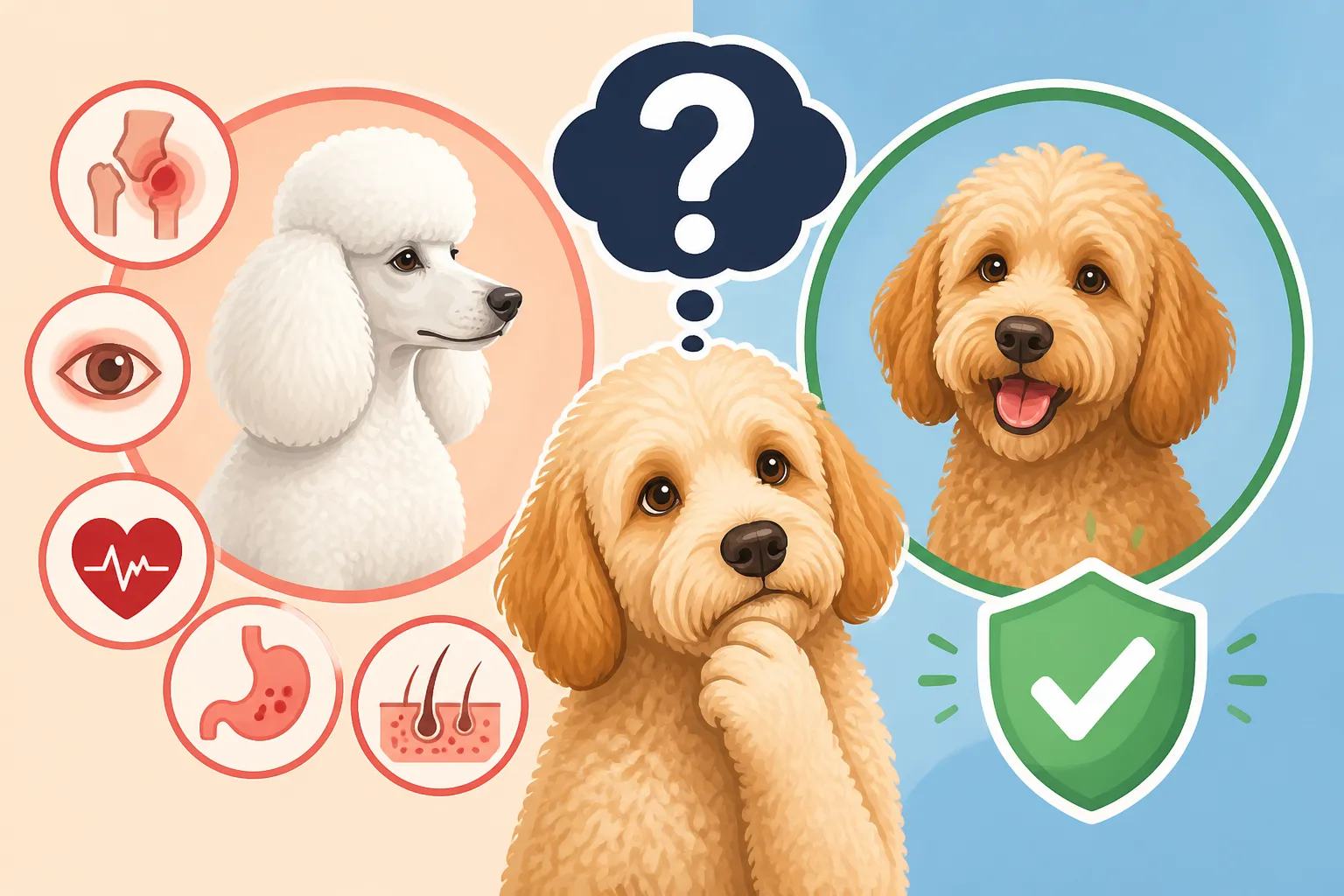
Whether Doodles Inherit Poodle Health Problems
Many prospective Doodle owners come to me worried about health, specifically whether these popular crossbreeds avoid the genetic pitfalls of purebred Poodles or inherit them entirely. It's a valid concern, often fueled by marketing claims that can sometimes be misleading, and this guide will demystify exactly what happens when Poodle genes mix with another breed, clarifying which health issues Doodles can and often do inherit from their Poodle lineage.
Understanding Hybrid Vigor and its Limits in Doodles
You've probably heard the term "hybrid vigor" thrown around when discussing Doodles, often implying that because they're a mix of two breeds, they're automatically healthier than their purebred parents. It's a lovely thought, and there's a kernel of truth to it, but it's far from a blanket guarantee of perfect health. Hybrid vigor, or heterosis, refers to the increased strength, growth, fertility, and often, resistance to disease, observed in the first generation (F1) offspring of two genetically distinct parents. The idea is that by mixing genes from two different gene pools, you reduce the likelihood of inheriting two copies of a single recessive disease gene, because the other parent is unlikely to carry the exact same one.
However, this phenomenon has its limitations, especially in the context of specific genetic diseases. For starters, hybrid vigor is most pronounced in the first generation cross. If you start breeding Doodles to Doodles (F2, F3, etc.) or back-crossing a Doodle to a Poodle (F1b), you quickly start diluting the genetic diversity that created the vigor in the first place. You're effectively reintroducing or concentrating genes, and with them, the potential for genetic conditions to express themselves. The benefit isn't a magical shield that makes them immune to every ailment that affects either parent breed. It simply lowers the statistical probability of a disease occurring if the disease-causing gene is present in only one of the parent lines and is recessive. If both parent breeds are predisposed to a similar condition, or if the Poodle parent carries a dominant gene for a specific issue, then hybrid vigor offers little to no protection.
Specific Poodle Health Issues Doodles Can Inherit
It's a harsh reality that many of the health challenges faced by Poodles can, and frequently do, show up in their Doodle offspring. A Doodle is, after all, half Poodle (at minimum!), and that Poodle half brings with it a specific genetic blueprint. It’s not about the "Doodle" part changing the Poodle genes; it’s about which genes are passed on.
Take, for example, Addison's Disease. This is an autoimmune disorder that impacts the adrenal glands, and it's notoriously prevalent in Standard Poodles. If a Poodle parent carries the genes for Addison's, there's a very real chance they'll pass it on to their Doodle puppies. A Doodle can absolutely present with the same vague, confusing symptoms as a purebred Poodle, which often leads to misdiagnosis because people assume Doodles are "healthier." You might notice lethargy, vomiting, or diarrhea, symptoms that could be dismissed as minor stomach upset, but could be First Signs of Addison's in a Poodle. Managing this condition involves lifelong medication, and it's something many Doodle owners have to contend with.
Then there's the dreaded bloat, or Gastric Dilatation-Volvulus (GDV). Standard Poodles, with their deep chests, are genetically predisposed to this life-threatening condition. If your Doodle's Poodle parent was a Standard Poodle, then your Doodle will likely inherit that deep chest conformation, making them just as susceptible. This isn't a recessive gene issue that hybrid vigor can easily bypass; it's a structural predisposition. Recognizing Bloat Symptoms in a Standard Poodle is absolutely critical, as timing can be everything.
We also see skin conditions like Sebaceous Adenitis (SA), another autoimmune disease highly overrepresented in Poodles. If a Poodle parent has SA or carries the genes for it, their Doodle puppies are at risk. This condition causes inflammation and destruction of the sebaceous glands, leading to dry, flaky skin, hair loss, and secondary infections. It's a chronic, management-heavy condition that can significantly impact a dog's quality of life, and it can begin with Early Sebaceous Adenitis on a Poodle's Topknot.
Beyond these, Doodles can inherit orthopedic problems such as Hip Dysplasia and Elbow Dysplasia, particularly from Standard Poodle lines. While these conditions aren't unique to Poodles, they are certainly prevalent enough that reputable Poodle breeders test for them. Smaller Doodles, like those from Miniature or Toy Poodle parents, are prone to issues like Luxating Patellas (slipping kneecaps) and Collapsing Trachea in a Toy Poodle. Eye conditions, especially Progressive Retinal Atrophy (PRA), which can lead to blindness, are also common genetic issues in Poodles that can transfer directly to Doodles. Knowing about Inherited Blindness in Poodles is key, as genetic tests exist for this.
Essentially, any genetic health issue common in the Poodle parent that is caused by a dominant gene, or a recessive gene that is also present in the other parent breed (or if the Doodle breeder simply wasn't diligent about genetic testing), can absolutely manifest in the Doodle offspring.
The Role of Parent Health Testing in Doodles
This is where the rubber meets the road, folks. The single most important factor in predicting the health of a Doodle puppy isn't the "Doodle" name, but the health testing of both its parents. A responsible breeder, whether of purebred Poodles or Doodles, will conduct a battery of health tests specific to the breeds involved.
For the Poodle parent, this means thorough screenings for conditions like:
- Hip and Elbow Dysplasia: Evaluations by organizations like the Orthopedic Foundation for Animals (OFA). Hip Scores Standard Poodle Breeders Publish give insight.
- Eye Diseases: Annual examinations by a board-certified veterinary ophthalmologist (CERF/OFA Eye Certification) and often DNA tests for specific conditions like Progressive Retinal Atrophy (PRA).
- Cardiac Health: OFA cardiac evaluations to screen for heart conditions.
- Thyroid Function: Regular testing for hypothyroidism.
- Von Willebrand Disease (vWD): A genetic blood clotting disorder for which DNA tests are available.
- Addison's Disease: While there isn't one definitive DNA test, breeders often screen for Addison's in their lines and avoid breeding affected dogs or carriers. What a Poodle Breeder Must Test For details these.
- Sebaceous Adenitis (SA): Skin biopsies and careful observation are used to identify affected Poodles.
For the other parent breed (e.g., Golden Retriever, Labrador, Bernese Mountain Dog), similar comprehensive health testing should be performed. A truly ethical Doodle breeder will be transparent with these results, providing verifiable documentation. They'll also be upfront about how Genetic Panels for the Three Poodle Sizes can reveal potential issues.
The problem arises when breeders either don't know about these tests, don't care, or actively try to cut corners. A breeder who tells you their Doodles are healthier because they're a mix, without showing proof of extensive health testing on both parents, is raising a huge red flag. This lack of testing is a hallmark of Poodle Mills and the Doodle Trade, where profit unfortunately takes precedence over animal welfare and health. Without proper testing, you're not getting "hybrid vigor"; you're just rolling the dice with two sets of potentially problematic genes. When you're preparing for a new Doodle puppy, just like a purebred Poodle, you'll find everything from age-appropriate food to enrichment toys on sites like Chewy, but no amount of good nutrition can compensate for poor genetics.
Navigating the Unpredictability of Doodle Genetics
Even with the best intentions and meticulous health testing, genetics can still throw curveballs, and with Doodles, there's an added layer of unpredictability compared to purebreds. The genetic inheritance is not always a simple 50/50 split, and the expression of genes can be complex.
Think about coat types. While Poodles have that signature curly, non-shedding coat, Doodles can have a wide range of coat textures – from straight to wavy to curly – which also impacts their shedding characteristics and grooming needs. This variability is a classic example of how Whether Doodle Coats Are Predictable is often a complex question. Similarly, health issues can be expressed in unexpected ways or combinations. A Doodle might inherit a mild form of hip dysplasia from one parent breed and a predisposition to ear infections from the Poodle side (thanks to those drop ears!).
The "generation" of the Doodle also plays a significant role in predictability. An F1 Doodle (first cross between a purebred Poodle and another purebred) has the most potential for hybrid vigor, assuming both parents were healthy and tested. But an F1b (F1 Doodle bred back to a Poodle) or an F2 (F1 Doodle bred to another F1 Doodle) can reintroduce or concentrate certain genes, making them more likely to inherit Poodle-specific traits and potential health issues. The further removed you get from the initial purebred cross, the more varied and potentially less predictable the genetic outcomes become. It's a spectrum, not an on-off switch.
Many people choose Doodles for their temperament or perceived hypoallergenic qualities, but it's crucial to understand that these traits, like health, are not guaranteed. They are a combination of genes from both parents, influenced by early socialization and training. Finding a good breeder who understands these complexities, provides full health clearances, and can explain the genetic background of their breeding dogs is paramount. And when you bring your Doodle home, ensuring you have high-quality food, perhaps a specific sensitive stomach formula you found on Chewy, is crucial, along with a good quality brush and comb set, easily found on Chewy, which will be your best friend, regardless of their eventual coat type or health trajectory. Ultimately, understanding that a Doodle carries Poodle genes means understanding they carry Poodle risks.
| Poodle Health Issue | Doodle Susceptibility (with Poodle parent) | Key Considerations for Doodles |
|---|---|---|
| Addison's Disease | High | Genetic predisposition from Poodle parent. Lifelong management. |
| Bloat (GDV) | High | Conformation (deep chest) from Standard Poodle parent. Emergency. |
| Sebaceous Adenitis (SA) | Moderate to High | Autoimmune genetic component from Poodle parent. Chronic skin issue. |
| Progressive Retinal Atrophy | Moderate to High | Specific DNA tests for Poodle parent are crucial. Leads to blindness. |
| Luxating Patella | High (Toy/Mini Poodle lines) | Common in smaller Poodles, affects smaller Doodles. |
| Hip/Elbow Dysplasia | Moderate to High (Standard Poodle lines) | Structural issue, often inherited. OFA testing essential. |
| Thyroid Disease | Moderate | Poodles prone; Doodles can inherit. Lifelong medication. |
Disclaimer
This article is for general informational purposes only and does not constitute professional advice. Laws, prices and regulations vary by location and change over time. Consult a qualified professional for guidance on your specific situation.