Choosing a Deductible for a Standard Poodle
Choosing the right pet insurance deductible for your cherished Standard Poodle can feel like an overwhelming decision, a complex knot of numbers and what-ifs. Many Poodle owners grapple with the desire to provide the absolute best care while also managing the practical realities of their budget, especially when facing the potential for unexpected health challenges or chronic conditions specific to the breed. This guide aims to meticulously unravel the intricacies of pet insurance deductibles, offering clear explanations and practical considerations to help you select a plan that offers both peace of mind for your Poodle's health and financial predictability for your household.
Understanding Pet Insurance Deductibles
Before we dive into the specifics for your Standard Poodle, let's get a solid grasp on what a deductible actually is in the world of pet insurance. It's often the most confusing part of any insurance policy, but once you understand it, the rest starts to click into place.
What a Deductible Really Means for Your Poodle's Care
At its core, a deductible is simply the amount of money you, the pet owner, are responsible for paying out of your own pocket before your pet insurance company begins to reimburse you for eligible veterinary expenses. Think of it as your "initial contribution" towards your Poodle's care for a given period or condition. It's a fundamental component of nearly every pet insurance plan, designed to share the financial risk between you and the insurer.
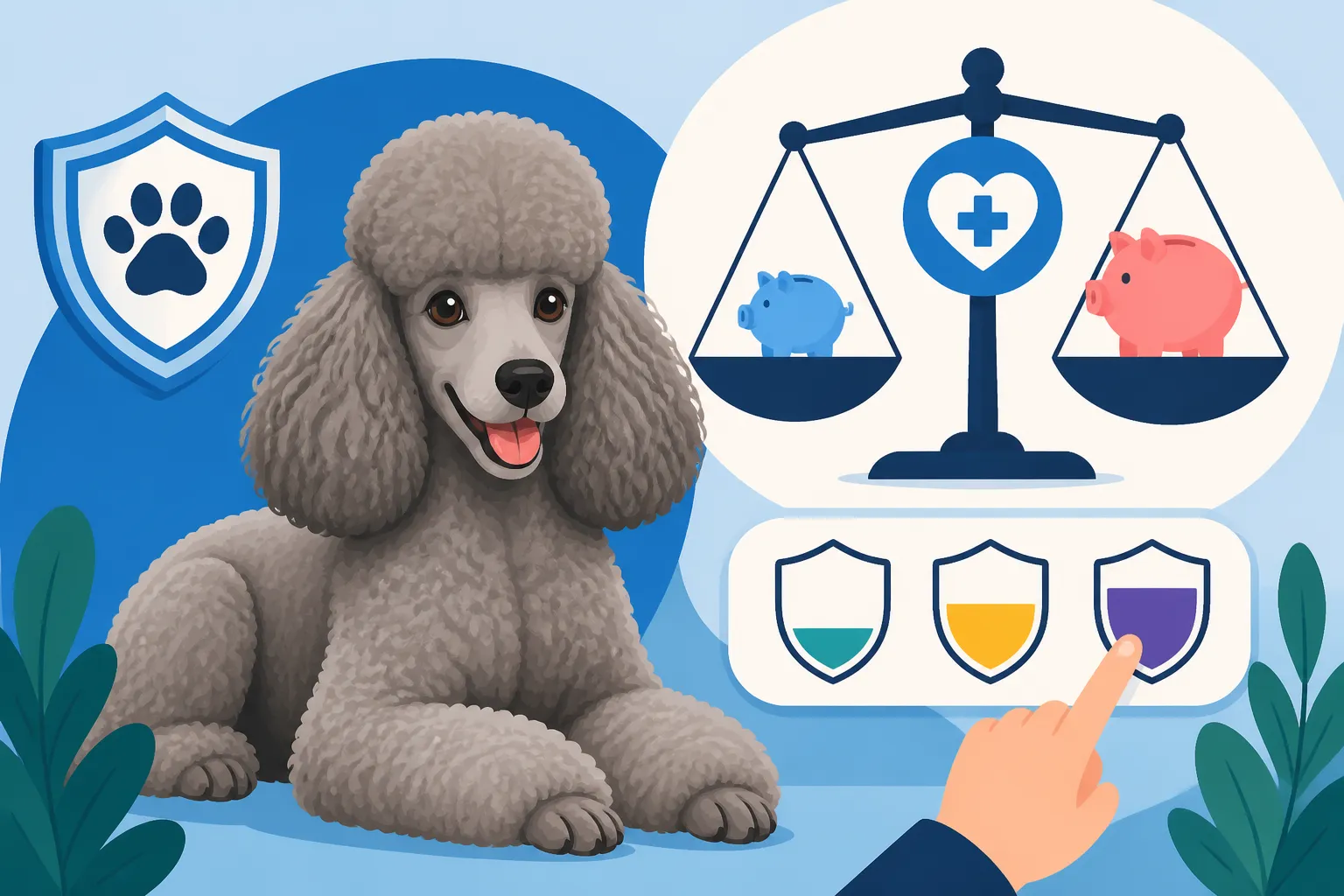
The amount of your deductible can vary significantly, ranging from as low as $0 to as high as $2,500 or more. This choice is usually made when you first purchase the policy. A crucial aspect to understand is the inverse relationship between your deductible and your monthly premium. Generally, if you opt for a higher deductible, your monthly insurance premiums (the amount you pay regularly to keep the policy active) will be lower. This can be appealing if you're trying to keep your recurring costs down. However, it means that if your Standard Poodle does need veterinary care, you'll have to pay a larger sum upfront before your insurance starts to contribute. Conversely, a lower deductible will typically result in higher monthly premiums, but it significantly reduces your out-of-pocket cost when a claim arises, which can be a huge relief in an emergency. For example, if you have a $500 deductible and your Poodle has an eligible vet bill of $2,000, you'd pay the first $500, and then your insurance would reimburse you based on your chosen reimbursement percentage (e.g., 80% of the remaining $1,500).
It's vital to consider your personal financial situation and your tolerance for unexpected expenses when making this choice. Are you comfortable with a potentially larger bill when an incident occurs, in exchange for lower monthly payments? Or do you prefer the peace of mind that comes with knowing your out-of-pocket costs will be smaller during a claim, even if it means a higher recurring premium? There’s no right or wrong answer, only what fits best for you and your beloved Standard Poodle.
Annual Deductibles vs. Per-Incident Deductibles
The type of deductible a policy uses can have a profound impact on your long-term costs and how frequently you'll be paying out of pocket. There are primarily two structures: annual deductibles and per-incident (or per-condition) deductibles. Understanding the difference is key, especially for a breed with specific health considerations.
Annual Deductible: This is by far the most common and generally preferred type of deductible offered by modern pet insurance providers. With an annual deductible, you pay this amount once per policy year, regardless of how many different illnesses or accidents your Standard Poodle experiences during that year. Once you've met that deductible, your insurance policy will then begin to reimburse you for all eligible veterinary expenses for the remainder of that policy year, based on your chosen reimbursement percentage. This is a fantastic structure for pets who might have multiple health issues or a chronic condition that requires ongoing treatment. For instance, if your Standard Poodle meets their $500 annual deductible in March due to an ear infection, and then needs care for a sprained paw in June and then a gastrointestinal upset in September, you won't pay the deductible again for those subsequent eligible claims within that same policy year. This can lead to significant savings and simpler financial planning over a 12-month period, which is why major providers like Healthy Paws predominantly offer annual deductibles.
Per-Incident / Per-Condition Deductible: This type of deductible is less common with newer, comprehensive plans but can still be found with some older policies or specific accident-only plans. With a per-incident deductible, you must meet the deductible amount for each new illness or accident your Standard Poodle encounters. Let's imagine your Poodle gets an ear infection that costs $200 – you'd pay a deductible for that. Then, a few months later, they develop a skin allergy costing $300 – you'd pay another deductible for that specific condition. If they then suffer from a sudden case of Bloat Symptoms in a Standard Poodle which requires emergency care, you'd pay yet another deductible for that incident. As you can imagine, if your Poodle has several different health issues throughout the year, these deductibles can quickly accumulate, leading to much higher out-of-pocket costs than with an annual deductible. While the monthly premiums for policies with per-incident deductibles might sometimes appear lower initially, the potential for rapidly mounting deductible payments makes them less appealing for most pet owners, especially those with breeds prone to multiple health issues.
Considering a Standard Poodle's potential for both acute accidents and chronic conditions like Addison's Disease in Standard Poodles or Sebaceous Adenitis and the Poodle Coat, an annual deductible typically offers far greater financial protection and predictability. It streamlines the claiming process and ensures that once your initial contribution for the year is met, you can focus more on your Poodle's recovery and less on accumulating new deductible payments.
Why Your Standard Poodle's Health Profile Impacts Deductible Choice
Understanding the general mechanics of deductibles is one thing, but tailoring that choice to the specific needs of your Standard Poodle adds another layer of critical consideration. This breed, while generally robust, does have certain health predispositions that make deductible selection even more important.
Common Health Concerns and Veterinary Costs for Standard Poodles
Standard Poodles are magnificent dogs, known for their intelligence and elegant appearance, but like all breeds, they come with a genetic roadmap that includes certain health vulnerabilities. When considering pet insurance, it's not just about covering random accidents; it's about anticipating potential breed-specific conditions that can lead to significant veterinary expenses.
One of the most concerning conditions for Standard Poodles is Bloat and the Deep Standard Poodle Chest, also known as Gastric Dilatation-Volvulus (GDV). This is a life-threatening emergency where the stomach fills with gas and twists, cutting off blood supply. Emergency surgery for bloat can easily run into thousands of dollars, often $5,000 to $8,000 or more, depending on where you live and the complexity of the case. Having a suitable deductible in place can drastically reduce your financial burden during such a critical and stressful event. Another significant concern is Addison's Disease in Standard Poodles, an autoimmune disorder affecting the adrenal glands. This is often called "the great pretender" because its symptoms can mimic many other conditions, making diagnosis tricky and sometimes delayed. Once diagnosed, it requires lifelong medication and regular monitoring, which can incur monthly costs in the hundreds of dollars.
Beyond these, Standard Poodles can also be prone to other issues. Hip dysplasia, while more common in larger, heavier breeds, can still affect them, potentially requiring costly diagnostics and even surgery. Sebaceous Adenitis and the Poodle Coat is another genetic skin condition that requires ongoing management and can be expensive to treat with specialized shampoos, conditioners, and topical therapies. Certain cancers can also affect Standard Poodles as they age, leading to chemotherapy, radiation, or surgical removal, all with hefty price tags. Given these possibilities, it's easy to see how a well-chosen deductible isn't just a number; it's a critical component of your financial safety net, especially when you consider that a reputable What a Poodle Breeder Must Test For will screen for many of these inherited conditions, but even with the best breeding, risks remain.
The Lifelong Financial Implications of Chronic Conditions
The potential for chronic conditions is perhaps where your deductible choice truly shines or falls short for a Standard Poodle. Unlike a one-off accident, chronic illnesses require ongoing, often lifelong, management, which means recurring veterinary visits, medications, and specialized care.
Let’s delve deeper into Addison's Disease in Standard Poodles. Once your Poodle is diagnosed and stabilized, they will typically need monthly injections of desoxycorticosterone pivalate (DOCP), like Zycortal or Percorten-V, along with daily oral steroids in some cases. Each injection, plus regular blood work to monitor electrolyte levels, quickly adds up. If you have an annual deductible, once you meet that initial deductible amount (which might happen within the first few months of diagnosis and stabilization treatments), all subsequent eligible costs for Addison's treatment for the rest of that policy year will be reimbursed at your chosen percentage. This means that for years to come, you'll meet your deductible relatively early in the policy year, and then a significant portion of the ongoing monthly medication costs will be covered. This predictable coverage for chronic conditions is a massive financial relief and a key reason why an annual deductible is so highly recommended for Standard Poodle owners. Imagine a scenario where Poodle Addison's Mistaken for Sulking is finally diagnosed – the initial diagnostic costs can be substantial, quickly helping you meet an annual deductible.
Now, consider the less ideal scenario of a per-incident deductible (though as mentioned, less common for comprehensive plans today). If each monthly injection or follow-up blood test for Addison's was considered a new "incident" or "flare-up" of the condition, you might be required to pay a new deductible every month or every few months. This would make managing a chronic condition incredibly expensive and defeat much of the purpose of having insurance. The sheer accumulation of deductibles would make the policy financially unsustainable for many. This example vividly illustrates why owners of breeds prone to chronic issues, particularly those that require ongoing medication like Addison's, almost universally prefer plans with an annual deductible. It offers a much clearer and more affordable pathway to managing Lifelong Treatment for an Addisonian Poodle and ensuring they receive the consistent care they need throughout their Poodle Lifespan Across the Three Sizes.
Matching Your Deductible to Your Budget and Risk Tolerance
Choosing a deductible isn't just about understanding the insurance jargon; it's about making a personal financial decision that aligns with your resources and your comfort level with risk. It's a balance between what you pay monthly and what you might pay in an emergency.
Assessing Your Financial Comfort Zone
When you're looking at pet insurance options, especially through platforms like Chewy's pet insurance marketplace or directly from providers like Healthy Paws, you'll see a range of deductible amounts. These typically span from $0, meaning your insurance starts reimbursing from the very first dollar (after waiting periods), to $250, $500, $750, $1,000, or even higher, up to $2,500 in some cases. The immediate temptation might be to choose the lowest deductible to minimize out-of-pocket costs, but that often comes with a noticeable bump in your monthly premium.
The key here is to honestly assess what you can comfortably afford to pay out of pocket if your Standard Poodle suddenly needed a costly vet visit, like an unexpected trip for Gastric Torsion Risk in a Standard Poodle. Do you have an emergency fund specifically for pet care? If you have $1,000 saved up and are confident you can replenish it quickly, a $750 or even $1,000 deductible might be a viable option, allowing you to enjoy lower monthly premiums. However, if a sudden $1,000 expense would strain your finances, then a lower deductible, such as $250 or $500, is likely a much safer and less stressful choice, even if it means a slightly higher recurring premium.
It’s also about what kind of financial shock you're willing to absorb. Some people prefer to pay more upfront monthly for insurance, knowing that if something happens, their immediate financial burden will be minimal. Others, who manage their savings diligently and prefer to keep recurring bills low, might opt for a higher deductible and self-insure for smaller incidents. There's no single "correct" amount; it's deeply personal. Think about your monthly budget, your savings habits, and your overall financial resilience. This introspection will guide you to a deductible that doesn't cause more stress, but rather alleviates it, during what could already be a very emotional time.
The Interplay of Deductible, Reimbursement, and Premium
Choosing a deductible doesn't happen in a vacuum. It's one part of a three-legged stool that also includes your reimbursement percentage and your monthly premium. Understanding how these three elements interact is crucial for making the most informed decision for your Standard Poodle.
The reimbursement percentage is the portion of the eligible vet bill that your insurance company will pay back to you after your deductible has been met. Common reimbursement rates are 70%, 80%, or 90%, and sometimes even 100% with certain high-end plans. A higher reimbursement percentage means the insurer pays more, leaving you with less to cover. Naturally, policies with higher reimbursement rates typically come with higher monthly premiums.
Here's a simplified breakdown to illustrate their relationship:
| Deductible Chosen | Reimbursement % | Estimated Monthly Premium (Hypothetical) | Payout on a $5,000 Eligible Vet Bill (After Deductible) | Your Out-of-Pocket for $5,000 Bill |
|---|---|---|---|---|
| $250 | 90% | $75 | $4,275 (90% of $4,750) | $725 ($250 deductible + $475 remaining 10%) |
| $500 | 80% | $60 | $3,600 (80% of $4,500) | $1,400 ($500 deductible + $900 remaining 20%) |
| $750 | 70% | $45 | $2,975 (70% of $4,250) | $2,025 ($750 deductible + $1,275 remaining 30%) |
| $1,000 | 90% | $55 | $3,600 (90% of $4,000) | $1,400 ($1,000 deductible + $400 remaining 10%) |
Note: Monthly premiums are illustrative and vary widely based on location, Poodle's age, specific plan, and provider.
As you can see from the table, there's a delicate balance. A low deductible with a high reimbursement percentage (like the $250 deductible, 90% reimbursement example) results in the highest monthly premium but the lowest out-of-pocket cost during a claim. Conversely, a higher deductible with a lower reimbursement percentage often means a lower premium but a significantly larger payment from you when your Poodle needs care. Many Standard Poodle owners find a sweet spot around a $250 or $500 deductible with an 80% or 90% reimbursement rate. This balance offers manageable monthly premiums while still providing substantial financial relief during significant vet bills. It truly becomes about figuring out what combination offers you the most comfort and confidence for your Poodle's health journey.
When to Consider a Higher or Lower Deductible
The decision to opt for a higher or lower deductible often comes down to your individual financial situation, your Poodle's age and health status, and your overall philosophy on managing risk. There are valid reasons for choosing either path, and understanding them can help solidify your choice.
Considering a Higher Deductible (e.g., $750 – $2,500):
A higher deductible might be a sensible choice for you if you have a robust emergency savings fund that you're comfortable tapping into for your Poodle's initial vet bills. This strategy effectively makes your pet insurance more of a "catastrophic coverage" plan, designed to protect against those truly massive, unexpected expenses like Emergency Bloat Surgery Prices for a Standard Poodle that could otherwise derail your finances. By taking on more of the initial risk yourself, you benefit from significantly lower monthly premiums, which can be a relief for your regular budget. This might be particularly appealing if you have a young, seemingly healthy Standard Poodle who rarely seems to get sick, and you're mainly concerned about very large, unforeseen accidents or illnesses. Just remember, this means you need to be prepared to cover that larger deductible amount promptly should an emergency strike. Platforms like Ollie, known for personalized pet food, also emphasize individual needs, which extends to financial planning for your pet's care.
Considering a Lower Deductible (e.g., $0 – $500):
Conversely, a lower deductible is often the preferred choice for owners who prioritize predictable monthly costs and wish to minimize their out-of-pocket expenses at the time of a vet visit. This option means you'll pay higher monthly premiums, but when your Poodle needs care, your immediate financial contribution will be smaller. This approach can significantly reduce stress during an already difficult time. For breeds with known predispositions to chronic or potentially expensive conditions, like Standard Poodles, a lower deductible is often highly recommended. If your Poodle is older and perhaps beginning to develop more age-related ailments (Caring for an Aging Poodle), or if you simply prefer not to have a large lump sum payment looming over you in an emergency, a lower deductible provides a greater sense of security. It means your insurance will start helping out much sooner, which can be invaluable for ongoing treatments or multiple smaller incidents that, while not catastrophic individually, can certainly add up.
Ultimately, the choice hinges on your comfort level. Do you prefer to save monthly and pay more during a claim, or pay more monthly to save during a claim? Neither is inherently better; it’s about what creates the most financial stability and peace of mind for you and your beloved Standard Poodle.
Real-World Impact: Deductibles in Action for Your Poodle
Let's move beyond the theoretical and look at how these deductible choices play out in real-life scenarios that many Standard Poodle owners might face. These examples will illustrate the tangible financial impact of your decision.
Scenario 1: The Unexpected Emergency
Imagine this: your vibrant, two-year-old Standard Poodle, Winston, is playing fetch in the park. Suddenly, he yelps, collapses, and you notice his abdomen is distended and he’s clearly in distress. You rush him to the emergency veterinary clinic. The diagnosis? Gastric Torsion Risk in a Standard Poodle – bloat, and he needs immediate surgery. The vet quotes you an estimate of $6,500 for the surgery, hospitalization, and post-operative care.
Scenario A: You have a $250 Annual Deductible with 90% Reimbursement.
- Total eligible vet bill: $6,500
- Your deductible: $250 (you pay this immediately at the vet)
- Remaining bill for reimbursement: $6,500 – $250 = $6,250
- Insurance reimbursement (90%): $6,250 * 0.90 = $5,625
- Your remaining out-of-pocket cost (after insurance payout): $6,500 – $5,625 = $875. This includes your $250 deductible and the 10% not covered by reimbursement.
In this scenario, after your insurance kicks in, you're out $875 for a $6,500 emergency. While still a significant amount, it's far more manageable than the full bill.
Scenario B: You have a $1,000 Annual Deductible with 80% Reimbursement.
- Total eligible vet bill: $6,500
- Your deductible: $1,000 (you pay this immediately at the vet)
- Remaining bill for reimbursement: $6,500 – $1,000 = $5,500
- Insurance reimbursement (80%): $5,500 * 0.80 = $4,400
- Your remaining out-of-pocket cost (after insurance payout): $6,500 – $4,400 = $2,100. This includes your $1,000 deductible and the 20% not covered by reimbursement.
Here, with a higher deductible and lower reimbursement, your out-of-pocket cost is considerably higher at $2,100. Both scenarios illustrate the value of insurance, but the deductible choice clearly dictates your immediate financial burden during such a terrifying emergency. The lower deductible meant significantly less stress at a time when your focus should be entirely on Winston's recovery.
Scenario 2: Managing a Chronic Condition
Now let's consider Bella, your beloved eight-year-old Standard Poodle, who has recently been diagnosed with Poodle Addison's Mistaken for Sulking. After the initial diagnostic tests and stabilization (which we'll assume were covered by a previous claim or met your deductible), Bella needs lifelong treatment. This involves monthly DOCP injections and daily oral prednisone, with periodic blood tests. Let’s estimate these ongoing costs at an average of $250 per month.
With an Annual Deductible (e.g., $500, 80% reimbursement):
- First month of chronic care in a new policy year: Bella's monthly treatment is $250. This goes towards meeting your $500 annual deductible. You pay the full $250 out of pocket.
- Second month: Another $250 for treatment. This completes your $500 annual deductible. You pay the full $250 out of pocket.
- Third month and onward for the rest of the policy year: Each subsequent $250 monthly treatment for Addison's is now eligible for reimbursement.
- Insurance reimburses 80% of $250 = $200.
- You pay the remaining 20% = $50.
- Total out-of-pocket for these months: $50/month.
Over a full year (10 months after deductible is met), you would pay $250 + $250 (deductible) + $50 x 10 = $1,000. Your insurance would pay $200 x 10 = $2,000. This is a huge help in managing what would otherwise be a $3,000 annual expense just for medication and monitoring.
With a Per-Incident Deductible (Hypothetical, e.g., $250 per condition, 80% reimbursement):
If this were a per-incident policy and each monthly injection was considered a new 'incident' (or if the policy considered each vet visit for medication a new incident), the costs would skyrocket. You could potentially be paying a $250 deductible every month before reimbursement even kicks in. This would mean $250 out of pocket, plus 20% of the remaining bill, every single month. This type of deductible structure quickly becomes unsustainable for chronic conditions. This scenario dramatically underscores why an annual deductible is nearly always the better choice for a Standard Poodle, allowing for predictable and more affordable long-term care for conditions like Addison's. Even for Reading Pain in a Sensitive Poodle leading to several vet visits for different minor issues, an annual deductible offers far better value.
Adjusting Your Deductible Over Your Poodle's Lifetime
Your Standard Poodle's health journey isn't static, and neither should your pet insurance deductible necessarily be. Many insurance providers understand this and offer flexibility, allowing you to adjust your deductible at policy renewal. This means you can tailor your coverage to your Poodle's evolving needs and your changing financial situation.
When your Standard Poodle is a vibrant, young puppy, perhaps only experiencing minor scrapes or routine wellness visits, you might initially opt for a higher deductible, say $750 or $1,000. The reasoning here is often two-fold: young dogs generally have fewer serious health issues, so you're minimizing your monthly premiums while still having catastrophic coverage in place for an unexpected severe accident. This strategy allows you to potentially save on premiums during a period when claims might be less frequent. However, it's crucial to still ensure you have that emergency fund ready.
As your Standard Poodle enters their senior years, perhaps around age eight or ten, their health profile naturally shifts. They might become more prone to arthritis (Arthritis in a Twelve-Year-Old Poodle), Thyroid Disease in Poodles, or Poodle Dental Disease by Size, leading to more frequent vet visits and potentially chronic conditions. This is often an ideal time to consider lowering your deductible to $250 or $500. While this will typically result in a higher monthly premium, it means that when those more frequent or ongoing senior health issues arise, your out-of-pocket costs at each vet visit will be significantly reduced. This shift can provide immense financial relief when you're managing the complexities of Caring for an Aging Poodle and ensures you can focus on providing the best quality of life without worrying as much about mounting initial costs.
It's paramount to review your pet insurance policy annually, usually at renewal time. This is your opportunity to assess your Poodle's current health, consider any new diagnoses (such as Poodle Obesity and Its Consequences which can lead to other health problems), and evaluate your financial comfort level. Discussing these changes with your insurer or a trusted pet insurance advisor can help you make the best decision. One crucial caveat: always remember that once a condition has been diagnosed, it typically becomes "pre-existing" and generally won't be covered if you switch to a new insurance provider. Some policies also have stipulations about how significantly you can alter coverage for existing conditions. Therefore, making these adjustments within your existing plan at renewal is often the safest and most effective approach to ensure continuous coverage for your Standard Poodle throughout their precious lifetime.
Disclaimer
This article is for general informational purposes only and does not constitute professional advice. Laws, prices and regulations vary by location and change over time. Consult a qualified professional for guidance on your specific situation.