What a Century Did to the Poodle’s Coat
For any Poodle owner, new or seasoned, the sheer volume and unique texture of their dog's coat can feel like a full-time job. Many of us grapple with mats, endless brushing, and the quest for that perfect groom, often wondering if Poodle coats have always been this demanding. The truth is, while the Poodle's signature curl is ancient, how we perceive and manage it has shifted dramatically over the last century, influenced by everything from show ring trends to the rise of popular crossbreeds. This guide will take a deep dive into the evolution of the Poodle's coat, exploring its original purpose, how breed standards reshaped it, and the challenges and joys of caring for it today.
The Poodle Coat's Original Purpose as a Working Tool
It's easy to look at a Poodle in a fancy show clip today and forget that these dogs were once rugged, working retrievers. Their coat wasn't just for show; it was an essential piece of equipment, perfectly adapted for their job in icy European waters. Imagine trying to swim through freezing bogs and retrieve waterfowl if your coat shed constantly or offered no protection. The Poodle's unique hair type was a matter of survival, not aesthetics.
The Water Retriever's Natural Insulation
The Poodle's dense, curly, and water-resistant coat was a marvel of natural engineering. Unlike dogs with fur that sheds, a Poodle's hair acts like a natural wetsuit, trapping air and providing insulation against cold water. This incredible density meant that the dogs could plunge into lakes and rivers in harsh climates without quickly succumbing to hypothermia. Think of it as a thick, protective armor that kept them warm and buoyant. This wasn't a coat that needed constant brushing to stay functional in the wild; it was designed to be resilient and self-preserving to a certain degree. Their historical role as water dogs is why their name, "Pudel," is German for "to splash in water." The Water Dog Behind the Poodle perfectly illustrates this heritage.
Practicality of the Early Working Clip
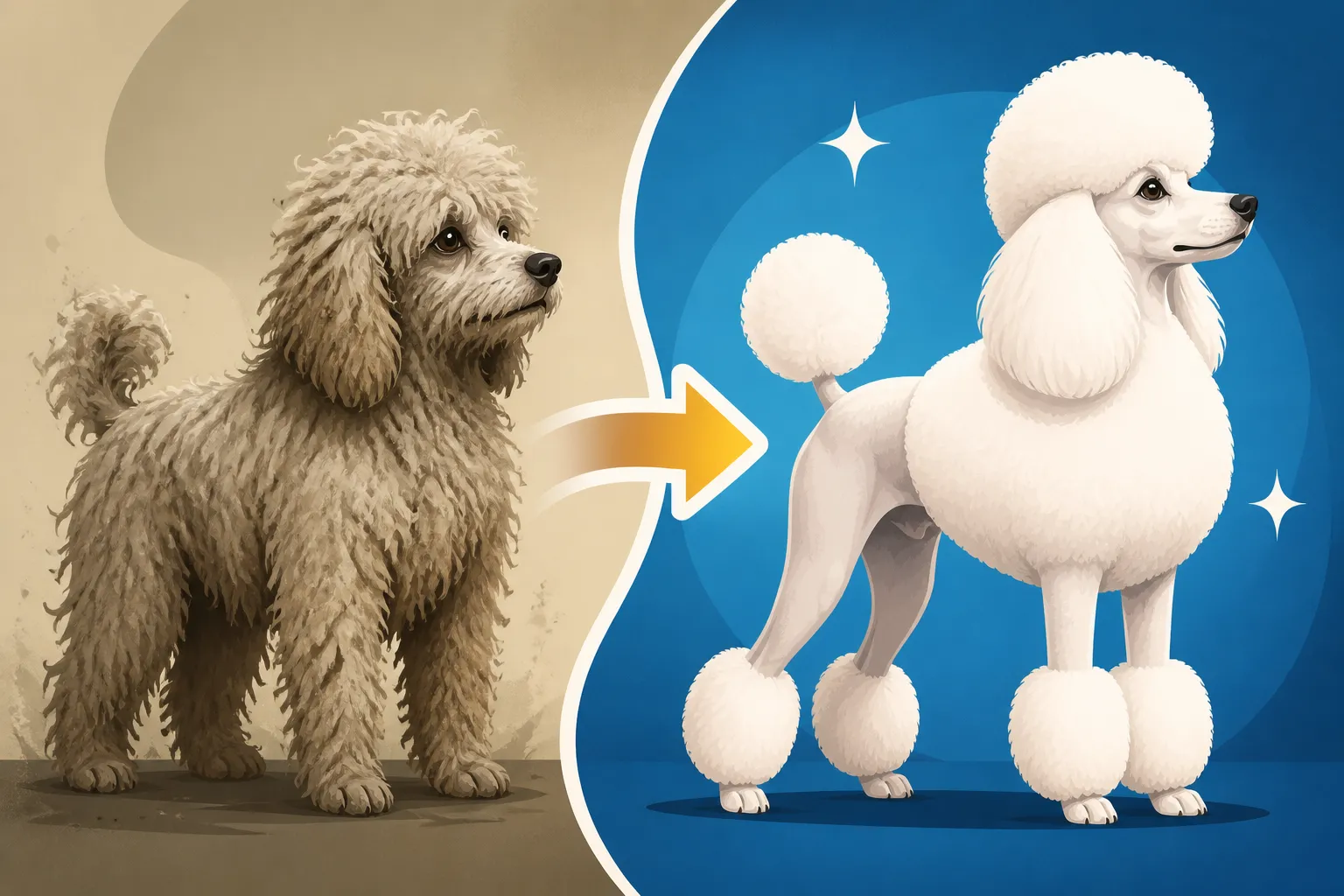
While modern Poodle clips can look flamboyant, the original clips were born purely out of practicality for hunting. Hunters would shave certain areas of the Poodle's body to reduce drag in the water and lighten the load, while leaving strategic "puffs" of hair over joints and vital organs to protect them from the cold. These puffs often covered the hips, chest, and ankle joints, which were most vulnerable to the chill of the water. This meant a working Poodle was comfortable and efficient. It wasn't about looking symmetrical or styled; it was about function. Why a Working Poodle Was Clipped at All delves deeper into these practical origins, showing how every clipped area had a purpose beyond mere decoration.
The Rise of the Show Ring and Breed Standards
As Poodles transitioned from working dogs to companions and show ring stars, the emphasis on their coat began to shift. The practical, functional aspects remained, but new interpretations and desires for aesthetics began to shape how the coat was bred, presented, and cared for. This era marked a significant turning point, moving the coat from pure utility to a blend of utility and artistry.
Emphasizing Density and Texture
When Poodles entered the show ring, judges began to favor certain qualities in the coat. Density became paramount, often measured by how resistant the coat was to parting and how tightly curled it was. A Poodle with a sparse, soft, or easily parted coat would not fare well. This drive for extreme density and harsh texture meant that breeders started selecting for these traits, subtly changing the Poodle coat over generations. The ideal coat was one that could be sculpted, held its shape, and looked substantial, creating an opulent silhouette. This focus inadvertently increased the challenge for pet owners, as these denser coats became more prone to matting without rigorous care. The Poodle Coat in the Standard gives a clearer picture of what the ideal coat looks like from a judge's perspective.
The Evolution of Elaborate Clips
The utilitarian clips of the past gradually gave way to more elaborate and stylized variations. The Continental clip, with its shaved hindquarters and bracelets, became the quintessential show Poodle look. While it retained some echoes of its working origins (like protecting joints), its primary purpose became demonstrating the groomer's skill and the Poodle's magnificent coat. This transformation wasn't instant, but rather a gradual evolution over the century as Poodles gained popularity in high society and dog shows. The artistry involved in maintaining these clips required immense dedication from owners and professional groomers alike, pushing the boundaries of what was considered "manageable" for a pet Poodle.
The Impact on Everyday Poodle Owners
As the show ring glorified intricate clips and dense coats, the average Poodle owner found themselves facing increasing grooming demands. What was once a practical, relatively low-maintenance working coat became a high-maintenance status symbol. This led to a boom in professional grooming services and a vast array of new tools and products designed specifically for the Poodle coat. Owners felt the pressure to keep their Poodles looking pristine, often without fully understanding the historical context or the sheer effort required. Many still wonder, "Why does my Poodle mat so easily?" The answer often lies in this historical shift toward a coat designed more for display than for daily life in a family home.
Modern Grooming Techniques and Tools
The Poodle coat, with its continuous growth and matting tendencies, necessitated the development of specialized grooming techniques and tools. Over the last century, as Poodles became more common in homes, grooming evolved from a rustic, functional task to a highly refined skill, with a vast array of products and methods to achieve that signature Poodle look.
The Tools That Shaped the Coat
Today, grooming a Poodle involves an arsenal of specialized tools that simply didn't exist a hundred years ago in their current form. High-quality slicker brushes, various types of combs (like the Greyhound comb), powerful high-velocity dryers, and precision clippers with interchangeable blades are all essential. These tools are designed to penetrate the dense coat, remove loose hair, prevent matting, and create smooth, even finishes. Without the right tools, keeping a Poodle mat-free is an uphill battle. For instance, a durable, wide-toothed comb is crucial for checking if you've brushed "to the skin," a technique vital for preventing hidden mats. Many Poodle owners find excellent, durable grooming tools at retailers like Chewy, ensuring they have what they need for effective home care. What a Poodle Owner Spends on Blades and Shampoo highlights the investment in these necessary tools.
The Art of Straightening and Drying
One of the most significant changes in Poodle grooming is the emphasis on straightening the coat before clipping. While a Poodle's coat is naturally curly, achieving those perfectly smooth, sculpted lines seen in many clips requires thorough bathing and a meticulous blow-dry. Using a high-velocity dryer and line brushing the coat as it dries stretches out the curls, allowing for a precise, even cut. This technique, almost an art form, prevents the clipper blades from snagging and ensures a uniform length, giving the Poodle its characteristic smooth finish. It's a time-consuming process, but crucial for maintaining the coat's health and appearance, especially when preparing for a groom. Using a High Velocity Dryer on a Poodle offers insights into this critical step.
Home Grooming Realities
For many pet owners, managing a Poodle's coat at home is a constant learning curve. The sheer commitment to regular brushing – often daily or every other day – can be a surprise. Skipping just a few days can lead to stubborn mats, especially in areas of friction like armpits, behind the ears, and around the collar. Learning to line brush Line Brushing a Poodle Explained correctly, understanding the different types of brushes, and even attempting basic trims between professional grooms has become a necessity for many. This can be daunting, but it's essential for preventing painful skin issues and costly dematting fees at the groomer. Many Poodle enthusiasts turn to online resources, like those found on Chewy's blog or YouTube channels, to learn these techniques, realizing that a Poodle's coat is truly a "never-ending" growth process. The Poodle Coat and Why It Never Stops Growing explains why this constant care is non-negotiable.
The Poodle Coat in the Era of "Doodles"
The last few decades have seen a massive surge in "Doodle" crossbreeds, putting the Poodle's coat squarely in the public consciousness, albeit often with a new set of misconceptions. The Poodle's coat has become both celebrated and misunderstood, influencing breeding practices and public perception.
The "Hypoallergenic" Myth's Influence
One of the primary drivers behind the Doodle craze is the Poodle's reputation for being "hypoallergenic" or "non-shedding." This perception, while not entirely accurate (no dog is truly 100% hypoallergenic), has led many to seek out Poodle crosses, hoping for a low-allergen pet. This emphasis has shone a spotlight on the Poodle's unique hair type, which grows continuously and, rather than shedding out, becomes tangled in the surrounding coat. This characteristic is precisely why Poodles require such rigorous grooming to prevent matting. Unfortunately, many Doodle owners discover that their Poodle-mix's coat still requires extensive care, often inheriting the Poodle's matting tendencies without the purebred predictability. Whether a Poodle Suits an Allergy Sufferer clarifies the nuances of Poodles and allergies.
Misconceptions About Poodle Coat Care
The popularity of Doodles has also inadvertently created misconceptions about Poodle coat care itself. Some believe that if a Poodle mix doesn't shed, a purebred Poodle must be low maintenance. This couldn't be further from the truth. The very characteristic that makes them desirable for allergy sufferers – their continuously growing hair – is what makes them high maintenance from a grooming perspective. Neglecting a Poodle's coat, assuming its "non-shedding" nature means less work, is a recipe for disaster, leading to painful mats, skin infections, and expensive corrective grooms. The truth is, Poodles shed into their own coats, which is why brushing is so critical to remove that dead hair before it forms felted mats. Why a Poodle Coat Mats Instead of Shedding explains this phenomenon in detail.
The Poodle as a Parent Breed
The Poodle's coat is a dominant trait, meaning it often influences the coat of its offspring when crossed with other breeds. This genetic legacy is a major reason why Poodles are chosen as a parent breed for so many crosses. Breeders are hoping to impart that desirable "low-shedding" quality. However, the outcome is not always predictable, and many Poodle crosses end up with coats that are even more challenging to manage than a purebred Poodle, combining the Poodle's matting curl with the shedding undercoat of another breed. This further underscores the unique and often demanding nature of the Poodle's ancestral coat. How a Poodle Differs From a Doodle and Why Doodle Breeders Choose Poodles provide more context on these genetic considerations.
Here's a quick look at how Poodle coat management has evolved:
| Aspect | A Century Ago (Working Poodle) | Today (Pet & Show Poodle) |
|---|---|---|
| Primary Purpose | Insulation & protection for hunting | Aesthetic, companion, show ring standard |
| Typical Clip | Utilitarian (e.g., lion clip for joints) | Puppy, Continental, Modern, Sporting clips |
| Grooming Frequency | As needed for function | Daily/every other day brushing, 4-8 week professional grooms |
| Tools Used | Shears, maybe simple comb | Slicker, pin brush, Greyhound comb, high-velocity dryer, clippers, various blades, detanglers, shampoos |
| Coat Ideal | Dense, weather-resistant, functional | Dense, harsh texture, sculptable, holds shape |
| Perception | Rugged working dog | Elegant companion, "hypoallergenic" |
Challenges and Care for the Modern Poodle Coat
Managing a Poodle's coat in today's world requires dedication, knowledge, and consistency. While the coat's unique properties are part of what makes Poodles so special, they also present specific challenges that owners must be prepared to address proactively.
Combating Mats and Tangles
Mats are the bane of every Poodle owner's existence. Because Poodle hair doesn't shed out easily, dead hairs get trapped within the growing coat, twisting and tangling into dense knots. These aren't just cosmetic issues; severe matting can pull on the skin, cause pain, restrict movement, and lead to skin infections due to lack of air circulation. The best defense is a strong offense: consistent, thorough line brushing How Often a Poodle Must Be Brushed. This means brushing in small sections, from the skin out, ensuring no tangles are left behind. Regular bathing with appropriate shampoo and conditioner, followed by a thorough blow-dry, also helps prevent mats by keeping the hair clean and manageable. Ignoring even small tangles can quickly lead to felted mats that require a full shave-down, which no Poodle owner wants.
Seasonal Changes and Coat Health
A Poodle's coat can also experience changes throughout the year, impacting its manageability. Puppies go through a significant "coat change" as their soft puppy fuzz transitions to the coarser adult coat, often between 6 and 18 months of age. This period is notorious for intense matting and requires even more diligent brushing. Environmental factors like humidity can also make the coat more prone to tangles, while dry winter air might lead to static and brittleness. Owners need to adapt their grooming routine to these seasonal shifts, perhaps increasing brushing frequency or using conditioning sprays. When a Poodle Puppy Coat Changes details this challenging period for young Poodles.
Maintaining Skin Health Beneath the Coat
It's easy to focus solely on the hair, but a healthy coat starts with healthy skin. The Poodle's dense coat can sometimes hide underlying skin issues. Mats can trap moisture, leading to hot spots or yeast infections. Allergies, common in Poodles, can also manifest as itchy, irritated skin, which then leads to scratching, further matting, and potential secondary infections. Regular inspection of the skin during brushing, especially in sensitive areas like the armpits and groin, is crucial. High-quality dog food, rich in omega fatty acids, can support skin and coat health from within. Additionally, using gentle, pH-balanced shampoos and conditioners designed for dogs is vital to prevent skin irritation. If you're ever concerned about your Poodle's skin, a quick chat with your vet is always a good idea. Poodle Allergies and Skin Reactions is a great resource if you notice your Poodle is unusually itchy.
Caring for a Poodle's coat is undeniably a commitment, but it's also one of the most rewarding aspects of Poodle ownership. It's a connection to their rich history as working dogs and a testament to their enduring elegance. Understanding how their coat evolved and dedicating yourself to proper, consistent care will ensure your Poodle remains happy, healthy, and stunning for years to come.
Disclaimer
This article is for general informational purposes only and does not constitute professional advice. Laws, prices and regulations vary by location and change over time. Consult a qualified professional for guidance on your specific situation.